
U Value Calculator
Calculate the thermal transmittance of a wall, roof, floor, ceiling, or other layered building element using material thickness and thermal conductivity.
Surface Thermal Resistance
Surface resistance values may vary depending on heat-flow direction, surface conditions, construction type, and the calculation standard used.
Building Element Layers
Optional Heat Loss Estimate
Heat flow is estimated using Q = U × A × ΔT. This is a simplified transmission heat-flow calculation and does not include ventilation, air leakage, thermal bridges, solar gains, or other building effects.
Layer-by-Layer Breakdown
| Layer | Thickness | Conductivity λ | Resistance R |
|---|
Important: This calculator provides a simplified one-dimensional estimate. Actual building U-values can require additional consideration of thermal bridges, repeating structural elements, air spaces, junctions, moisture, workmanship, geometry, and the applicable calculation standard.
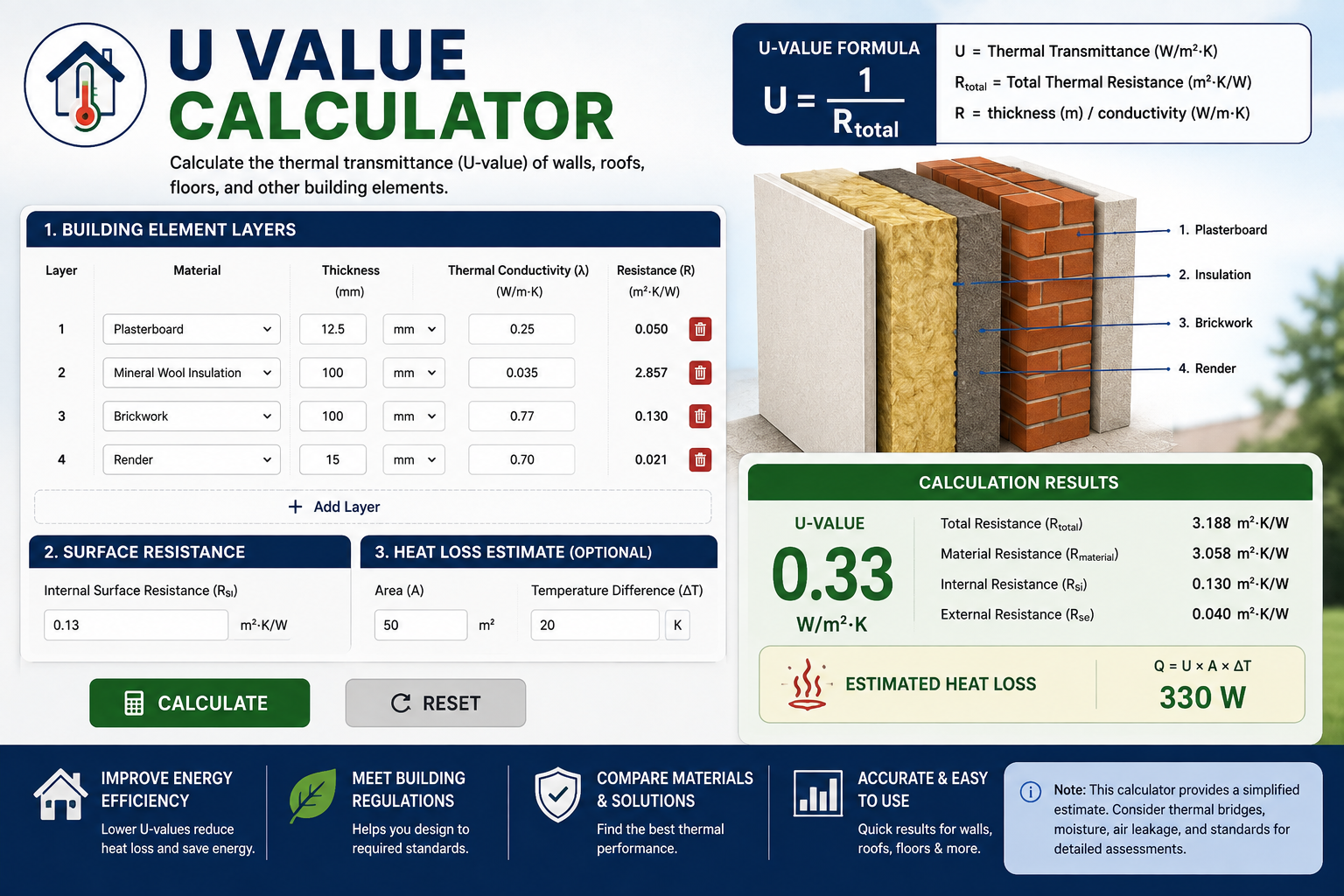
What Is a U Value Calculator?
A U Value Calculator is an online tool used to estimate the thermal transmittance of a building element such as a wall, roof, floor, ceiling, door, window, or other part of a building envelope. The U-value describes how readily heat passes through a building element when there is a temperature difference between the two sides.
U-values are normally expressed in W/(m²·K). A lower U-value generally indicates that less heat passes through the building element for a given area and temperature difference. This makes U-value an important measure when comparing insulation systems and building constructions.
The calculator works by calculating the thermal resistance of each material layer and combining those resistances with the internal and external surface resistances. The reciprocal of the total thermal resistance gives the simplified U-value.
U Value Formula
For a simple layered building element, the basic U-value relationship is:
The thermal resistance of an individual material layer can be calculated using:
Where:
- U = thermal transmittance in W/(m²·K)
- R = thermal resistance in m²·K/W
- d = material thickness in metres
- λ = thermal conductivity in W/(m·K)
For a basic series-layer construction, the total resistance is obtained by adding the internal surface resistance, each material layer resistance, and the external surface resistance.
How Does a U Value Calculator Work?
Most building elements consist of multiple materials rather than a single solid layer. For example, an external wall may contain plasterboard, insulation, masonry, an air space, and an external finish. Each layer has its own thickness and thermal conductivity.
To calculate the resistance of a material, the thickness must first be converted into metres. The thickness is then divided by the material's thermal conductivity.
The calculator above allows you to enter each layer individually. You can add as many layers as required, select a common material, enter the thickness, choose the thickness unit, and enter or use the corresponding thermal conductivity.
After calculating each individual resistance, the calculator adds the resistances together with Rsi and Rse. The reciprocal of the total resistance is then displayed as the estimated U-value.
Why Is a Lower U-Value Better?
A lower U-value generally means that less heat is transmitted through a building element for the same area and temperature difference. In practical terms, a well-insulated construction normally has a lower U-value than a poorly insulated construction of the same general type.
For example, if two wall constructions have the same area and are exposed to the same temperature difference, the construction with the lower U-value will have a lower calculated transmission heat flow.
However, U-value is not a measurement of the entire energy performance of a building. Windows, doors, ventilation, air leakage, thermal bridges, orientation, solar gains, heating systems, occupancy and many other factors can influence total energy consumption.
Thermal Resistance vs U-Value
Thermal resistance and U-value are closely related concepts. Thermal resistance describes how strongly a material or construction resists heat flow, while U-value describes thermal transmittance.
For a simplified calculation, they are reciprocal quantities:
Therefore, increasing the total thermal resistance generally decreases the U-value. This is one reason why insulation is an important component of energy-efficient building assemblies.
Thermal Conductivity vs U-Value
Thermal conductivity, represented by the symbol λ (lambda), is a property of a material. It describes how readily heat conducts through that material.
The U-value, on the other hand, describes the thermal transmittance of a complete building element or assembly. It is therefore affected by the thickness and thermal properties of all relevant layers.
For example, an insulation product may have a low thermal conductivity, but the U-value of an entire wall also depends on the insulation thickness and the other materials forming the wall.
U Value Calculation Example
Consider a simplified three-layer wall construction containing:
- 100 mm masonry with λ = 0.70 W/(m·K)
- 100 mm insulation with λ = 0.035 W/(m·K)
- 12.5 mm board with λ = 0.25 W/(m·K)
First convert the thicknesses into metres:
- 100 mm = 0.100 m
- 100 mm = 0.100 m
- 12.5 mm = 0.0125 m
Next, calculate each layer's resistance using R = d ÷ λ. The insulation layer contributes a relatively large amount of resistance because its thermal conductivity is much lower than that of the masonry in this example.
Finally, the material resistances are added together with the applicable surface resistances. The reciprocal of the resulting total resistance gives the simplified U-value.
U Value Calculator for Walls
A wall U-value calculation can help compare different wall construction options. A wall may contain several layers, including internal finishes, structural materials, insulation, cavities and external finishes.
When calculating a wall U-value, accurate thickness and thermal conductivity data should be used whenever possible. Manufacturer technical information is generally preferable to generic values found online.
Structural framing can also influence heat flow. Timber studs, metal components, fixings and other repeating elements can create different heat paths, meaning that a simple one-dimensional calculation may not fully represent the completed wall assembly.
U Value Calculator for Roofs
Roof and ceiling assemblies are important parts of the building envelope. The basic principle for a simplified roof U-value calculation is the same: calculate the resistance of each relevant layer and determine the reciprocal of the total resistance.
However, roofs can include rafters, joists, insulation, cavities, membranes, roof coverings and other components. These features may create more complex heat-flow paths, so detailed design calculations should follow the applicable standard or professional methodology.
U Value Calculator for Floors
A floor U-value depends on the floor construction, insulation, geometry, ground conditions and the calculation method being used.
A simple layer-by-layer calculator can help demonstrate the effect of changing material thickness and thermal conductivity. However, floors connected to the ground may require more detailed calculation methods than a simple plane-wall approach.
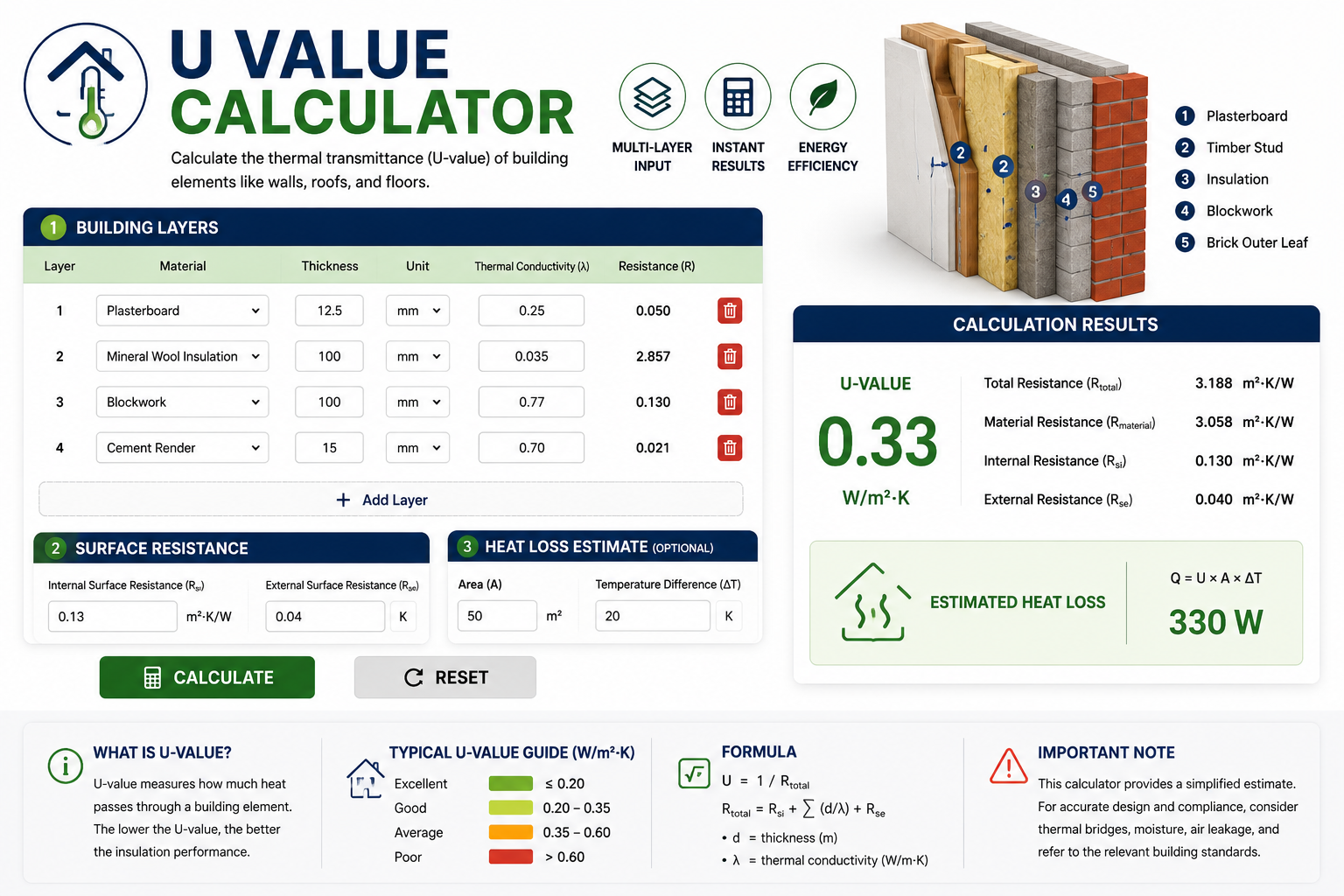
What Is a Good U-Value?
There is no single U-value that is considered good for every building element or every project. Suitable U-values depend on the building type, climate, construction method, renovation requirements, location and applicable building regulations or standards.
A target value for an external wall may be different from the appropriate value for a roof, floor, window or door. Existing buildings may also have different requirements from new construction.
For professional design and regulatory compliance, always use the applicable building code, standard, approved calculation method and verified product data rather than relying only on a generic online target.
Factors That Affect U-Value
1. Material Thickness
Increasing the thickness of a material generally increases its thermal resistance when the material's thermal conductivity remains unchanged. Increasing insulation thickness can therefore reduce the calculated U-value.
2. Thermal Conductivity
Thermal conductivity has a major effect on thermal resistance. For a given thickness, a material with lower thermal conductivity generally provides greater thermal resistance.
3. Surface Resistance
The internal and external surfaces of a building element can contribute to overall thermal resistance. Appropriate Rsi and Rse values depend on the calculation method and conditions.
4. Thermal Bridges
Thermal bridges can create alternative heat-flow paths through a building element. Structural junctions, framing members, fixings, penetrations and other details can therefore affect actual thermal performance.
5. Moisture
Moisture can affect the thermal performance of some construction materials. For detailed building calculations, suitable design properties and project-specific conditions should be considered.
U-Value and Heat Loss
Once a U-value has been calculated, a simplified transmission heat-flow estimate can be made using:
Here, U is measured in W/(m²·K), area is measured in square metres, and the temperature difference is measured in K. The resulting heat flow is expressed in watts.
For example, if a building element has a U-value of 0.30 W/(m²·K), an area of 50 m² and a temperature difference of 20 K:
This represents a simplified transmission heat-flow estimate. It is not the same as the complete heating requirement of a building because other heat transfer mechanisms can also be significant.
Benefits of Using a U Value Calculator
- Quickly estimate the thermal transmittance of a layered construction.
- Compare different insulation thicknesses.
- Understand the relationship between R-value and U-value.
- Estimate simplified transmission heat flow.
- Compare wall, roof and floor construction options.
- Reduce repetitive manual calculations.
- Understand how material conductivity affects thermal resistance.
- Explore the effect of adding or removing insulation layers.
- Check preliminary calculations before detailed analysis.
Limitations of a Simple U Value Calculator
A layer-by-layer U-value calculator is useful for preliminary calculations, education and material comparisons, but it should not automatically be treated as a certified building-performance calculation.
Real construction can contain framing, repeating thermal bridges, junctions, fasteners, cavities, air movement and other heat-flow paths that may not be represented by a simple series-layer calculation.
For building regulation compliance, professional energy modelling, certification or detailed construction design, use the applicable standard, verified material data and the required professional calculation method.
Frequently Asked Questions About U Value Calculators
1. What is a U-value?
A U-value is a measure of thermal transmittance. It indicates the rate of heat transfer through a building element per unit area and per unit temperature difference. It is normally expressed in W/(m²·K). Lower U-values generally indicate greater resistance to heat transfer.
2. How do you calculate U-value?
For a simplified layered construction, calculate each material resistance using R = thickness ÷ thermal conductivity. Add the material resistances and the relevant surface resistances, then calculate U = 1 ÷ total resistance.
3. What is the difference between U-value and R-value?
R-value represents thermal resistance, while U-value represents thermal transmittance. In a simplified reciprocal relationship, U = 1/R. Therefore, a higher total thermal resistance generally corresponds to a lower U-value.
4. What units are used for U-value?
U-value is normally expressed in W/(m²·K), meaning watts per square metre per kelvin. A temperature difference expressed in °C has the same numerical magnitude as the equivalent temperature difference expressed in K.
5. Does thicker insulation reduce U-value?
Generally, yes. If the insulation material and its thermal conductivity remain unchanged, increasing its thickness increases its thermal resistance and normally reduces the overall U-value.
6. What is a good U-value for a wall?
There is no universal U-value that is suitable for every wall. Appropriate values depend on the building type, climate, construction, location, renovation requirements and applicable regulations or standards.
7. Can this calculator calculate roof and floor U-values?
Yes. The calculator can perform a simplified layer-by-layer calculation for many building elements, including walls, roofs, ceilings and floors. However, some floor, roof and ground-contact constructions require more detailed calculation methods.
8. Does a U-value calculator include thermal bridging?
A basic layer-by-layer calculator does not automatically account for all thermal bridges. Structural framing, junctions, penetrations, fixings and other alternative heat-flow paths may require separate consideration.
9. What thermal conductivity should I enter?
Whenever possible, use the appropriate thermal conductivity or design value for the actual product being considered. Manufacturer technical documentation and applicable standards are preferable to generic material values.
10. Is a U-value calculator suitable for building regulation compliance?
An online calculator can be useful for preliminary estimates, but formal compliance calculations may require specific standards, verified material properties, construction details and additional thermal-bridge calculations. For regulatory work, follow the requirements applicable to the specific project.
Conclusion
A U Value Calculator provides a practical way to understand how different building materials, insulation thicknesses and surface resistances affect thermal transmittance. By entering the thickness and thermal conductivity of each layer, you can calculate individual thermal resistances and estimate the overall U-value of a wall, roof, floor or other layered building element.
The basic principle is simple: increasing total thermal resistance generally reduces U-value. This makes the calculator useful for comparing construction options and exploring how changes in insulation thickness or material properties may affect thermal performance.
However, the result from a simplified calculator should be treated as a preliminary estimate. Actual building performance can be affected by thermal bridges, structural framing, junctions, cavities, moisture, workmanship, air leakage and other factors. For professional design, certification or regulatory compliance, use verified material data and the calculation method required by the relevant standard.