
Tile Calculator Canada
Calculate how many floor or wall tiles you need, including extra wastage, boxes and estimated tile cost.
Your Tile Calculation Results
This is an estimate for planning purposes. Actual requirements can vary depending on room shape, cutting, tile pattern and installation conditions.
What Is a Tile Calculator?
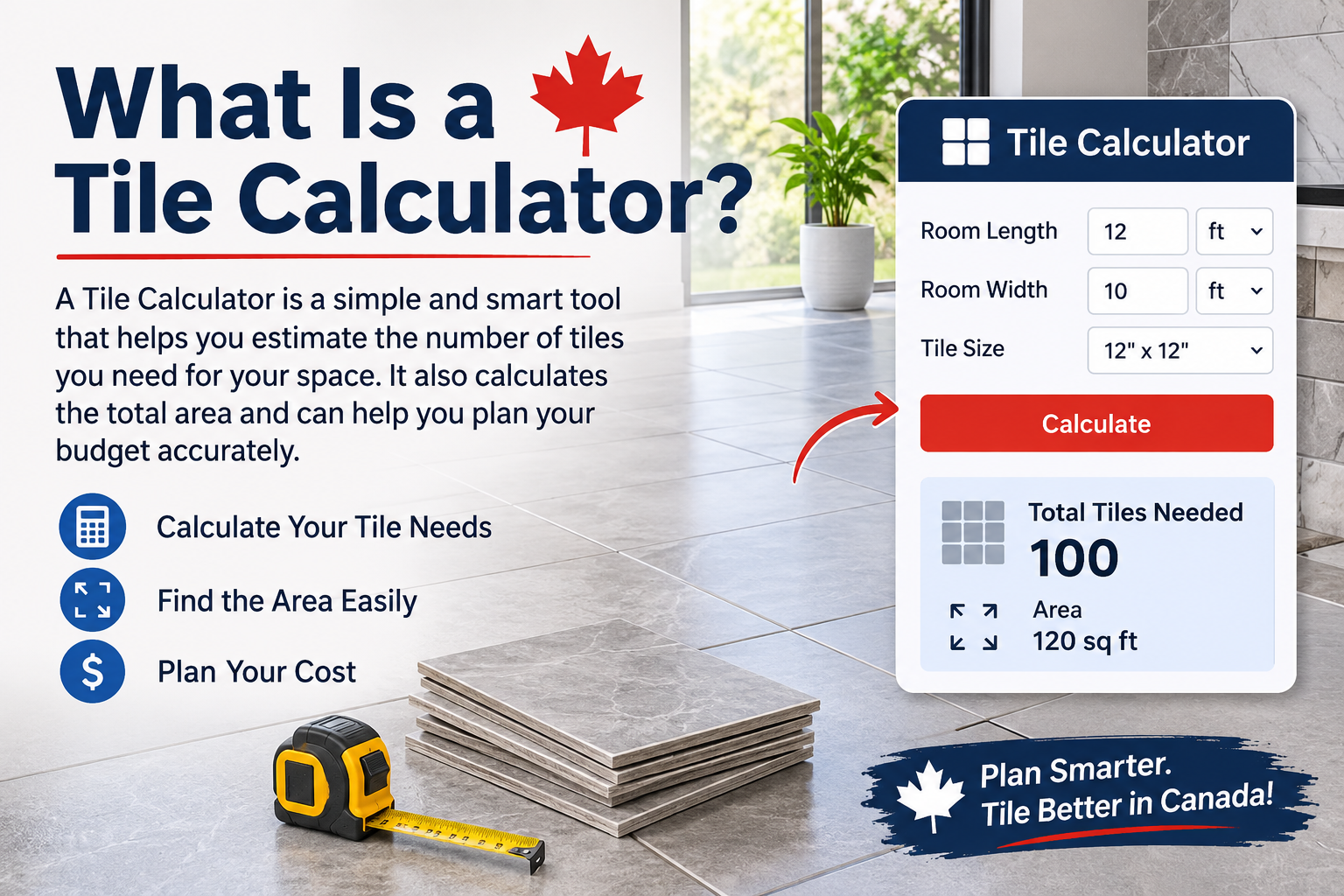
A Tile Calculator is a practical online tool that helps homeowners, contractors and renovation planners estimate how many tiles are needed for a particular floor or wall area. Before starting a tiling project, it is important to understand the size of the space and the dimensions of the tiles you plan to install.
Buying too few tiles can delay your renovation, while purchasing too many can increase your material costs unnecessarily. A tile calculator makes this planning process easier by using your room measurements and tile dimensions to estimate the required quantity.
For Canadian homeowners planning a kitchen renovation, bathroom upgrade, basement flooring project or a new backsplash, calculating tile requirements in advance can make shopping and budgeting more manageable.
Our Tile Calculator Canada also includes a wastage allowance, box quantity and an optional estimated material cost in CAD. This gives you a useful starting point before visiting a local tile retailer or contacting an installer.
How Does a Tile Calculator Work?
A tile calculator works by comparing the total surface area you want to cover with the coverage provided by one tile. It then adds an extra allowance for cutting, breakage and installation waste.
For example, imagine that you want to install tiles in a rectangular room measuring 12 feet long and 10 feet wide. The room area is 120 square feet. If you select tiles measuring 12 inches by 12 inches, each tile covers 1 square foot before accounting for grout joints.
With a 10% wastage allowance, the estimated quantity becomes 132 tiles. If each box contains 4 tiles, you will need 33 boxes.
The actual requirement can vary depending on the installation pattern, room shape and cutting plan. The calculator provides an estimate rather than a final installation measurement.
How to Use This Tile Calculator Step by Step
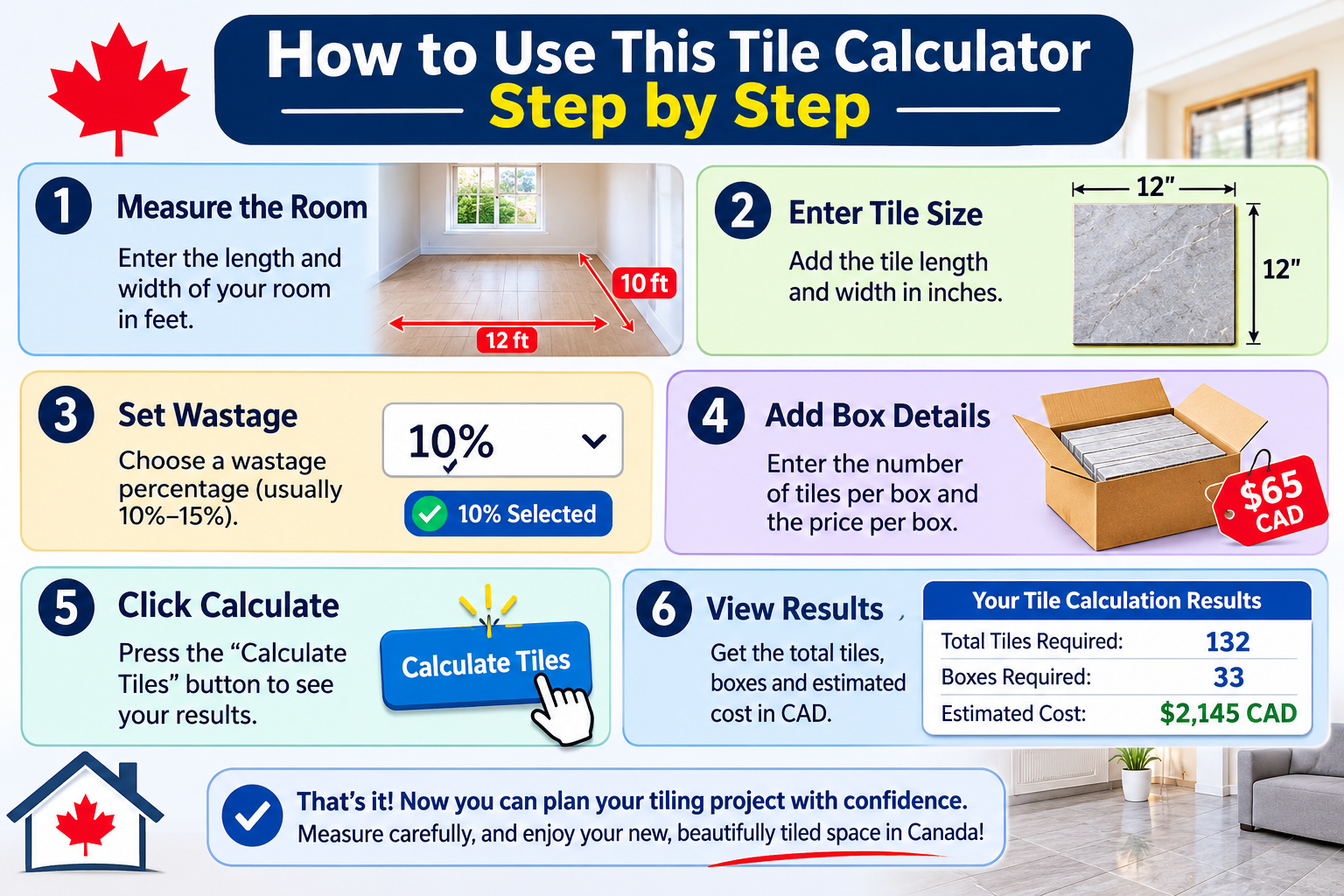
Using the Tile Calculator Canada is straightforward. Follow these steps to estimate the quantity of tiles required for your renovation project.
Step 1: Measure the Room Length
Measure the length of the floor or wall you want to cover. Enter the measurement in feet in the Room Length field. For wall tiling, measure the horizontal length of the wall.
Step 2: Measure the Room Width
Measure the width of the room or the height of the wall, depending on the surface you are tiling. Enter this measurement in feet.
Step 3: Enter the Area to Deduct
If there are permanent areas that will not receive tiles, enter their combined area in square feet. If you want to tile the entire surface, leave this field at zero.
Step 4: Select the Surface Type
Choose whether you are calculating tiles for a floor or wall. This helps identify the type of project you are planning.
Step 5: Enter Tile Dimensions
Check the tile packaging or product specifications to find its length and width. Enter both measurements in inches. Common tile sizes include 12 × 12 inches, 12 × 24 inches and 24 × 24 inches.
Step 6: Select the Wastage Percentage
Choose an appropriate wastage allowance. A straight layout may use around 10%, while diagonal and more complicated patterns may require 15% or more. Adjust the allowance based on your installer’s advice.
Step 7: Enter Box Quantity and Price
Check the packaging to see how many individual tiles are included in one box. Enter that number along with the price per box in Canadian dollars if you want a cost estimate.
Step 8: Click Calculate Tiles
Click the Calculate Tiles button. The calculator will display the estimated room area, net area, number of tiles, boxes required and tile material cost.
Types of Tiles Commonly Used in Canada
Different tile materials are suitable for different rooms and renovation requirements. Before purchasing tiles, consider the location, expected foot traffic, moisture exposure and maintenance needs.
1. Ceramic Tiles
Ceramic tiles are commonly used for kitchen walls, bathroom walls and other indoor applications. They are available in different colours, patterns and sizes. Their suitability for flooring depends on the product's wear rating and specifications.
2. Porcelain Tiles
Porcelain tiles are a popular choice for floors, bathrooms and other areas where durability and moisture resistance are important. They are generally denser than standard ceramic tiles. Always check the manufacturer's specifications before choosing them for a particular application.
3. Natural Stone Tiles
Natural stone tiles include marble, granite, slate and travertine. They can create an attractive finish, but some varieties require sealing and regular maintenance. Their installation requirements may also differ from manufactured tiles.
4. Mosaic Tiles
Mosaic tiles are smaller pieces arranged in sheets or decorative patterns. They are often used for shower floors, kitchen backsplashes and feature walls. Because of their smaller size, they involve more grout joints than larger tiles.
5. Glass Tiles
Glass tiles are frequently used for decorative walls and kitchen backsplashes. They reflect light and can add a modern appearance to an interior. Follow the manufacturer's installation recommendations when selecting adhesives and grout.
How to Calculate the Number of Tiles Needed
You can estimate the number of tiles required by following a simple mathematical formula.
Step 1: Calculate the Room Area
For a rectangular room:
Room Area = Length × Width
For example:
- Room length = 12 feet
- Room width = 10 feet
- Total area = 12 × 10 = 120 sq ft
Step 2: Calculate the Area of One Tile
Convert tile dimensions from inches into square feet by multiplying the tile length and width and dividing by 144.
Tile Area = (Tile Length × Tile Width) ÷ 144
For a 12 × 12 inch tile:
144 ÷ 144 = 1 square foot per tile.
Step 3: Calculate Tiles Before Wastage
Tiles Required = Net Room Area ÷ Tile Area
For 120 square feet and 1 square foot per tile, you need 120 tiles before wastage.
Step 4: Add Wastage
Tiles Including Wastage = Tiles Required × (1 + Wastage Percentage ÷ 100)
With 10% wastage:
120 × 1.10 = 132 tiles.
Step 5: Calculate Boxes
Boxes Required = Total Tiles ÷ Tiles Per Box
If each box contains 4 tiles:
132 ÷ 4 = 33 boxes.
How Much Extra Tile Wastage Should You Allow?
Tile wastage is the additional material needed to account for cuts, broken tiles and pieces that cannot be reused. It is an important part of planning a flooring or wall renovation.
The right allowance depends on the room layout, tile dimensions, installation pattern and the number of corners or obstacles.
- 5%: May be suitable for simple projects with very little cutting and an experienced installation plan.
- 10%: A common starting estimate for a straightforward straight or grid layout.
- 12%: Can be useful for some offset layouts and rooms with additional cuts.
- 15%: A reasonable planning allowance for diagonal patterns and more complicated layouts.
- 20%: May be appropriate for intricate patterns such as herringbone or rooms with substantial cutting.
These are planning guidelines, not fixed industry requirements. Your installer may recommend a different allowance after reviewing the actual space.
Tile Calculator for Different Rooms
Bathroom Tile Calculator
Bathroom renovations often involve both floor and wall tiles. Measure the floor separately from each wall. If you are tiling around a shower, vanity or other fixtures, make sure your measurements reflect the surfaces that will actually receive tiles.
Kitchen Tile Calculator
A kitchen tile calculator can help estimate materials for kitchen floors, backsplashes and selected wall areas. Measure the backsplash height and length separately, and account for permanent openings where appropriate.
Living Room Tile Calculator
Living rooms often have larger floor areas. Measure the longest and widest dimensions and consider any additional sections, alcoves or irregular corners. For an L-shaped room, calculate each rectangular section separately and add the areas together.
Basement Tile Calculator
Canadian homeowners may consider tile flooring for basement renovation projects. Before installation, ensure that the subfloor is suitable, moisture conditions are addressed and the selected tile and installation system are appropriate for the space.
Understanding Tile Cost in Canada
The cost of a tiling project depends on the tile material, size, design, brand, retailer and installation requirements. Ceramic, porcelain and natural stone products can have very different prices.
Our calculator includes an optional price-per-box field. Once you enter the price, it multiplies the number of complete boxes by the price of each box to estimate the tile material cost in CAD.
For example, if you need 20 boxes and each box costs $55 CAD, your estimated tile cost is:
20 × $55 = $1,100 CAD.
This estimate covers tiles only. It does not automatically include sales tax, delivery, labour, tile adhesive, grout, underlayment, waterproofing materials, trim or surface preparation. These expenses should be considered separately when preparing a renovation budget.
Important Tips Before Buying Tiles
- Measure each surface carefully before ordering materials.
- Check the exact tile dimensions printed on the packaging.
- Review the square-foot coverage stated on each box.
- Choose a suitable wastage allowance for your layout.
- Purchase tiles from the same production batch whenever possible to reduce shade differences.
- Keep a few spare tiles for future repairs, particularly if the design may be discontinued.
- Check whether the tile is suitable for the intended floor or wall application.
- Confirm the final quantity with your tile installer or supplier before placing a large order.
Benefits of Using an Online Tile Calculator
An online tile calculator can make renovation planning easier by reducing manual calculations and providing a quick estimate of material requirements.
- Saves time: You can calculate tile quantities in seconds.
- Helps with budgeting: Estimate tile material costs before shopping.
- Reduces shortages: Include additional tiles for cutting and breakage.
- Easy to use: Enter measurements without performing complicated calculations.
- Useful for different projects: Plan bathroom, kitchen, basement and other tiling projects.
- Supports Canadian budgeting: Estimate box costs in Canadian dollars.
Frequently Asked Questions About Tile Calculator Canada
1. How do I calculate how many tiles I need?
First, calculate the room area by multiplying its length by its width. Divide the net area by the area of one tile, then add a suitable wastage allowance. Round the final quantity up to a whole tile.
2. How many 12 × 12 inch tiles do I need for 100 square feet?
A 12 × 12 inch tile covers approximately 1 square foot. For a 100 sq ft area, you need 100 tiles before wastage. With a 10% allowance, the estimated purchase quantity is 110 tiles.
3. How much tile wastage should I add?
A 10% allowance is a common starting point for straightforward layouts. Diagonal, herringbone and complicated patterns may require 15% to 20% or more depending on the room and cutting requirements.
4. Can I use this tile calculator for walls?
Yes. You can use the calculator for both floor and wall projects. Enter the wall length and height in feet, then enter the tile dimensions in inches.
5. How many tiles are usually included in one box?
The number varies depending on the tile size, manufacturer and product packaging. Some boxes contain four large tiles, while smaller formats may include many more pieces. Always check the packaging.
6. Does the tile calculator include installation costs?
No. The estimated cost in this calculator is based on the price per box and the number of boxes required. Labour, adhesive, grout, delivery and other installation expenses are not included.
7. Should I buy extra tiles for future repairs?
Yes, keeping a few spare tiles is a sensible idea. A matching tile may be difficult to find later if a particular design, colour or production batch is discontinued.
8. Can I calculate tiles for an irregular or L-shaped room?
Yes, but you should divide the room into smaller rectangular sections. Calculate the area of each section separately, add them together and use the combined area as your measurement.
Conclusion
Planning a flooring or wall tiling project becomes easier when you know how much material you need before purchasing it. The Tile Calculator Canada helps estimate room area, tile quantity, additional wastage, complete boxes and tile material costs in CAD.
Whether you are renovating a bathroom, updating your kitchen, installing new living room flooring or finishing a basement, accurate measurements can help you make better purchasing decisions and avoid unnecessary material shortages.
Use the free Tile Calculator above to estimate your requirements, compare tile options and prepare for your next home improvement project in Canada. For the final order, always confirm measurements and box coverage with your supplier or professional installer.