
Calculate the missing side, hypotenuse, angles, area, and perimeter of a right triangle using the Pythagorean theorem and basic trigonometry.
Enter Triangle Measurements
Right Triangle Diagram
Step-by-Step Solution
| Property | Calculated Value |
|---|---|
| Side a | — |
| Side b | — |
| Side c | — |
| Angle A | — |
| Angle B | — |
| Area | — |
| Perimeter | — |
What Is a Right Triangle Calculator?
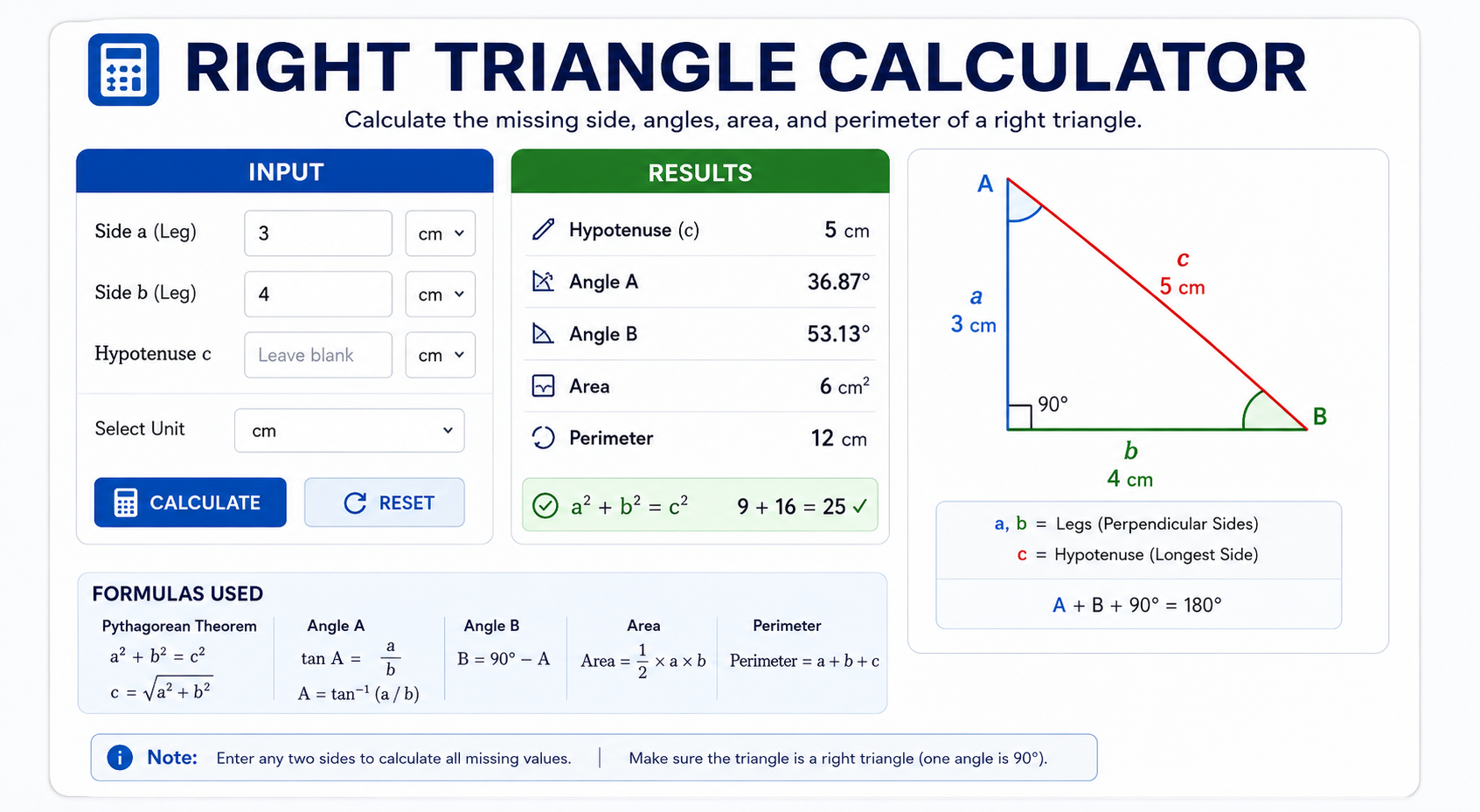
A Right Triangle Calculator is an online geometry tool designed to help you find missing measurements in a triangle that has one 90-degree angle. Depending on the measurements you enter, the calculator can determine a missing side, the hypotenuse, the two acute angles, the area, and the perimeter.
The main mathematical relationship behind a right triangle calculator is the Pythagorean theorem. If the two perpendicular sides are represented by a and b, and the hypotenuse is represented by c, the formula is a² + b² = c².
This makes a right triangle calculator useful for students, teachers, engineers, architects, designers, carpenters, builders, and anyone who needs to calculate a distance involving a right angle.
What Is a Right Triangle?
A right triangle is a triangle containing exactly one 90-degree angle. The two sides that form the right angle are called the legs, while the side directly opposite the right angle is called the hypotenuse.
The hypotenuse is always the longest side of a right triangle. It may appear horizontal, vertical, or diagonal depending on how the triangle is drawn. Its position does not determine whether it is the hypotenuse. The correct way to identify it is to find the side opposite the 90-degree angle.
Pythagorean Theorem Formula
The most important formula for a right triangle is:
a² + b² = c²
In this equation:
- a = first leg
- b = second leg
- c = hypotenuse
When both legs are known, the hypotenuse can be calculated with:
c = √(a² + b²)
When the hypotenuse and one leg are known, the missing leg can be found by rearranging the equation:
a = √(c² − b²)
b = √(c² − a²)
How to Use the Right Triangle Calculator
Using the calculator is straightforward. You need to provide any two appropriate side lengths. The calculator then determines the missing side and calculates the remaining measurements.
Step 1: Confirm the Triangle Is a Right Triangle
Before using the calculator, make sure the triangle has one angle equal to 90 degrees. The standard Pythagorean theorem is specifically designed for right triangles.
Step 2: Identify the Hypotenuse
Locate the 90-degree angle. The side opposite this angle is the hypotenuse. It must be the longest side.
Step 3: Enter Two Known Measurements
Enter two positive side lengths into the calculator. You can enter both legs to calculate the hypotenuse, or enter the hypotenuse and one leg to calculate the missing leg.
Step 4: Select a Measurement Unit
You can select units such as millimeters, centimeters, meters, inches, feet, or yards. The calculator uses the same unit for the linear measurements and square units for area.
Step 5: Click Calculate
Click Calculate Right Triangle to display the missing side, angles, area, perimeter, triangle type, and a step-by-step solution.
How to Find the Hypotenuse
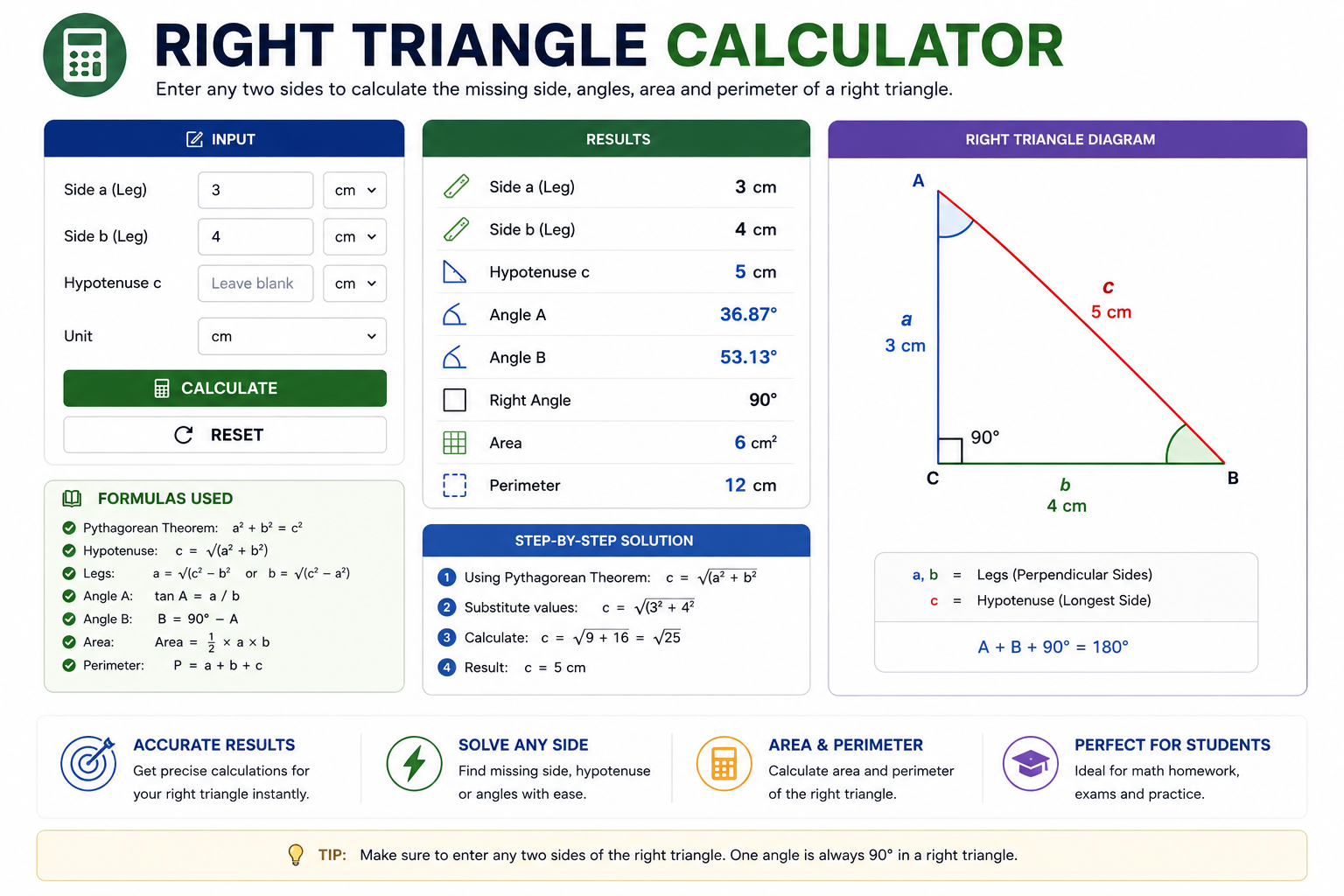
If the two legs of a right triangle are known, the hypotenuse can be found using the Pythagorean theorem.
For example, consider a triangle where:
- a = 3
- b = 4
Apply the formula:
c = √(3² + 4²)
This becomes:
c = √(9 + 16)
c = √25 = 5
Therefore, the hypotenuse is 5 units. This is the classic 3-4-5 Pythagorean triple.
How to Find a Missing Leg
If you know the hypotenuse and one leg, you can calculate the other leg by subtracting the square of the known leg from the square of the hypotenuse.
Suppose:
- c = 13
- b = 12
The missing side is:
a = √(13² − 12²)
a = √(169 − 144)
a = √25 = 5
Therefore, the missing leg is 5 units.
Right Triangle Area Formula
The area of a right triangle can be calculated using the two legs as the base and height.
Area = ½ × a × b
For example, if a triangle has legs of 6 and 8:
Area = ½ × 6 × 8 = 24
The area is therefore 24 square units.
Right Triangle Perimeter Formula
The perimeter of a triangle is the total length of all three sides. For a right triangle:
P = a + b + c
For a 3-4-5 triangle:
P = 3 + 4 + 5 = 12
Therefore, the perimeter is 12 units.
How to Calculate the Angles of a Right Triangle
Every right triangle has one angle measuring 90 degrees. The other two angles are acute angles, and together they add up to 90 degrees.
Basic trigonometry can be used to determine the acute angles. For example:
tan(A) = a ÷ b
Therefore:
A = arctan(a ÷ b)
The second acute angle can then be calculated as:
B = 90° − A
The calculator automatically performs these calculations and reports both angles in degrees.
What Is a Pythagorean Triple?
A Pythagorean triple is a set of three positive whole numbers that satisfy the equation:
a² + b² = c²
Some common Pythagorean triples include:
- 3, 4, 5
- 5, 12, 13
- 6, 8, 10
- 8, 15, 17
- 7, 24, 25
- 9, 12, 15
Multiplying all three numbers in a Pythagorean triple by the same positive number produces another valid triple. For example, multiplying 3-4-5 by 2 gives 6-8-10.
Right Triangle Example: 6-8-10
Consider a right triangle with legs of 6 meters and 8 meters. The hypotenuse can be calculated as follows:
c = √(6² + 8²)
c = √(36 + 64)
c = √100 = 10 meters
The area is:
Area = ½ × 6 × 8 = 24 m²
The perimeter is:
P = 6 + 8 + 10 = 24 meters
Common Uses of a Right Triangle Calculator
Right triangles appear in both mathematics and everyday measurement. A right triangle calculator can be useful for:
- Geometry homework and classroom exercises
- Calculating diagonal distances
- Construction measurements
- Carpentry and woodworking
- Roof slope calculations
- Ladder measurements
- Architecture and design
- Engineering calculations
- Surveying and layout work
- Checking rectangular diagonals
- Calculating triangular areas
- Verifying right-angle measurements
Right Triangle Calculator for Construction
Right triangles are common in construction, carpentry, roofing, and building layout work. For example, the diagonal of a rectangular area can be treated as the hypotenuse of a right triangle.
Suppose a rectangular layout is 6 feet wide and 8 feet long. Its diagonal is:
√(6² + 8²) = 10 feet
This type of calculation can also help with preliminary checks of square layouts, sloping lengths, and diagonal measurements. Professional construction and engineering work should still follow the applicable plans, tolerances, codes, and measurement procedures.
Right Triangle vs. Other Types of Triangles
Triangles can be classified according to their angles or side lengths. A right triangle is identified by its 90-degree angle.
- Right triangle: Contains one 90° angle.
- Acute triangle: All three angles are less than 90°.
- Obtuse triangle: One angle is greater than 90°.
- Equilateral triangle: All three sides are equal.
- Isosceles triangle: At least two sides are equal.
- Scalene triangle: All three sides have different lengths.
The standard Pythagorean theorem applies specifically to right triangles. Other triangle types may require different formulas, such as the Law of Cosines.
Common Mistakes When Using the Pythagorean Theorem
1. Using the Formula on a Non-Right Triangle
The equation a² + b² = c² is specifically associated with right triangles. Make sure one angle is 90 degrees before using the formula.
2. Selecting the Wrong Hypotenuse
The hypotenuse is opposite the right angle and is always the longest side.
3. Forgetting to Square the Sides
The Pythagorean theorem uses squared side lengths. It is not a + b = c. The correct relationship is a² + b² = c².
4. Entering an Invalid Hypotenuse
The hypotenuse must be longer than either leg. If the hypotenuse is equal to or smaller than a known leg, the measurements cannot form a valid right triangle.
5. Confusing Area and Perimeter
Area is expressed in square units, such as cm² or m². Perimeter is expressed in linear units, such as cm or m.
Benefits of Using an Online Right Triangle Calculator
An online calculator can save time when you need to perform several right-triangle calculations. Instead of manually repeating square roots and trigonometric calculations, the calculator provides the main results together.
- Quickly calculates missing sides
- Finds the hypotenuse automatically
- Calculates both acute angles
- Calculates triangle area
- Calculates perimeter
- Supports decimal measurements
- Provides step-by-step calculations
- Supports several measurement units
- Useful for checking manual calculations
- Helpful for geometry students and practical measurements
Frequently Asked Questions About Right Triangle Calculators
1. What is a Right Triangle Calculator?
A Right Triangle Calculator is an online tool that calculates missing measurements of a triangle containing a 90-degree angle. It can find missing sides, the hypotenuse, acute angles, area, and perimeter.
2. What is the formula for a right triangle?
The primary formula is the Pythagorean theorem: a² + b² = c². Here, a and b are the legs and c is the hypotenuse.
3. How do I find the hypotenuse?
If both legs are known, use c = √(a² + b²). For example, legs of 3 and 4 produce a hypotenuse of 5.
4. How do I find a missing leg?
If the hypotenuse and one leg are known, subtract the square of the known leg from the square of the hypotenuse and take the square root. For example, if c = 13 and b = 12, the missing leg is 5.
5. Which side is the hypotenuse?
The hypotenuse is the side directly opposite the 90-degree angle. It is always the longest side of a right triangle.
6. Can I calculate the area of a right triangle?
Yes. The area is calculated using Area = ½ × a × b, where a and b are the two perpendicular legs.
7. How do I calculate the perimeter?
Add the three side lengths using P = a + b + c. For a 3-4-5 triangle, the perimeter is 12 units.
8. Does the Pythagorean theorem work for every triangle?
No. The standard Pythagorean theorem applies specifically to right triangles. Non-right triangles require other mathematical relationships.
9. What are common Pythagorean triples?
Common examples include 3-4-5, 5-12-13, 6-8-10, 8-15-17, and 7-24-25. Each set satisfies the Pythagorean theorem.
10. Can a right triangle have decimal side lengths?
Yes. A right triangle can have decimal or irrational side lengths. The Pythagorean theorem applies as long as the measurements satisfy the required right-triangle relationship.
Conclusion
A Right Triangle Calculator provides a convenient way to solve common measurements involving a right-angled triangle. By entering two appropriate side lengths, you can determine the missing side and calculate the hypotenuse, acute angles, area, and perimeter.
The central formula is the Pythagorean theorem, a² + b² = c². When both legs are known, the theorem can be used to find the hypotenuse. When the hypotenuse and one leg are known, the same relationship can be rearranged to find the missing leg.
Whether you are studying geometry, checking a mathematical problem, working with diagonal measurements, or performing a preliminary construction calculation, this calculator can make right-triangle calculations faster and easier.
For accurate results, always confirm that the triangle is actually right-angled and that the hypotenuse is the longest side. For professional engineering, surveying, construction, or safety-critical applications, calculations should also be verified using the appropriate technical requirements and professional procedures.