Fuel Cost Calculator
Calculate your estimated fuel consumption, trip fuel cost, and cost per kilometre or mile.

What Is a Fuel Cost Calculator?
A Fuel Cost Calculator is an online tool that estimates how much fuel your vehicle will use during a journey and how much the trip is likely to cost. By entering your travel distance, vehicle fuel efficiency, fuel price, and trip type, you can quickly estimate your total fuel consumption and expected fuel expenses.
Planning fuel expenses before travelling can be particularly useful for daily commuters, families, business travellers, road-trip drivers, delivery workers, rideshare drivers, and fleet operators. Instead of calculating fuel consumption manually, a Fuel Cost Calculator performs the necessary conversions and calculations automatically.
Fuel prices can change frequently because of crude oil prices, taxes, transportation costs, supply and demand, and regional market conditions. For this reason, the most useful way to estimate a trip cost is to enter the current fuel price along with your vehicle's actual or estimated fuel economy.
How Does a Fuel Cost Calculator Work?
A Fuel Cost Calculator generally requires three main pieces of information: the distance you plan to travel, your vehicle's fuel efficiency, and the price of fuel. The calculator then determines the approximate quantity of fuel required for the journey and multiplies that amount by the fuel price.
This calculator also supports different measurement systems. You can enter the distance in kilometres or miles and select fuel efficiency using L/100 km, km/L, US MPG, or UK MPG.
For a round trip, the calculator doubles the one-way distance before calculating fuel consumption. This helps prevent one of the most common mistakes in travel budgeting: calculating only the outbound journey while forgetting the return trip.
Fuel Cost Formula
The basic calculation depends on how your vehicle's fuel economy is expressed.
For vehicles using L/100 km:
Fuel Required = (Distance × Fuel Consumption) ÷ 100
For vehicles using km/L:
Fuel Required = Distance ÷ Kilometres per Litre
Once the estimated fuel requirement is known:
Total Fuel Cost = Fuel Required × Fuel Price per Litre
The calculator automatically converts miles and MPG values where necessary so that the final fuel requirement is calculated in litres.
What Information Do You Need to Calculate Fuel Cost?
To get a useful estimate, you need a few basic details about your trip and vehicle.
- Travel distance: The total distance of your journey.
- Distance unit: Kilometres or miles.
- Fuel efficiency: Your vehicle's fuel economy.
- Efficiency unit: L/100 km, km/L, US MPG, or UK MPG.
- Fuel price: The current price per litre.
- Trip type: One-way or round trip.
If you are unsure about your vehicle's exact fuel economy, check the vehicle manufacturer's specifications or your vehicle's owner documentation. Real-world fuel economy can differ from laboratory or manufacturer estimates.
Understanding L/100 km Fuel Efficiency
Litres per 100 kilometres (L/100 km) is a commonly used fuel-consumption measurement in Canada and many other countries. It tells you how many litres of fuel a vehicle is expected to use to travel 100 kilometres.
With L/100 km, a lower number generally means better fuel efficiency. For example, a vehicle consuming 6 L/100 km generally uses less fuel than one consuming 10 L/100 km under comparable driving conditions.
Example of L/100 km
Suppose your vehicle has a fuel consumption rating of 8 L/100 km and you plan to drive 500 km.
Fuel Required = (500 × 8) ÷ 100 = 40 litres
If fuel costs $1.70 per litre, the estimated fuel expense would be:
40 × $1.70 = $68.00
Understanding Kilometres per Litre (km/L)
Kilometres per litre (km/L) measures how far a vehicle can travel using one litre of fuel. Unlike L/100 km, a higher km/L value indicates better fuel efficiency.
For example, a vehicle that travels 15 km using one litre of fuel is generally more fuel-efficient than a vehicle that travels only 8 km per litre, assuming comparable conditions.
Understanding Miles per Gallon (MPG)
Miles per gallon (MPG) is another common way to describe vehicle fuel economy. However, US gallons and UK Imperial gallons are different sizes, which means US MPG and UK MPG cannot be treated as identical values.
This is why the calculator provides separate options for US MPG and UK MPG. The selected value is converted into kilometres per litre before calculating the amount of fuel required.
One-Way vs Round-Trip Fuel Cost
Trip type can have a major effect on your final fuel estimate. A one-way calculation uses the distance from your starting point to your destination. A round-trip calculation assumes you will travel the same distance back to your starting point.
For example, if a destination is 250 km away:
- One-way distance = 250 km
- Round-trip distance = 500 km
Selecting the correct trip type ensures that the estimated fuel consumption reflects the journey you actually plan to make.
Why Use a Fuel Cost Calculator?
Fuel can represent a significant portion of the total cost of driving. A long road trip, frequent commute, or business journey can involve substantial fuel expenses. A Fuel Cost Calculator gives you an estimate before you travel, allowing you to plan your budget more effectively.
Some of the main benefits include:
- Estimate fuel expenses before a trip.
- Calculate expected fuel consumption.
- Compare different vehicles.
- Estimate commuting expenses.
- Plan road-trip budgets.
- Calculate approximate business travel costs.
- Understand cost per kilometre and mile.
- Compare the effect of different fuel prices.
Factors That Affect Fuel Consumption
The result produced by a fuel cost calculator is an estimate because real-world fuel consumption can change depending on driving and environmental conditions.
Driving Speed
Driving at very high speeds can increase aerodynamic drag and fuel consumption. Maintaining a consistent and reasonable speed can often improve fuel economy.
Traffic Conditions
Stop-and-go traffic can consume more fuel than steady highway driving. Frequent acceleration and braking require additional energy from the engine.
Vehicle Weight
Carrying unnecessary luggage or heavy equipment can increase the amount of energy required to move the vehicle.
Tire Pressure
Incorrect tire pressure can increase rolling resistance and may reduce fuel efficiency. Drivers should follow the vehicle manufacturer's recommended tire-pressure specifications.
Weather Conditions
Cold temperatures, strong winds, snow, rain, and other weather conditions can influence fuel consumption. Winter driving can be particularly different from normal conditions.
Air Conditioning
Using climate-control systems can increase energy consumption. The effect varies depending on the vehicle, weather, speed, and operating conditions.
Gasoline, Diesel and Hybrid Vehicles
A Fuel Cost Calculator can be used with many types of fuel-powered vehicles. Gasoline and diesel vehicles may have different fuel economy characteristics, while hybrid vehicles can achieve different efficiency depending on driving conditions and how much of the journey is powered electrically.
Regardless of vehicle type, the calculation still depends on the fuel consumption figure and the applicable fuel price. For hybrid vehicles, real-world fuel usage may vary considerably depending on battery charge, driving style, temperature, traffic, and the proportion of electric versus engine-powered driving.
Cost Per Kilometre and Cost Per Mile
Knowing your total fuel cost is useful, but understanding your cost per kilometre or cost per mile can provide additional insight.
Cost per kilometre can be useful for commuters, businesses, delivery drivers, rideshare operators, and fleet managers who want to understand the fuel component of their vehicle operating expenses.
Keep in mind that fuel cost is only one part of the total cost of operating a vehicle. Insurance, maintenance, depreciation, tires, registration, financing, parking, and repairs may also contribute to the overall cost of driving.
Fuel Cost Example
Consider a vehicle travelling 400 km with a fuel consumption of 8 L/100 km. Suppose the fuel price is $1.75 per litre.
Fuel required:
(400 × 8) ÷ 100 = 32 litres
Estimated fuel cost:
32 × $1.75 = $56.00
Therefore, the estimated fuel cost for the 400 km trip would be approximately $56.00 under the assumptions provided.
Who Can Use a Fuel Cost Calculator?
A Fuel Cost Calculator is useful for almost anyone who wants to estimate vehicle fuel expenses.
- Daily commuters
- Road-trip travellers
- Families planning vacations
- Business travellers
- Delivery drivers
- Rideshare drivers
- Taxi drivers
- Fleet managers
- Small businesses
- Students
- Vehicle owners
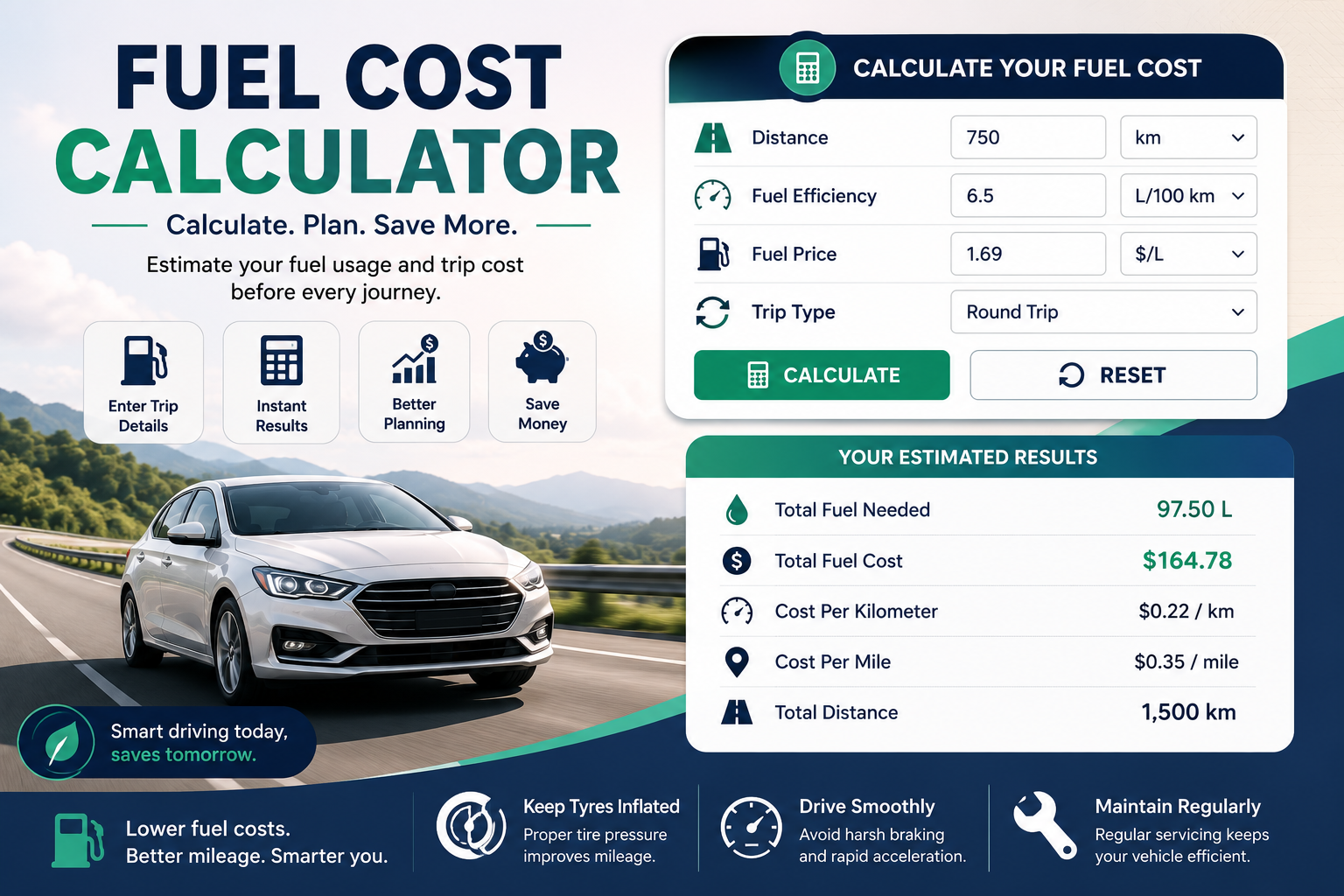
Ways to Reduce Fuel Costs
Fuel expenses are an important part of vehicle ownership and travel. Although drivers cannot control the market price of fuel, they can often reduce their fuel consumption through better driving habits, vehicle maintenance, and trip planning.
1. Maintain a Steady Driving Speed
Frequent acceleration and braking can increase fuel consumption. Smooth acceleration and maintaining a reasonably consistent speed can help improve fuel economy.
2. Avoid Unnecessary Idling
Leaving a vehicle running while parked or waiting can consume fuel without adding any distance to the journey. Avoiding unnecessary idling can reduce wasted fuel.
3. Check Tire Pressure
Tires that are not inflated according to the manufacturer's recommendations can affect rolling resistance and fuel economy. Regular tire-pressure checks can also support tire life and safe vehicle operation.
4. Remove Unnecessary Weight
Carrying heavy items that are not needed for a journey can increase the energy required to move the vehicle. Removing unnecessary cargo can help improve efficiency.
5. Reduce Aerodynamic Drag
Roof racks, cargo boxes, and other external accessories can increase aerodynamic resistance, particularly at highway speeds. Removing unused equipment may help reduce fuel consumption.
6. Maintain Your Vehicle
Following the manufacturer's recommended maintenance schedule can help keep your vehicle operating properly. Oil changes, inspections, tire alignment, filters, and other maintenance tasks can contribute to efficient vehicle operation.
7. Plan Efficient Routes
Unnecessary detours, traffic congestion, and repeated short trips can increase fuel use. Planning routes in advance and combining errands can reduce unnecessary driving.
8. Drive Smoothly
Aggressive acceleration, hard braking, and frequent speed changes can reduce fuel economy. Anticipating traffic and maintaining safe following distances can encourage smoother driving.
9. Compare Fuel Prices
Fuel prices can differ between stations and locations. Comparing prices before refuelling can help reduce the amount you pay over time, particularly for drivers who purchase large quantities of fuel.
10. Use the Fuel Grade Recommended by the Manufacturer
Always follow your vehicle manufacturer's fuel recommendations. Using a more expensive fuel grade does not necessarily provide a benefit if it is not required or recommended for your vehicle.
City Driving vs Highway Driving
Your vehicle's actual fuel economy can vary significantly depending on where and how you drive.
City Driving
- Frequent stops and starts
- Traffic congestion
- More acceleration and braking
- Lower average speeds
- Potentially higher fuel consumption
Highway Driving
- More consistent speeds
- Fewer stops
- Less frequent acceleration and braking
- Potentially better fuel economy
Because driving conditions vary, the fuel economy shown by a manufacturer may not exactly match the fuel economy experienced during everyday driving.
Fuel Budget Planning Tips
A fuel budget can make regular travel expenses easier to understand. Start by estimating your average monthly distance and your vehicle's typical fuel efficiency. Then use a realistic current fuel price to estimate your monthly fuel spending.
- Track your monthly kilometres or miles.
- Monitor your average fuel consumption.
- Use current fuel prices when budgeting.
- Account for both directions of a trip.
- Compare fuel expenses between vehicles.
- Review your fuel spending regularly.
Common Fuel Cost Calculation Mistakes
Even a simple fuel calculation can produce an inaccurate result if incorrect information is entered. Some of the most common mistakes include:
- Using an outdated fuel price.
- Forgetting the return journey.
- Confusing miles with kilometres.
- Confusing US MPG with UK MPG.
- Entering the wrong fuel-efficiency value.
- Using an incorrect fuel price unit.
- Assuming laboratory fuel economy will always match real-world consumption.
Checking each input before calculating can make your estimate more useful and realistic.
Fuel Cost Calculator for Road Trips
A Fuel Cost Calculator is especially helpful when planning a road trip. Before travelling, you can estimate the distance, fuel required, and expected fuel expense. If your journey involves several stops, calculate each major section separately or use the total planned distance.
For longer journeys, it is also sensible to allow some additional budget because actual fuel consumption can change due to traffic, weather, detours, passengers, luggage, road conditions, and driving style.
Fuel Cost Calculator for Daily Commuting
Commuters can use the calculator to estimate how much they spend on fuel each day, week, or month. For example, if your daily round-trip commute is 50 km, you can calculate the approximate fuel required for that distance and multiply the result by the number of working days.
Tracking this information over time can help you understand the effect of fuel prices, route changes, vehicle choice, and driving habits on your transportation budget.
Fuel Cost Calculator for Business Travel
Businesses and independent professionals may also use fuel cost calculations when estimating travel expenses. Knowing the approximate fuel cost of a journey can help with trip budgeting and internal expense planning.
However, fuel cost should not automatically be treated as the full vehicle reimbursement amount. Business mileage policies, tax rules, reimbursement rates, and allowable expenses can vary by jurisdiction and situation.
Frequently Asked Questions About Fuel Cost Calculator
1. What is a Fuel Cost Calculator?
A Fuel Cost Calculator is an online tool that estimates fuel consumption and the expected cost of a trip using distance, fuel efficiency, and fuel price. It can also calculate approximate cost per kilometre and cost per mile.
2. How do I calculate the fuel cost of a trip?
First determine the amount of fuel your vehicle is expected to use. Then multiply the required fuel by the fuel price per litre. For L/100 km, fuel required can be calculated as distance multiplied by fuel consumption and divided by 100.
3. Can I calculate fuel cost in miles?
Yes. This calculator supports miles as a distance unit. It converts the entered distance into kilometres internally so that the fuel calculation can be performed consistently.
4. Can I use MPG in this calculator?
Yes. The calculator supports both US MPG and UK MPG. Because US and UK gallons have different volumes, the two MPG measurements are converted separately.
5. Can I calculate a round-trip fuel cost?
Yes. Select Round Trip from the Trip Type menu. The calculator doubles the entered one-way distance before calculating the estimated fuel requirement and total cost.
6. Does the calculator work for diesel vehicles?
Yes. The calculation can be used for gasoline, diesel, and many other fuel-powered vehicles. Enter the appropriate fuel-efficiency figure and current fuel price per litre.
7. Why is my actual fuel cost different from the calculator result?
The calculator provides an estimate. Actual fuel consumption can be affected by traffic, speed, weather, road conditions, tire pressure, vehicle weight, maintenance, air conditioning, driving style, and fuel-price changes.
8. What does L/100 km mean?
L/100 km means litres of fuel consumed to travel 100 kilometres. A lower L/100 km number generally represents better fuel efficiency because the vehicle uses less fuel for the same distance.
9. What does km/L mean?
Km/L means kilometres travelled per litre of fuel. In this measurement system, a higher number generally represents better fuel efficiency.
10. Can I use the calculator for long-distance road trips?
Yes. The calculator is useful for both short and long journeys. For very long trips, consider adding a reasonable contingency to your budget because actual fuel consumption may differ from the estimate.
11. Does the calculator include maintenance and insurance costs?
No. This calculator estimates fuel-related expenses only. Maintenance, insurance, depreciation, parking, registration, financing, and other vehicle expenses are not included in the fuel-cost calculation.
12. Is the Fuel Cost Calculator free?
Yes. The online Fuel Cost Calculator is designed to provide a quick and convenient estimate without requiring manual mathematical calculations.
Conclusion
A Fuel Cost Calculator is a practical tool for estimating how much fuel a journey may require and how much that fuel is likely to cost. By entering your distance, fuel efficiency, fuel price, and trip type, you can quickly create a useful estimate before starting your journey. The calculator also supports kilometres, miles, L/100 km, km/L, US MPG, and UK MPG, making it suitable for users who work with different measurement systems.
Whether you are planning a daily commute, family vacation, business journey, weekend road trip, or long-distance drive, understanding your expected fuel expense can make travel budgeting easier. The estimated cost per kilometre and cost per mile can also help you compare vehicles and understand how fuel contributes to your overall driving expenses.
Remember that calculated fuel costs are estimates rather than guarantees. Real-world fuel consumption can change because of traffic, driving style, weather, vehicle condition, tire pressure, road conditions, cargo, and other factors. Using realistic fuel-efficiency figures and current fuel prices will produce a more useful estimate.
For better fuel economy, combine the calculator with practical habits such as maintaining proper tire pressure, avoiding unnecessary idling, reducing excess weight, driving smoothly, maintaining your vehicle, and planning efficient routes. Used regularly, a Fuel Cost Calculator can help you make better travel decisions, manage fuel expenses, and prepare a more realistic budget for your next journey.