
Factorise Calculator
Enter a positive integer to find its prime factorization instantly.

What Is a Factorise Calculator?
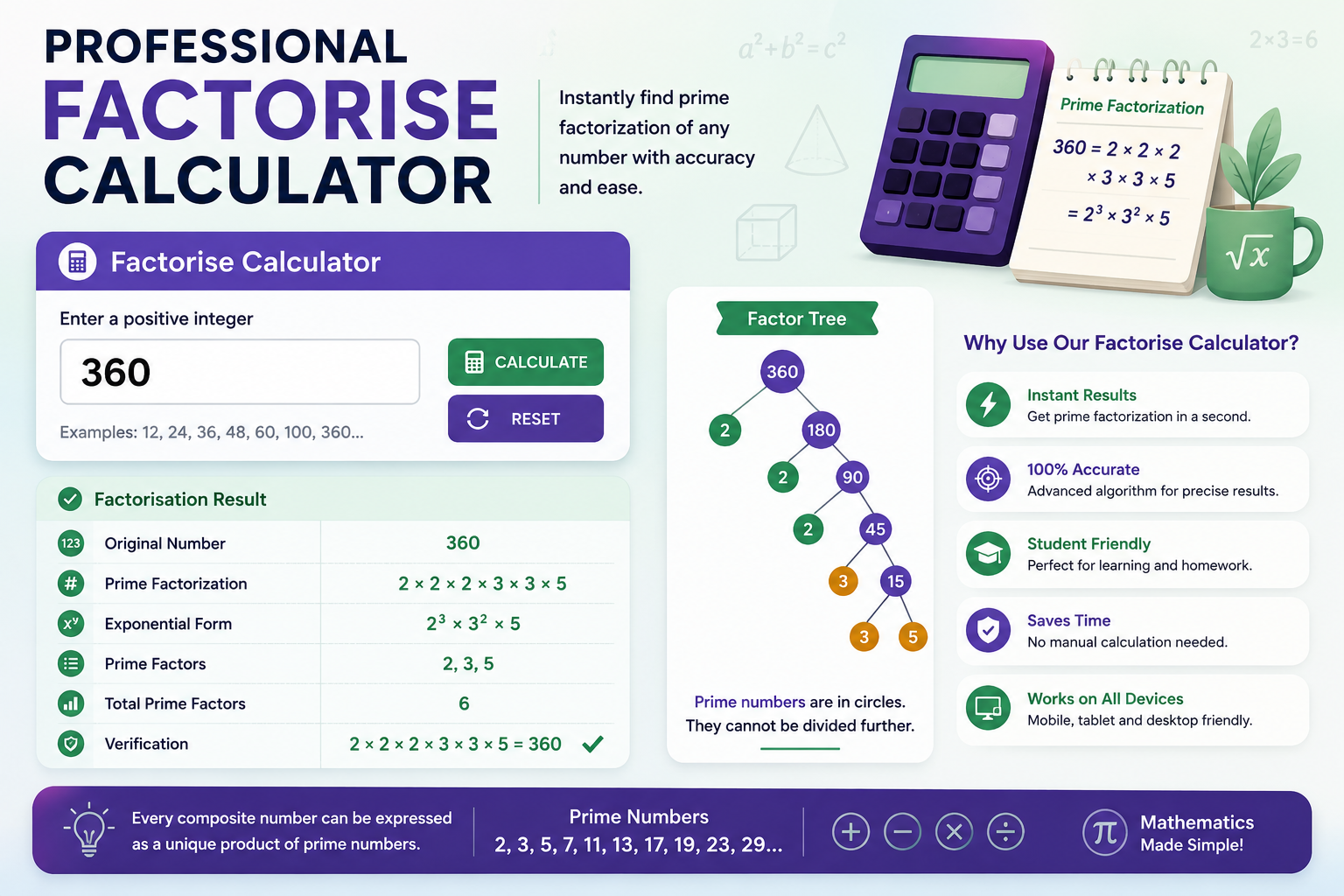
A Factorise Calculator is an online mathematical tool that breaks a positive integer into its prime factors quickly and accurately. Instead of performing repeated division manually, the calculator identifies the prime numbers that multiply together to produce the original number and displays the result in an easy-to-understand format.
Factorisation is one of the fundamental concepts in arithmetic and number theory. Every composite whole number greater than 1 can be expressed as a product of prime numbers. These prime numbers are often described as the basic building blocks of whole numbers.
An online Factorise Calculator can be useful for students, teachers, parents, tutors, engineers, programmers, and anyone who needs to check a mathematical calculation. It can save time, reduce arithmetic mistakes, and make prime factorization easier to understand.
What Does Factorising a Number Mean?
Factorising a number means expressing it as a product of smaller whole numbers called factors. When the factors are all prime numbers, the result is called prime factorization.
For example:
- 12 = 2 × 2 × 3
- 24 = 2 × 2 × 2 × 3
- 36 = 2 × 2 × 3 × 3
- 60 = 2 × 2 × 3 × 5
- 100 = 2 × 2 × 5 × 5
The prime factorization of a number is unique apart from the order of the factors. This important property is known as the Fundamental Theorem of Arithmetic.
How Does a Factorise Calculator Work?
The calculator uses repeated division to find the prime factors of the number you enter. It starts with the smallest prime number, 2, and checks whether the number can be divided evenly.
If division by 2 is possible, the calculator continues dividing by 2 until it is no longer a factor. It then moves to the next possible divisor and continues the process until the remaining number is prime.
The calculator provides several useful results, including:
- The original number
- Prime factors
- Prime factorization
- Exponential notation
- Total number of prime factors
- Multiplication verification
Prime Numbers and Composite Numbers
What Is a Prime Number?
A prime number is a whole number greater than 1 that has exactly two positive factors: 1 and itself.
Examples of prime numbers include:
2, 3, 5, 7, 11, 13, 17, 19, 23, 29
What Is a Composite Number?
A composite number is a whole number greater than 1 that has more than two positive factors. Composite numbers can be broken down into smaller prime factors.
Examples include:
4, 6, 8, 9, 10, 12, 15, 20, 24, 36
The number 1 is neither prime nor composite.
Prime Factorization Explained
Prime factorization represents a number using only prime numbers multiplied together.
For example, consider 360:
360 = 2 × 2 × 2 × 3 × 3 × 5
This can also be written in exponential form:
360 = 2³ × 3² × 5
The exponent tells you how many times that particular prime factor appears in the factorization.
How to Factorise a Number Manually
You can factorise a number manually by repeatedly dividing it by the smallest prime number that divides it exactly.
Example: Factorising 72
Start with 72.
72 ÷ 2 = 36
36 ÷ 2 = 18
18 ÷ 2 = 9
9 ÷ 3 = 3
3 ÷ 3 = 1
Therefore:
72 = 2 × 2 × 2 × 3 × 3
Or in exponential form:
72 = 2³ × 3²
Repeated Division Method
Repeated division is one of the simplest ways to find prime factors. You continue dividing the number by prime numbers until the final quotient is 1.
For example, to factorise 60:
60 ÷ 2 = 30
30 ÷ 2 = 15
15 ÷ 3 = 5
5 ÷ 5 = 1
Therefore:
60 = 2² × 3 × 5
Factor Tree Method
A factor tree is another popular method for finding prime factors. Instead of repeatedly dividing one number, you split a composite number into two factors and continue splitting each composite factor until every branch ends in a prime number.
For example, 36 can be split into 6 × 6. Each 6 can then be split into 2 × 3. The final prime factors are:
36 = 2 × 2 × 3 × 3
Factor trees are particularly useful for students because they provide a visual way to understand how composite numbers are constructed from prime numbers.
Why Is Prime Factorization Important?
Prime factorization is used in many areas of mathematics. Once a number has been expressed as prime factors, several other calculations become easier.
- Finding the Greatest Common Factor (GCF)
- Finding the Least Common Multiple (LCM)
- Simplifying fractions
- Working with divisibility
- Solving mathematical problems
- Algebraic factorization
- Number theory
- Cryptography
- Computer science
- Engineering and scientific calculations
Benefits of Using an Online Factorise Calculator
An online Factorise Calculator provides a convenient way to perform prime factorization without completing every division step manually.
- Fast calculations: Get factorization results within seconds.
- Accurate results: Reduces common arithmetic mistakes.
- Easy verification: Check whether the prime factors multiply back to the original number.
- Exponential notation: Repeated factors are displayed using powers.
- Educational: Useful for understanding prime factorization.
- Convenient: No special software is required.
- Free to use: The calculator can be used whenever you need a quick calculation.
Prime Factorization Examples
Example 1: Factorization of 12
12 = 2 × 2 × 3
Exponential form: 12 = 2² × 3
Example 2: Factorization of 24
24 = 2 × 2 × 2 × 3
Exponential form: 24 = 2³ × 3
Example 3: Factorization of 36
36 = 2 × 2 × 3 × 3
Exponential form: 36 = 2² × 3²
Example 4: Factorization of 48
48 = 2 × 2 × 2 × 2 × 3
Exponential form: 48 = 2⁴ × 3
Example 5: Factorization of 100
100 = 2 × 2 × 5 × 5
Exponential form: 100 = 2² × 5²
Example 6: Factorization of 360
360 = 2 × 2 × 2 × 3 × 3 × 5
Exponential form: 360 = 2³ × 3² × 5
Using Prime Factors to Find the GCF
Prime factorization can make it easier to find the Greatest Common Factor (GCF) of two or more numbers.
Consider 24 and 36:
24 = 2³ × 3
36 = 2² × 3²
The common prime factors with the lowest powers are 2² and 3.
Therefore:
GCF = 2² × 3 = 12
Using Prime Factors to Find the LCM
Prime factorization can also be used to calculate the Least Common Multiple (LCM).
Using 24 and 36:
24 = 2³ × 3
36 = 2² × 3²
For the LCM, use the highest power of each prime:
LCM = 2³ × 3²
LCM = 72
Applications of Prime Factorization
Prime factorization is not limited to classroom exercises. It is an important concept in several mathematical and computing applications.
Mathematics
Prime factors are used to study divisibility, factors, GCF, LCM, fractions, and number relationships.
Algebra
Factorization concepts are used when simplifying expressions and solving certain types of equations.
Cryptography
Properties of large prime numbers play an important role in several cryptographic systems. The difficulty of certain number-theory problems involving large integers has historically been useful in public-key cryptography.
Computer Science
Prime numbers and factorization appear in algorithms, computational number theory, security systems, and programming problems.
Common Mistakes When Factorising Numbers
Manual prime factorization can lead to mistakes, especially when dealing with larger numbers. Some common errors include:
- Stopping before all factors are prime.
- Forgetting a repeated factor.
- Using a composite number as a final factor.
- Making an arithmetic error during division.
- Writing an incorrect exponent.
- Failing to verify the final multiplication.
Using a Factorise Calculator can help you quickly check your work and identify whether the final factorization is correct.
Tips for Faster Prime Factorization
- Start with the smallest prime number, 2.
- Check whether the number is divisible by 2.
- Use divisibility rules for 3, 5, 7, and other small primes.
- Continue dividing until the remaining value is prime.
- Use exponential notation to simplify repeated factors.
- Multiply the factors together to verify the answer.
- Use an online Factorise Calculator for a quick independent check.
Who Can Use a Factorise Calculator?
A Factorise Calculator is useful for anyone working with whole numbers and prime factors.
- School students
- High school students
- College students
- Mathematics teachers
- Parents helping with homework
- Private tutors
- Competitive exam students
- Engineers
- Programmers
- Anyone studying mathematics
Frequently Asked Questions About Factorise Calculator
1. What is a Factorise Calculator?
A Factorise Calculator is an online tool that breaks a positive integer into its prime factors. It displays the prime factors, repeated factor form, exponential notation, total number of prime factors, and a verification of the result.
2. What does factorising a number mean?
Factorising a number means expressing it as a product of smaller factors. Prime factorization specifically expresses the number as a product of prime numbers. For example, 60 can be written as 2² × 3 × 5.
3. What is a prime factor?
A prime factor is a prime number that divides another number exactly. For example, the prime factors of 30 are 2, 3, and 5.
4. Can a prime number be factorised?
Yes, but its prime factorization consists only of the number itself. For example, the prime factorization of 13 is simply 13 because 13 is already prime.
5. Is 1 a prime number?
No. The number 1 is neither prime nor composite. A prime number must have exactly two distinct positive factors: 1 and itself.
6. What is the prime factorization of 360?
The prime factorization of 360 is 2³ × 3² × 5. In expanded form, this is 2 × 2 × 2 × 3 × 3 × 5.
7. What is the difference between factors and prime factors?
Factors are numbers that divide another number exactly. Prime factors are factors that are also prime numbers. For example, the factors of 12 include 1, 2, 3, 4, 6, and 12, while its prime factors are only 2 and 3.
8. Why is prime factorization useful for GCF and LCM?
Prime factorization breaks numbers into their basic prime components. Comparing these components makes it easier to determine the common factors needed for GCF and the highest powers needed for LCM.
9. Can this Factorise Calculator be used for homework?
Yes. Students can use the calculator to check their prime factorization work and understand whether their manual calculations are correct. It is best used as a learning and verification tool rather than replacing the process of learning factorization.
10. Is the Factorise Calculator free?
Yes. This online Factorise Calculator is free to use. Enter a positive integer and select the Factorise button to view the prime factorization and related results.
Final Thoughts
A Factorise Calculator makes prime factorization faster, easier, and more convenient. Instead of performing repeated divisions manually, users can enter a positive integer and instantly see its prime factors, expanded factorization, exponential form, total number of prime factors, and verification.
Prime factorization is an important foundation of mathematics and supports many other topics, including GCF, LCM, fractions, divisibility, algebra, and number theory. It also has applications in computer science, cryptography, engineering, and scientific computing.
Whether you are a student checking homework, a teacher preparing examples, a tutor explaining factors, or simply someone working with numbers, this online Factorise Calculator can provide a quick and reliable way to verify prime factorization. For learning purposes, it is also helpful to compare the calculator's result with a manual repeated-division or factor-tree method.