
🐪 Camel Feed Calculator
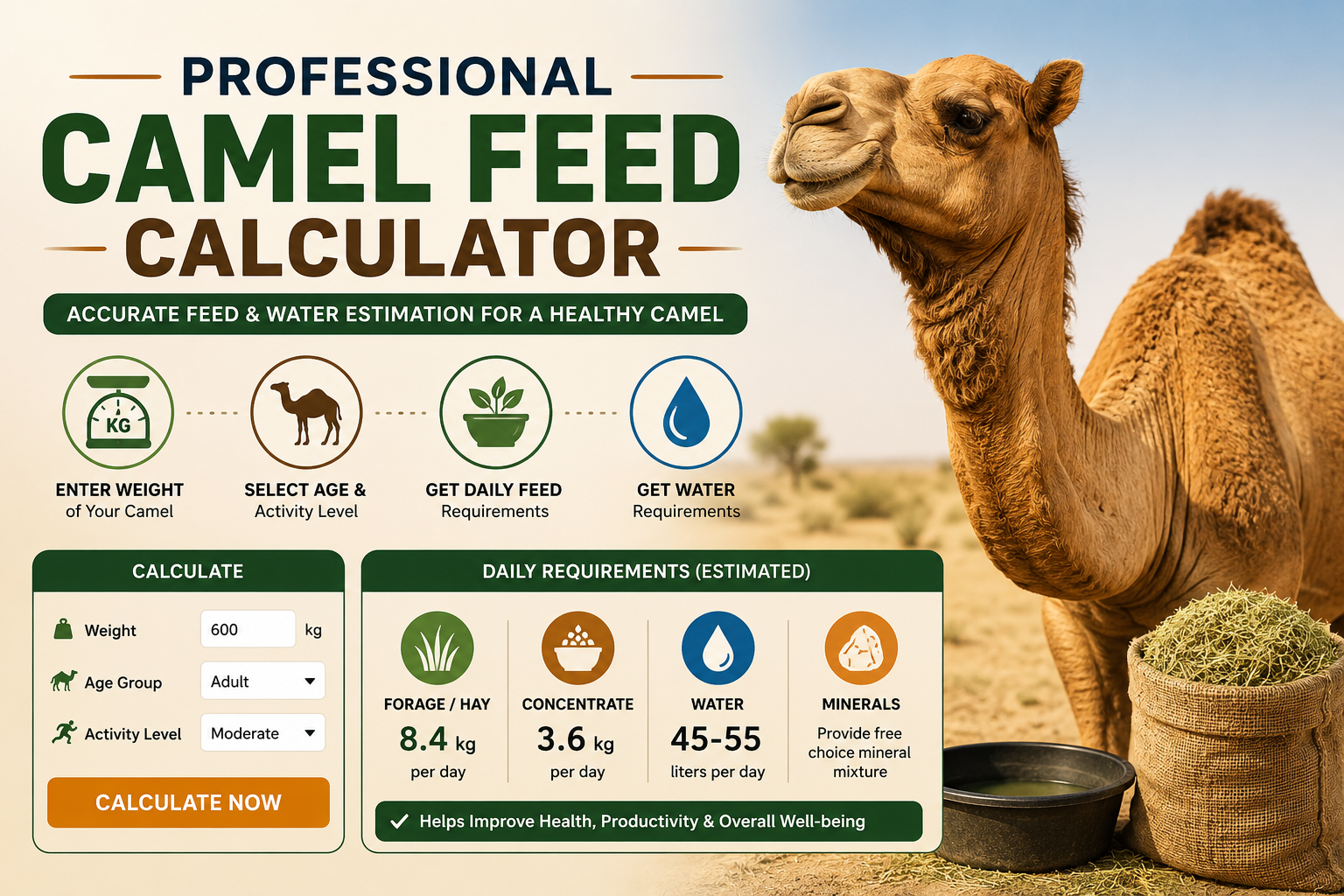
Estimate your camel's approximate daily dry feed requirement based on body weight, age, and activity level.
What Is a Camel Feed Calculator?
A Camel Feed Calculator is an online tool designed to provide an approximate estimate of a camel's daily dry feed requirement based on body weight, age, and activity level. It can help camel owners, breeders, farmers, livestock managers, and animal-care professionals create an initial feeding plan without performing the calculations manually.
Camel nutrition is different from the nutrition of many conventional livestock species. Camels are adapted to browse and graze on fibrous vegetation and can make efficient use of plants that may be difficult for other animals to utilize. However, domesticated camels still need appropriate amounts of forage, energy, protein, minerals, and water to maintain good body condition and productivity. FAO resources describe camels as animals that browse shrubs and tree branches as well as graze grasses, and note that their feed and water intake can vary considerably according to environmental conditions and diet. :contentReference[oaicite:1]{index=1}
This calculator uses body weight as the main starting point and applies an approximate dry-matter intake percentage. Published FAO material reports camel forage dry-matter intake across a broad range, including approximately 1.4% to 2.5% of body weight in different conditions. This is why the calculator should be treated as an estimation and not as a fixed veterinary feeding prescription. :contentReference[oaicite:2]{index=2}
Why Is Proper Camel Nutrition Important?
Proper nutrition is essential for maintaining a camel's body condition, digestive health, growth, reproduction, milk production, and ability to perform physical work. A camel that receives inadequate nutrition may gradually lose weight and condition, while excessive energy intake may contribute to unnecessary weight gain and increased feeding costs.
A well-planned feeding program should consider the quality of available forage as well as the camel's body weight, age, workload, reproductive status, climate, and health. Feed quantity alone does not determine nutritional adequacy because two feeds with the same weight can contain very different amounts of moisture, energy, protein, minerals, and fiber.
How Does a Camel Feed Calculator Work?
The calculator begins with the camel's body weight. If the weight is entered in pounds, it is automatically converted to kilograms. The calculator then applies an approximate dry-matter intake percentage according to the selected activity level.
The basic concept is:
The estimated dry feed is then divided into an approximate forage portion and concentrate portion. This division is intended for planning purposes only. Actual rations should be based on feed analysis, nutritional requirements, body condition, and professional advice where appropriate.
How Much Feed Does a Camel Need?
There is no single feed quantity that is correct for every camel. Feed intake changes according to body size, forage quality, activity, production status, environmental conditions, and other factors. FAO literature reports camel dry-matter intake values ranging broadly depending on the production and environmental situation. :contentReference[oaicite:3]{index=3}
For example, a large working camel may have different energy requirements from a mature camel kept mainly for maintenance. A lactating female may require additional nutrients to support milk production, while a growing camel needs nutrients to support development.
Forage and Hay for Camels
Forage is an important part of a camel's diet. Depending on availability and region, camels may consume grasses, hay, shrubs, tree leaves, browse, crop residues, and other fibrous plant material.
Grass Hay
Good-quality grass hay can provide fiber and bulk in a camel feeding program. Its nutritional value depends on plant species, maturity, harvesting method, storage, and moisture content.
Alfalfa Hay
Alfalfa is a relatively nutrient-dense forage and can provide protein and minerals. The appropriate amount depends on the rest of the ration and the camel's nutritional needs.
Natural Browse
Camels naturally browse shrubs and tree vegetation. FAO describes camels as capable of consuming thorny plants, bushes, tree branches, and grasses. :contentReference[oaicite:4]{index=4}
Concentrate Feed for Camels
Concentrates can provide additional energy and protein when forage alone does not meet the animal's nutritional requirements. Depending on the local feeding system, concentrate ingredients may include grains, bran, protein sources, or commercially formulated livestock feeds.
Concentrate feed should not automatically replace forage. The overall ration should provide sufficient fiber and should be adjusted according to the camel's workload, production stage, body condition, and forage quality.
Factors That Affect Camel Feed Requirements
1. Body Weight
Body weight is one of the most useful starting points for estimating feed intake. A larger animal generally requires more nutrients than a smaller animal, although body condition and production status also matter.
2. Age
Young camels require nutrients for growth and development. Mature camels generally have maintenance requirements, while older animals may need adjustments depending on dental condition, body condition, health, and feed utilization.
3. Activity Level
A camel used for transportation, agriculture, racing, tourism, or other physically demanding work can have greater energy requirements than an animal kept under maintenance conditions.
4. Pregnancy
Pregnancy can increase nutritional requirements, particularly as gestation progresses. Pregnant females should receive a diet appropriate for their stage of pregnancy rather than relying only on a generic maintenance estimate.
5. Lactation
Milk-producing camels require additional nutrients to support milk production. A lactating camel may therefore need a more nutrient-dense ration than a dry, non-pregnant maintenance animal.
6. Climate
Temperature, humidity, forage moisture, and access to water can influence feeding and drinking patterns. Camel water requirements are particularly variable because camels have highly effective adaptations for conserving water. :contentReference[oaicite:5]{index=5}
How Much Water Does a Camel Need?
Camels are famous for their ability to tolerate periods of limited water availability, but this should not be interpreted as meaning that domestic camels should routinely be denied water. Fresh, clean drinking water should be made available whenever practical and appropriate.
Water consumption can change according to temperature, diet, forage moisture, workload, salt intake, lactation, and hydration status. FAO sources emphasize that camel water requirements vary substantially according to climate and feed, so a single fixed daily water number should not be treated as universally applicable. :contentReference[oaicite:6]{index=6}

Understanding Dry Matter in Camel Feed
Dry matter is important when comparing different feeds because feeds contain different amounts of water. For example, a kilogram of fresh green forage and a kilogram of dry hay do not provide the same amount of actual feed nutrients because their moisture contents differ.
This is one reason why professional nutritionists often formulate rations using dry-matter intake rather than simply comparing the physical weight of fresh feed.
Benefits of Using a Camel Feed Calculator
- Provides a quick starting estimate for daily feed planning.
- Converts pounds to kilograms automatically.
- Considers body weight.
- Includes age-based adjustments.
- Includes activity-level adjustments.
- Estimates forage and concentrate quantities.
- Provides a broad water-planning range.
- Helps users understand how feed requirements change.
- Can assist with preliminary feed budgeting.
- Works on desktop and mobile devices.
Who Can Use a Camel Feed Calculator?
A Camel Feed Calculator can be useful for a wide range of users, including:
- Camel owners
- Camel farmers
- Livestock managers
- Camel breeders
- Zoo and animal-care staff
- Agriculture students
- Animal husbandry professionals
- Researchers
Common Camel Feeding Mistakes
- Feeding excessive concentrate without considering forage intake.
- Making sudden changes to the diet.
- Ignoring forage quality.
- Failing to monitor body condition.
- Not considering workload.
- Ignoring pregnancy or lactation.
- Providing poor-quality or spoiled feed.
- Failing to provide appropriate access to clean water.
- Using a generic ration for every camel regardless of individual needs.
Tips for Healthy Camel Feeding
- Provide good-quality forage as an important part of the ration.
- Make dietary changes gradually.
- Monitor body condition regularly.
- Adjust feeding according to workload and production status.
- Store hay and feed in a clean, dry location.
- Provide clean drinking water whenever practical.
- Use mineral supplementation when required by the diet or local deficiencies.
- Seek professional advice for pregnant, lactating, sick, or underweight animals.
Can This Calculator Be Used for Pregnant or Lactating Camels?
The calculator can provide a general starting estimate, but pregnant and lactating camels should not be managed using a generic calculator result alone. Their nutrient requirements can differ substantially from those of maintenance animals.
For a pregnant or milk-producing camel, the final ration should consider reproductive stage, milk yield, body condition, forage analysis, energy requirements, protein requirements, minerals, and overall health.
Can This Calculator Be Used for Working Camels?
Yes, the calculator includes a high-activity option intended to provide a higher planning estimate for animals performing heavier work. However, actual working-camel requirements depend on the intensity and duration of work, distance traveled, environmental conditions, body condition, and diet.
Camel Feed Calculator Formula
The calculator uses a simplified body-weight approach:
The selected activity level changes the approximate percentage used by the calculator. The age selection makes a modest adjustment to the estimate. This approach is designed to make the tool useful for general planning while avoiding the impression that one exact ration is suitable for every camel.
Frequently Asked Questions About Camel Feed
1. What is a Camel Feed Calculator?
A Camel Feed Calculator is an online tool that estimates approximate daily dry feed requirements based on a camel's body weight, age, and activity level.
2. How much feed does a camel need per day?
The amount varies considerably according to body weight, forage quality, workload, reproductive status, and environmental conditions. Published FAO material reports camel dry-matter intake across a broad range rather than one universal percentage. :contentReference[oaicite:7]{index=7}
3. What percentage of body weight does a camel eat?
Camel dry-matter intake can vary substantially. FAO literature reports values approximately between 1.4% and 2.5% of body weight in different conditions. Therefore, a calculator should be considered an estimate rather than a fixed feeding prescription. :contentReference[oaicite:8]{index=8}
4. What is the best food for camels?
Camels can consume a variety of forage and browse, including grasses, hay, shrubs, and tree vegetation. The best feeding program depends on forage quality and the camel's nutritional requirements. :contentReference[oaicite:9]{index=9}
5. Do camels need concentrate feed?
Not every camel requires the same amount of concentrate. Concentrates may be useful when additional energy or protein is needed, particularly for animals with higher nutritional demands.
6. How much water does a camel drink?
Water intake is highly variable. Climate, feed moisture, workload, salt intake, lactation, and hydration status can all affect drinking requirements. FAO sources show substantial variation in camel water use under different feeding and environmental conditions. :contentReference[oaicite:10]{index=10}
7. Can I use this calculator for a young camel?
Yes. Select the Young Camel option to apply a modest adjustment to the general estimate. Growing animals may require more nutrients relative to maintenance animals, so professional assessment is recommended for detailed feeding programs.
8. Can I use this calculator for an old camel?
Yes. The Senior Camel option provides an adjusted estimate. However, older animals may have individual issues such as dental problems, reduced body condition, or health conditions that require a customized diet.
9. Should working camels receive more feed?
Working camels may require additional energy because physical activity increases energy expenditure. The calculator's high-activity option provides a higher preliminary estimate, but the actual ration should be adjusted according to workload and body condition.
10. Does pregnancy affect camel feed requirements?
Yes. Pregnancy can increase nutritional requirements, especially during later stages. A pregnant camel should be evaluated individually rather than relying only on a basic maintenance calculation.
11. Does lactation increase feed requirements?
Yes. Milk production requires additional nutrients, so lactating camels generally need a more nutrient-dense feeding program than non-lactating maintenance animals.
12. Is this Camel Feed Calculator accurate?
The calculator is useful for an approximate estimate, but it cannot replace a professionally formulated ration. Feed quality, body condition, climate, health, pregnancy, lactation, and workload can all change actual requirements.
13. Why does the calculator show dry feed?
Dry matter makes it easier to compare feeds with different moisture levels. One kilogram of fresh forage does not provide the same amount of nutrients as one kilogram of dry hay.
14. Can I use this calculator for a whole camel herd?
You can use the individual estimate as a starting point and multiply it for animals with similar body weight and management conditions. For a commercial herd, animals should ideally be grouped according to body weight, age, workload, reproductive status, and production level.
15. Should I consult a veterinarian?
Yes, especially if the camel is pregnant, lactating, sick, underweight, overweight, recovering from illness, or performing intensive work. A veterinarian or qualified animal nutritionist can create a diet based on the animal's actual nutritional requirements.
Conclusion
A Camel Feed Calculator is a convenient tool for estimating the approximate amount of daily dry feed a camel may require based on body weight, age, and activity level. It can simplify preliminary feed planning and help camel owners understand how changes in body size and activity can influence estimated feed requirements.
However, camel nutrition is more complex than a single mathematical formula. Forage quality, climate, workload, pregnancy, lactation, health, body condition, and water availability can all influence actual nutritional requirements. Research and FAO resources demonstrate considerable variation in camel feed and water intake under different environmental and feeding conditions. :contentReference[oaicite:11]{index=11}
For this reason, the result from this online Camel Feed Calculator should be used as a general planning estimate, not as a replacement for professional nutritional advice. For special-needs animals or commercial production systems, a veterinarian or qualified animal nutritionist should evaluate the complete ration.
Used appropriately, a Camel Feed Calculator can make preliminary feed planning easier, help organize daily feeding routines, and provide a useful starting point for understanding the relationship between camel body weight, activity, forage intake, and nutrition.