
Pro Rata Calculator
Calculate a proportional amount based on the total amount, total period, and the amount of time or units used. Useful for salary, rent, subscriptions, bonuses, insurance, leave and other partial-payment calculations.
Enter Your Pro Rata Details
Example: If the total salary is $6,000 for 30 days and the employee worked 18 days, enter 6000, 30, and 18 to calculate the pro rata salary.
Pro Rata Formula
The calculation assumes that the total amount is distributed evenly throughout the selected period.
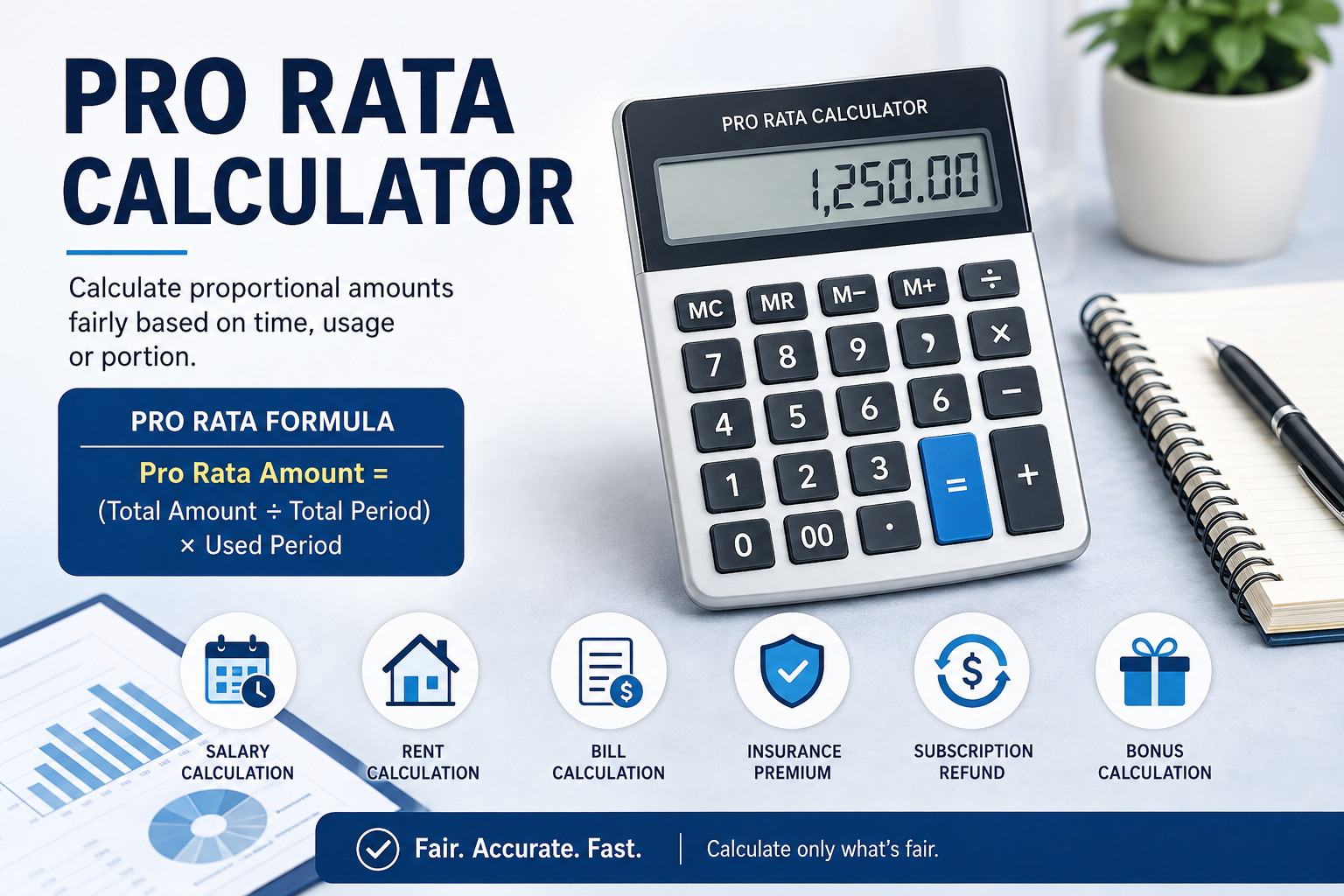
What Is a Pro Rata Calculator?
A Pro Rata Calculator is an online tool that calculates a proportional amount from a larger total based on the portion of time, quantity, usage, or entitlement involved. The phrase pro rata means "in proportion" or "according to the share." Instead of applying the full amount, a pro rata calculation determines the amount that corresponds to the part actually used or earned.
Pro rata calculations are common in payroll, rent, subscriptions, insurance, accounting, business expenses, bonuses, commissions, leave entitlements, utility bills and many other financial situations. For example, an employee who works only part of a pay period may receive a proportional salary rather than the full salary.
Our online Pro Rata Calculator makes this process easier by dividing the total amount by the total period and multiplying the resulting rate by the period used. This allows you to calculate partial amounts quickly without performing the calculation manually.
What Does Pro Rata Mean?
Pro rata is a Latin expression that refers to something being allocated proportionally. In financial calculations, it means that an amount is distributed according to a particular share, period, quantity, or percentage.
For example, suppose a service costs $300 for a 30-day period but is used for only 10 days. A simple pro rata calculation would determine the amount associated with those 10 days rather than charging the entire $300.
The same principle can be applied to salaries, rent, annual subscriptions, insurance premiums, employee benefits and other payments where the full period has not been completed.
How Does a Pro Rata Calculator Work?
A Pro Rata Calculator uses a straightforward proportional formula. You enter the total amount, the total period, and the portion of the period that has been used. The calculator then determines the amount corresponding to the used portion.
The basic process is:
- Enter the total amount.
- Enter the total period.
- Select the period type.
- Enter the used period.
- Choose the currency.
- Click the Calculate Pro Rata button.
The calculator then displays the proportional amount, rate per period, remaining amount, remaining period and used percentage.
Pro Rata Formula
The standard formula used for a simple time-based pro rata calculation is:
Where:
- Total Amount is the complete amount for the full period.
- Total Period is the complete number of days, weeks, months, years or hours.
- Used Period is the portion of the period that has been used.
- Pro Rata Amount is the proportional amount for the used period.
Pro Rata Calculation Example
Suppose an employee has a monthly salary of $6,000 and the salary period contains 30 days. If the employee worked for 18 days, the calculation would be:
Therefore, under this simple 30-day proportional method, the amount for 18 days would be $3,600.
Actual payroll calculations may use different rules depending on the employer, contract, jurisdiction, payroll policy and number of calendar or working days in the relevant period. The calculator is intended for general proportional calculations rather than a substitute for a specific payroll policy.
Pro Rata Salary Calculator
One of the most common uses of a Pro Rata Calculator is calculating a partial salary. Employees may start employment after the beginning of a pay period or leave before the end of a pay period. In such cases, a proportional calculation can help estimate the amount associated with the portion of the period worked.
For example, an employee earning $5,000 per month who works for only 15 days of a 30-day period would have a simple pro rata amount of $2,500 under the 30-day method.
However, payroll departments may use working days, calendar days, contractual rules, or other approved methods. Always check the applicable employment agreement and payroll policy when calculating an actual payment.
Pro Rata Rent Calculator
A Pro Rata Calculator can also be useful for partial rental periods. If a tenant moves into a property partway through the month, the landlord may need to calculate rent for only the occupied portion of the billing period.
For example, if monthly rent is $2,400 and the relevant period contains 30 days, the simple daily rate is:
If the property is occupied for 12 days, the proportional rent would be:
Rental agreements can specify their own proration method, so the actual amount charged should always be checked against the lease or rental agreement.
Pro Rata Subscription Refund Calculator
Subscription services may also use pro rata calculations when determining the value of unused service periods. For example, if an annual subscription costs $240 and the service is valued evenly over 12 months, the simple monthly value would be $20.
If five months remain unused, a simple proportional value would be:
The actual refund from a subscription provider may differ because companies can have cancellation policies, minimum terms, non-refundable fees, credits, taxes, or other contractual conditions.
Common Uses of a Pro Rata Calculator
1. Employee Salary
Employers can use proportional calculations to estimate salary amounts for employees who join or leave during a pay period. The applicable payroll method should be followed for actual payroll processing.
2. Rent
Landlords and tenants can use pro rata calculations to estimate partial rent when a tenancy begins or ends during a billing period.
3. Subscription Fees
A Pro Rata Calculator can estimate the value of a partial subscription period or unused service period.
4. Insurance Premiums
Proportional calculations can be used to estimate premiums for partial coverage periods or potential unused amounts, depending on the policy terms.
5. Employee Bonuses
Companies may calculate partial bonuses based on the amount of time an employee worked during a relevant bonus period.
6. Leave Entitlement
Employees joining partway through a year may have annual leave calculated proportionally according to company policy.
7. Utility Bills
Shared utility costs may sometimes be divided proportionally according to occupancy or another agreed allocation method.
8. Business Expenses
Businesses can use proportional calculations to allocate shared expenses across departments, projects or accounting periods.
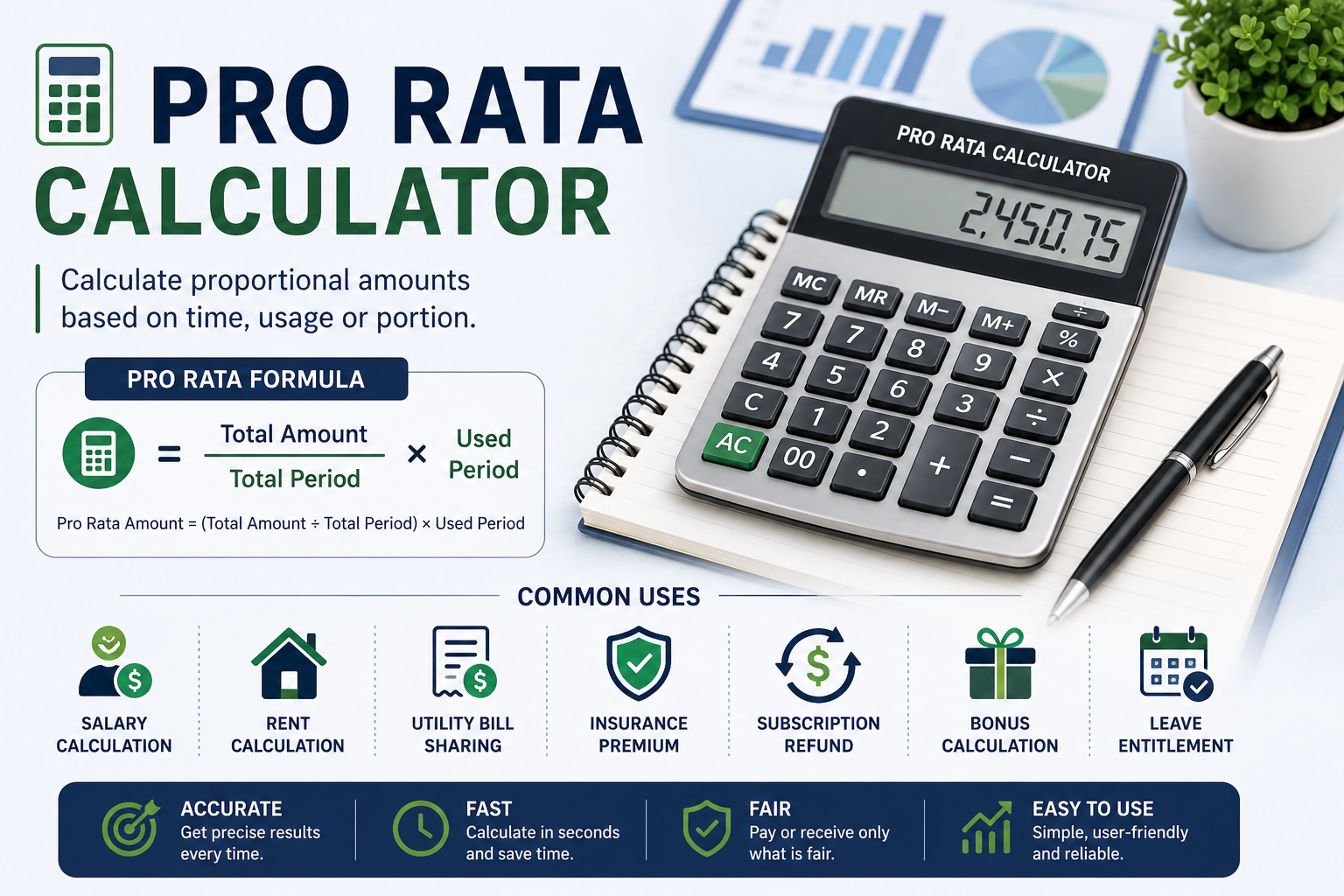
Pro Rata Daily Calculation
Daily pro rata calculations are useful when an amount needs to be allocated over a number of days. The basic daily rate is calculated by dividing the total amount by the total number of days.
The daily rate can then be multiplied by the number of days used to determine the proportional amount.
Pro Rata Monthly Calculation
Monthly pro rata calculations are often used for rent, subscriptions, salaries and recurring services. The calculation can be based on the number of months in the relevant period when the amount is distributed evenly across those months.
For example, an annual service costing $1,200 would have a simple monthly equivalent of $100 if the cost is evenly distributed across 12 months.
Pro Rata Yearly Calculation
Annual amounts can also be prorated when only part of the year is applicable. For example, a yearly membership, allowance, bonus or benefit may be allocated according to the number of months or days involved.
The exact method depends on the agreement or policy governing the payment. Some organizations use calendar days while others use months or another defined measurement period.
Pro Rata Weekly Calculation
Weekly pro rata calculations can be useful when an amount is based on a weekly contract or service. If a total amount covers several weeks, the amount can be divided by the total number of weeks and multiplied by the number of weeks used.
Pro Rata Hourly Calculation
Hourly pro rata calculations can be used when an amount is allocated across a defined number of hours. This can be useful for certain services, contracts, usage charges and other time-based calculations.
The hourly rate is calculated by dividing the total amount by the total number of hours and multiplying the result by the hours used.
Benefits of Using a Pro Rata Calculator
- Provides fast proportional calculations.
- Reduces manual arithmetic.
- Helps calculate partial salary amounts.
- Useful for partial rent calculations.
- Can estimate subscription values.
- Useful for business and personal calculations.
- Supports multiple currencies.
- Shows the rate per period.
- Displays the remaining amount.
- Shows the percentage of the period used.
- Works with days, weeks, months, years and hours.
Common Pro Rata Calculation Mistakes
Although the basic formula is simple, incorrect inputs can produce an incorrect result. Common mistakes include using the wrong total period, entering the wrong amount, mixing different time units, or using a proration method that does not match the applicable agreement.
Before using a result, check:
- The total amount is correct.
- The total period is correct.
- The used period is correct.
- The same type of period is used for both values.
- The currency is correct.
- The applicable contract or policy does not require another method.
Pro Rata vs Full Amount
A full amount applies to the entire agreed period, while a pro rata amount applies only to the relevant portion of that period. This distinction is important when a service, employment relationship, tenancy or other agreement starts or ends partway through a billing period.
For example, a $1,000 monthly charge may become a $500 proportional amount when exactly half of the relevant period is used, assuming the amount is distributed evenly and no other rules apply.
Who Can Use a Pro Rata Calculator?
A Pro Rata Calculator can be useful for a wide range of users, including:
- Employees
- Employers
- HR professionals
- Payroll teams
- Accountants
- Landlords
- Tenants
- Business owners
- Freelancers
- Property managers
- Subscription customers
- Students
Frequently Asked Questions About Pro Rata Calculators
1. What is a Pro Rata Calculator?
A Pro Rata Calculator is an online tool that calculates a proportional amount based on a total amount and the portion of time or quantity used. It can be used for salary, rent, subscriptions, bonuses, insurance and many other financial calculations.
2. What does pro rata mean?
Pro rata means "in proportion" or "according to the share." It means that an amount is allocated based on a particular proportion rather than applying the entire amount.
3. What is the pro rata formula?
The basic formula is: Pro Rata Amount = (Total Amount ÷ Total Period) × Used Period.
4. Can I use this calculator for salary?
Yes. The calculator can estimate a proportional salary amount when an employee works for only part of a defined salary period. Actual payroll rules may use calendar days, working days or another approved method.
5. Can I calculate pro rata rent?
Yes. You can use the calculator to estimate partial rent when a tenant occupies a property for only part of the relevant rental period.
6. Can this calculator calculate subscription refunds?
Yes. It can calculate a simple proportional value for an unused subscription period. The actual refund may differ depending on the provider's cancellation and refund policy.
7. Can I calculate a daily pro rata amount?
Yes. Select Days as the period type and enter the total number of days and the number of days used. The calculator will calculate the corresponding proportional amount.
8. Can I use months or years in the calculator?
Yes. The calculator supports days, weeks, months, years and hours. The calculation treats the selected period as the unit used for the proportional calculation.
9. Does the calculator support different currencies?
Yes. The calculator includes USD, CAD, GBP, EUR, AUD and INR currency symbols. The currency selection changes the displayed symbol but does not perform currency conversion.
10. Is a pro rata calculation always legally applicable?
No. A simple mathematical pro rata calculation does not automatically determine what an employer, landlord, insurer or service provider must legally charge or pay. Contracts, company policies, employment rules and local regulations may specify a different calculation method.
11. How do I calculate a pro rata salary?
Divide the full salary amount by the total number of units in the relevant period, such as days, and multiply the result by the number of units worked. The exact payroll method should match the applicable employment agreement and payroll policy.
12. What is the difference between pro rata and prorated?
The terms are closely related. "Pro rata" describes an allocation made in proportion, while "prorated" describes an amount that has been adjusted proportionally.
Conclusion
A Pro Rata Calculator is a useful tool for calculating partial amounts based on time, usage or another proportional measurement. It can simplify calculations involving salaries, rent, subscriptions, bonuses, insurance, leave, business expenses and many other situations.
The basic principle is straightforward: divide the total amount by the total period to find the rate, then multiply that rate by the portion used. This makes it possible to calculate a proportional amount quickly without performing repetitive manual calculations.
However, a mathematical pro rata result should not automatically be treated as the final amount for payroll, rent, insurance, tax or contractual purposes. Different organizations and agreements may use different proration methods. Always verify the applicable terms, policies and requirements before using a calculated amount for an actual financial transaction.