
Percentage Decrease Calculator
Use this free Percentage Decrease Calculator to find the amount decreased and the percentage decrease between an original value and a new value. Enter both values below to get an instant result with a detailed step-by-step calculation.
Percentage Decrease Formula
Percentage Decrease = ((Original Value − New Value) ÷ Original Value) × 100
How to Use This Calculator
- Enter the original value.
- Enter the new value.
- Click Calculate Percentage Decrease.
- View the amount decreased.
- See the percentage decrease.
- Review the step-by-step calculation.
What Is a Percentage Decrease Calculator?
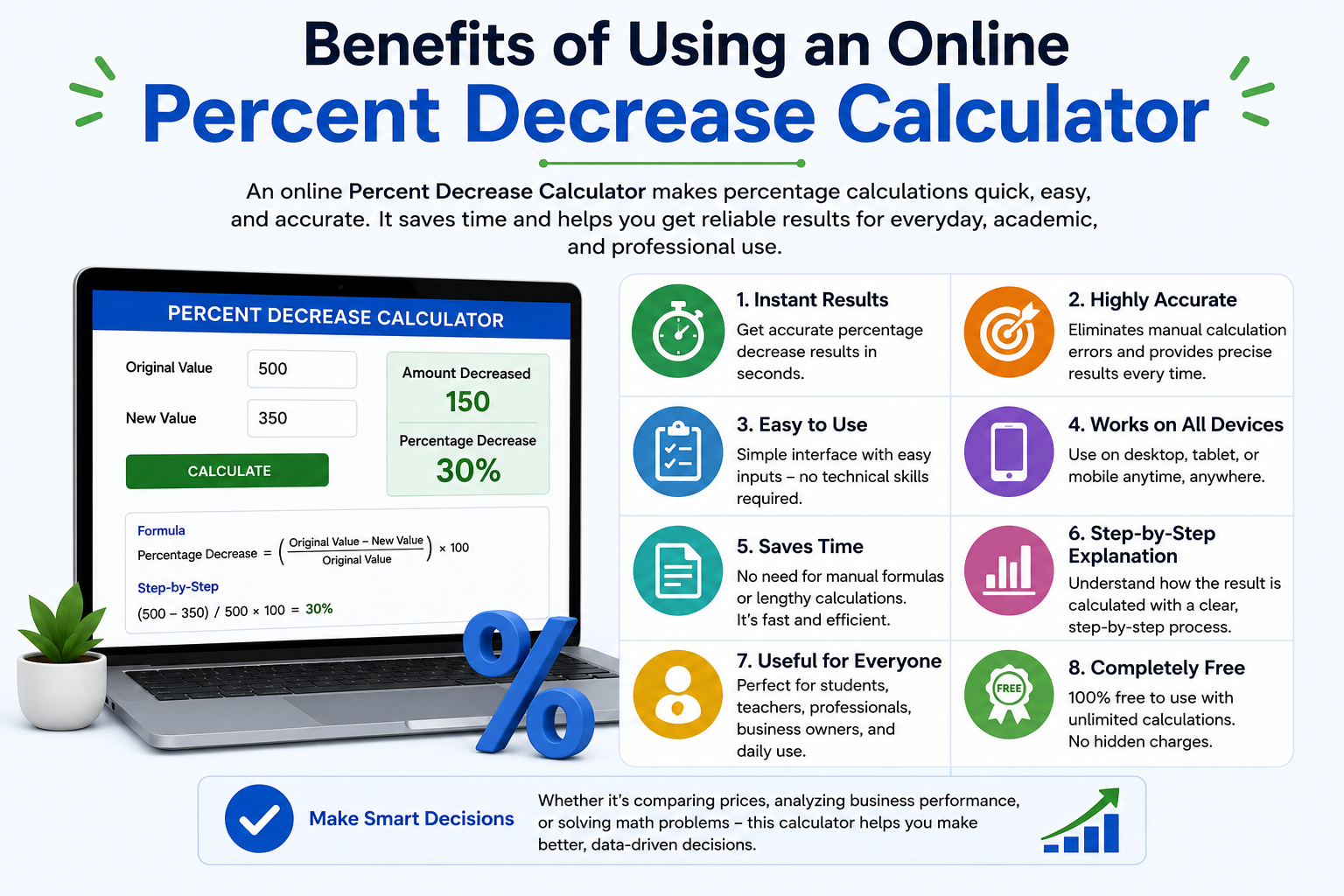
A Percentage Decrease Calculator is an online tool used to determine how much a value has decreased compared with its original value. Instead of working through the percentage formula manually, you can enter the original value and the new value to instantly find both the numerical decrease and the percentage decrease.
Percentage decrease is useful whenever a quantity becomes smaller. It can be used for changes in product prices, sales figures, business revenue, expenses, measurements, inventory, investment values, test results, and many other situations. Expressing a reduction as a percentage makes it easier to understand the size of the change relative to the starting value.
This calculator is designed to provide a simple result along with the calculation steps, making it useful for students, teachers, professionals, businesses, shoppers, and anyone who needs to compare two values.
What Does Percentage Decrease Mean?
Percentage decrease describes the reduction from an original value to a smaller new value. The calculation uses the original value as the reference point. This is important because the same numerical reduction can represent different percentages depending on the starting value.
For example, suppose a product price falls from $250 to $200. The numerical decrease is $50. Since $50 represents 20% of the original $250, the percentage decrease is 20%.
Percentage decrease therefore gives more context than the difference alone. A decrease of $50 may be significant for a small amount but relatively minor for a much larger amount.
Percentage Decrease Formula
The standard formula for calculating percentage decrease is:
Percentage Decrease = ((Original Value − New Value) ÷ Original Value) × 100
The formula contains three main parts. First, subtract the new value from the original value to find the amount of decrease. Next, divide that decrease by the original value. Finally, multiply by 100 to convert the decimal result into a percentage.
How to Calculate Percentage Decrease
You can calculate a percentage decrease manually by following these steps:
- Identify the original value.
- Identify the new value.
- Subtract the new value from the original value.
- Divide the amount decreased by the original value.
- Multiply the result by 100.
The important point is that the original value is used as the denominator. Using the new value instead will produce a different result and will not represent the standard percentage decrease.
Percentage Decrease Example
Suppose a laptop originally costs $1,000 and its price is reduced to $750.
Step 1: Find the amount decreased.
$1,000 − $750 = $250
Step 2: Divide the decrease by the original value.
$250 ÷ $1,000 = 0.25
Step 3: Convert the decimal into a percentage.
0.25 × 100 = 25%
Therefore, the laptop price has decreased by 25%.
Percentage Decrease vs. Percentage Difference
Percentage decrease and percentage difference are related concepts, but they are not always interchangeable. Percentage decrease specifically describes a reduction from an original value to a lower value and uses the original value as the reference point.
Percentage difference is generally used when comparing two values without designating one of them as the original or starting value. Therefore, when you are measuring a reduction from an old value to a new value, the percentage decrease formula is normally the appropriate calculation.
Percentage Decrease vs. Percentage Increase
A percentage decrease occurs when the new value is lower than the original value. A percentage increase occurs when the new value is higher than the original value.
| Calculation | Formula | When It Is Used |
|---|---|---|
| Percentage Decrease | ((Original − New) ÷ Original) × 100 | When the new value is lower |
| Percentage Increase | ((New − Original) ÷ Original) × 100 | When the new value is higher |
How to Use Our Percentage Decrease Calculator
Using this online calculator requires only two numbers. You do not need to remember the formula or perform the calculation manually.
- Enter the Original Value in the first field.
- Enter the New Value in the second field.
- Select Calculate Percentage Decrease.
- The calculator displays the amount decreased.
- The percentage decrease is displayed as a percentage.
- Review the step-by-step calculation to understand the result.
For a standard percentage decrease, the new value should be less than the original value. If the new value is equal to or greater than the original value, the calculation is not a percentage decrease.
Common Uses of Percentage Decrease
Percentage decrease calculations are useful in many everyday, academic, and professional situations.
Shopping and Discounts
Shoppers can use percentage decrease to determine how much a product price has fallen from its original price to a sale price. This can make it easier to compare discounts offered by different retailers.
Business and Sales
Businesses can calculate percentage decreases in sales, revenue, customer orders, inventory, production, or other performance measures. Comparing percentage changes can help identify trends over time.
Finance and Investments
Percentage decrease can be used to describe a fall in the value of an investment, stock, fund, or other financial figure. Investors may use percentage changes to compare movements across assets with different starting values.
Education and Mathematics
Percentage decrease is a common mathematics topic. Students may encounter it in classroom exercises, homework, tests, and practical word problems involving prices, quantities, measurements, and financial calculations.
Household Expenses
Percentage decrease can also be useful when comparing household expenses. For example, you can calculate the percentage reduction in a utility bill, monthly spending category, or other recurring cost.
Benefits of Using a Percentage Decrease Calculator
Calculating percentages manually is not difficult, but an online calculator can make repeated calculations much faster. This is particularly useful when you need to compare several pairs of values.
- Provides instant percentage decrease results.
- Calculates the numerical amount decreased.
- Shows the calculation steps clearly.
- Reduces the possibility of arithmetic mistakes.
- Works with decimal values.
- Useful for students and professionals.
- Works on desktop, tablet, and mobile devices.
- Requires no software installation.
- Free and easy to use.
Manual Calculation vs. Online Percentage Decrease Calculator
| Manual Calculation | Online Calculator |
|---|---|
| Formula must be applied manually. | Formula is applied automatically. |
| Requires additional arithmetic. | Provides results within seconds. |
| More opportunity for arithmetic errors. | Reduces calculation errors. |
| May take longer for repeated calculations. | Useful for repeated comparisons. |
| Steps must be written manually. | Step-by-step calculation can be displayed automatically. |
Common Mistakes When Calculating Percentage Decrease
Percentage calculations can produce incorrect results if the wrong reference value is used or if the formula is applied incorrectly. Some common mistakes include:
- Using the new value instead of the original value as the denominator.
- Confusing percentage decrease with percentage increase.
- Subtracting the values in the wrong order.
- Forgetting to multiply the decimal result by 100.
- Entering incorrect values into the calculator.
- Rounding the numbers too early.
- Comparing values that use different units.
Tips for Accurate Percentage Calculations
- Always identify the original value first.
- Use the original value as the denominator.
- Check that the new value is actually lower when calculating a decrease.
- Keep decimal places until the final result when working manually.
- Double-check the values entered into the calculator.
- Use consistent units when comparing measurements.
- Review the calculation steps if the result seems unexpected.
Who Can Use a Percentage Decrease Calculator?
This calculator can be useful for anyone who needs to measure a reduction between two values. Common users include:
- Students learning percentages.
- Teachers creating mathematics examples.
- Business owners reviewing sales data.
- Accountants and financial professionals.
- Shoppers comparing sale prices.
- Investors reviewing changes in asset values.
- Researchers and data analysts.
- Households comparing expenses.
- Anyone who needs a quick percentage calculation.
Why Is the Original Value Used in Percentage Decrease?
The original value represents the starting point of the comparison. Percentage decrease measures how large the reduction is relative to that starting point.
For example, if a value decreases from 200 to 150, the decrease is 50. Dividing 50 by the original value of 200 gives 0.25, or 25%. The result tells us that the reduction represents one-quarter of the original value.
Using the original value keeps the calculation consistent and is the standard approach for expressing a decrease from a starting amount.
Can Percentage Decrease Be More Than 100%?
Under the standard definition of percentage decrease between a non-negative original value and a non-negative new value, a decrease from a positive original value to zero is 100%. A value cannot become less than zero in many ordinary real-world contexts, so a standard percentage decrease will generally not exceed 100%.
Different mathematical contexts, especially those involving signed values or specialized financial measures, may require a different interpretation. For ordinary price, quantity, measurement, or expense comparisons, the standard formula is appropriate.
Frequently Asked Questions About Percentage Decrease
1. What is a Percentage Decrease Calculator?
A Percentage Decrease Calculator is an online tool that determines how much a value has decreased compared with its original value. It calculates both the numerical amount decreased and the percentage decrease.
2. What is the formula for percentage decrease?
The standard formula is ((Original Value − New Value) ÷ Original Value) × 100. The original value is used as the reference point for measuring the reduction.
3. How do I calculate a percentage decrease?
Subtract the new value from the original value, divide the result by the original value, and multiply by 100. For example, a decrease from 500 to 400 is a decrease of 100, which equals 20% of the original 500.
4. What is the difference between percentage decrease and percentage increase?
Percentage decrease measures a reduction when the new value is lower than the original value. Percentage increase measures growth when the new value is higher than the original value.
5. Can I use decimal values in this calculator?
Yes. The calculator supports decimal values, so you can enter numbers such as 125.50, 99.75, or 42.5 when needed.
6. What happens if the new value is greater than the original value?
If the new value is greater than the original value, the result represents an increase rather than a decrease. This calculator is specifically designed for situations where the new value is lower than the original value.
7. What happens if the new value is equal to the original value?
If both values are the same, there is no decrease. The percentage change is 0%.
8. Can this calculator be used for discounts?
Yes. You can enter the original price as the original value and the sale price as the new value to determine the percentage decrease in price.
9. Can I use this calculator for business calculations?
Yes. It can be used to compare reductions in sales, revenue, expenses, inventory, production figures, or other numerical business measurements.
10. Is the Percentage Decrease Calculator free to use?
Yes. This online calculator is designed as a free tool for quick percentage decrease calculations without requiring software installation or registration.
Conclusion
A Percentage Decrease Calculator provides a quick and convenient way to determine how much a value has decreased compared with its original amount. By entering the original value and the new value, you can instantly find both the numerical decrease and the percentage decrease.
The standard percentage decrease formula uses the original value as the reference point, which makes it possible to understand the reduction in relative terms rather than simply looking at the numerical difference. This is useful for comparing prices, discounts, expenses, sales, investments, measurements, and many other types of data.
Whether you are a student learning percentages, a shopper comparing discounts, a business owner reviewing performance, or simply checking a change between two values, this calculator can save time and reduce the possibility of manual arithmetic errors. The included step-by-step calculation also makes the result easier to understand.
Use the calculator whenever you need a fast and clear percentage decrease calculation, and bookmark this page for future percentage calculations.