Percentage Calculator
Use this free Percentage Calculator to calculate percentages quickly and accurately. Find a percentage of a number, work out what percentage one value is of another, calculate a percentage increase or decrease, and compare changes between two values.
Whether you are checking shopping discounts in Canada, comparing prices in Canadian dollars, calculating school grades, or reviewing household expenses, this online percentage calculator gives you the result and shows the formula used.
Calculate Your Percentage
Choose a calculation type, enter your numbers and click Calculate.
What Is a Percentage Calculator?
A percentage calculator is an online tool that helps you express a value as a fraction of 100 or calculate an amount based on a percentage. The word percent means “per hundred.” For example, 25% means 25 out of every 100, while 50% represents one-half.
Percentages make it easier to compare values of different sizes. Students can calculate test scores, shoppers can work out sale discounts, and households can compare changes in monthly bills. A percentage calculator performs these calculations without requiring you to work through every equation manually.
How to Use This Percentage Calculator
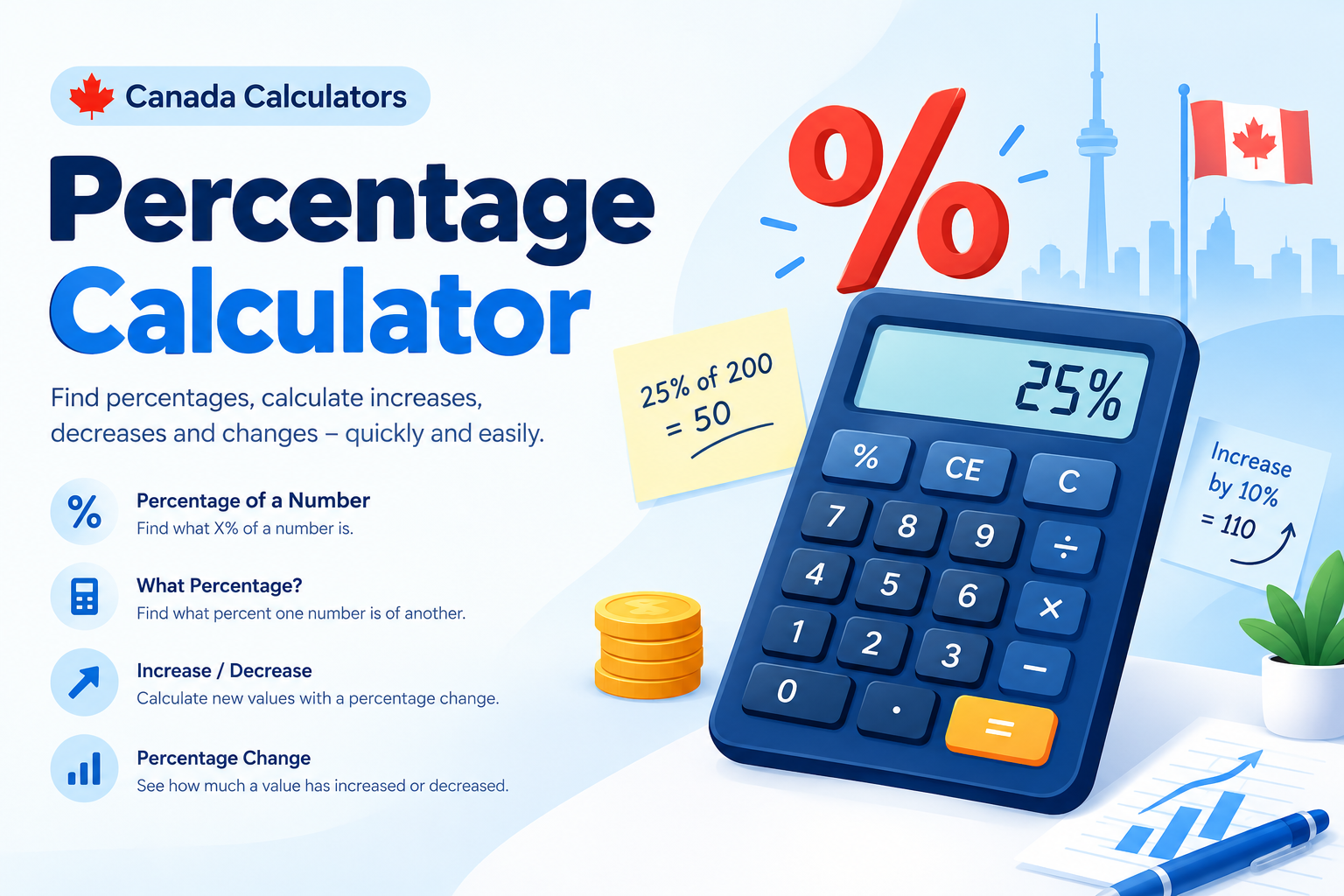
- Select a calculation type: Choose percentage of a number, percentage comparison, increase, decrease or percentage change.
- Enter your first value: Type the percentage or starting value requested by the selected calculation.
- Enter your second value: Fill in the remaining number. The input labels update automatically.
- Click Calculate: View your answer and the calculation steps.
- Click Reset: Clear both inputs and start a new calculation.
Types of Percentage Calculations
1. Percentage of a Number
Use this method when you know a percentage and a total but need to calculate the corresponding amount. It is useful for discounts, tips, budgets and calculating a portion of a total.
Formula: Percentage Amount = (Percentage ÷ 100) × Total
Example: What is 15% of $200?
(15 ÷ 100) × 200 = 30. Therefore, 15% of $200 is $30.
2. What Percentage Is One Number of Another?
This calculation shows what proportion one number represents compared with a total. It can help with exam marks, survey results, budgets and progress reports.
Formula: Percentage = (Part ÷ Whole) × 100
Example: You answer 42 questions correctly out of 60.
(42 ÷ 60) × 100 = 70%. Your score is 70%.
3. Percentage Increase
A percentage increase measures how much a value rises relative to its original amount. It can help you compare price increases, higher monthly expenses or sales growth.
Formula: New Value = Original Value × (1 + Percentage ÷ 100)
Example: A monthly expense of $400 increases by 10%.
Increase = $400 × 10 ÷ 100 = $40. New amount = $400 + $40 = $440.
4. Percentage Decrease
A percentage decrease shows how much a value falls compared with its original amount. It is particularly useful for sale prices, reduced expenses and falling sales.
Formula: New Value = Original Value × (1 − Percentage ÷ 100)
Example: An item priced at $120 receives a 25% discount.
Discount = $120 × 25 ÷ 100 = $30. Sale price = $120 − $30 = $90.
5. Percentage Change Between Two Values
Use percentage change when you know an original value and a new value. A positive result indicates an increase, while a negative result indicates a decrease. The original value must not be zero.
Formula: Percentage Change = ((New Value − Original Value) ÷ Original Value) × 100
Example: A bill increases from $250 to $300.
((300 − 250) ÷ 250) × 100 = 20%. The bill increased by 20%.
Percentage Formula Reference Table
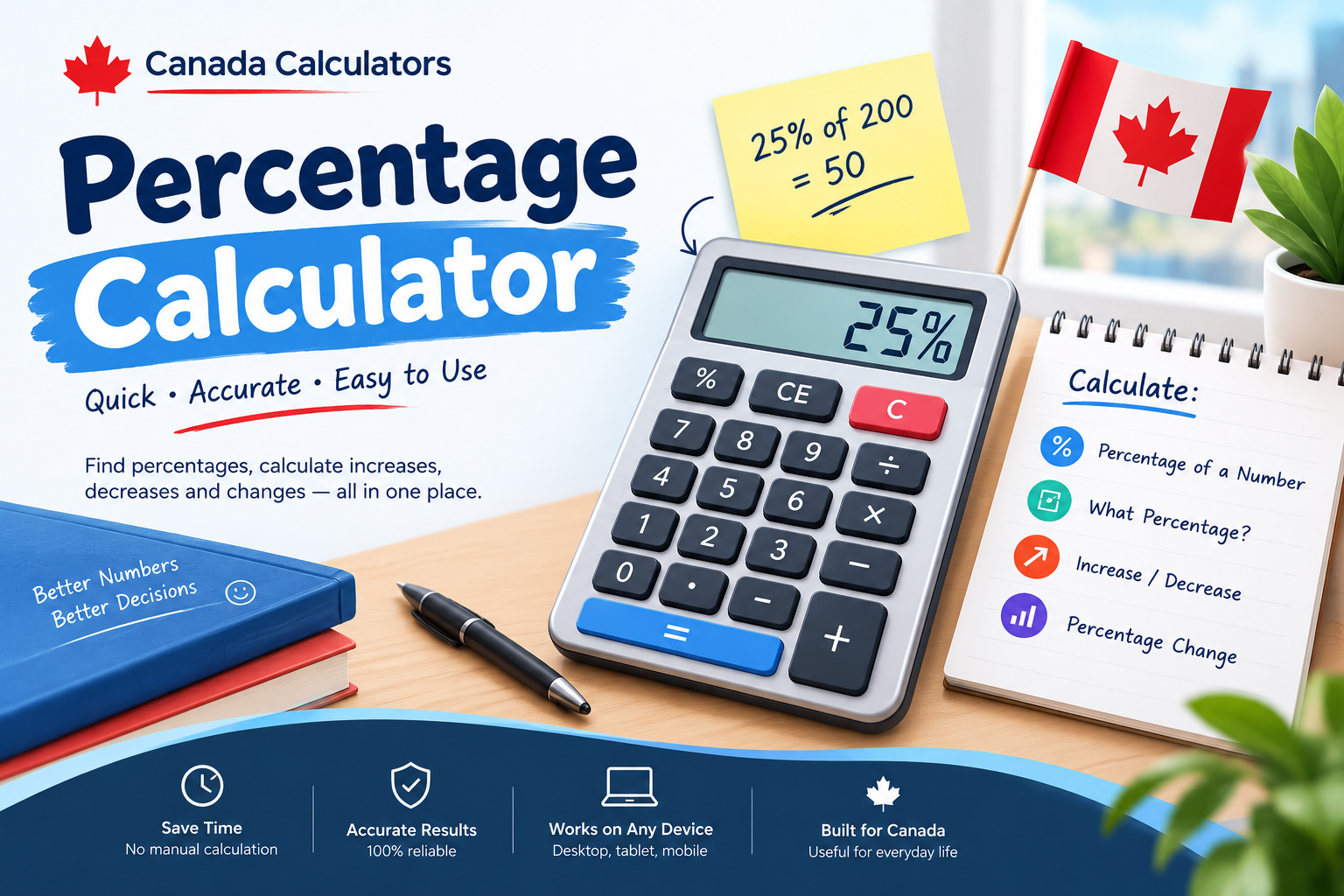
| Calculation | Formula | Example |
|---|---|---|
| Percentage of a number | (X ÷ 100) × Y | 20% of 150 = 30 |
| Find what percentage | (Part ÷ Whole) × 100 | 30 of 150 = 20% |
| Increase by a percentage | Original × (1 + X ÷ 100) | 100 increased by 20% = 120 |
| Decrease by a percentage | Original × (1 − X ÷ 100) | 100 decreased by 20% = 80 |
| Percentage change | ((New − Old) ÷ Old) × 100 | 100 to 120 = 20% increase |
Where Are Percentages Used in Canada?
Shopping Discounts and Sale Prices
Percentages help shoppers calculate savings during sales. For example, a 30% discount on a $100 item saves $30 before applicable taxes and additional charges. The final amount payable may differ depending on taxes and store conditions.
School Grades and Test Results
Students can convert marks into percentages to understand their performance. Divide the marks earned by the total possible marks and multiply by 100. For example, 36 marks out of 45 equals 80%.
Household Budgets and Expenses
Percentage calculations can show how much of a household budget goes toward groceries, rent, transportation or utilities. Comparing monthly spending as percentages can help identify changes in expenses.
Taxes and Financial Planning
Percentages are useful for understanding rates and comparing financial figures. Canadian sales taxes and income taxes depend on the applicable rules and circumstances. This general-purpose calculator does not determine official tax liability or replace a dedicated Canadian tax calculator.
Business and Sales
Businesses use percentage calculations to review revenue growth, compare expenses and understand profit margins. Always use the appropriate original value when calculating percentage increases or decreases.
Common Percentage Calculation Mistakes
- Using the wrong base: Percentage change is normally measured against the original value.
- Confusing an amount with a percentage: A $20 discount is not necessarily a 20% discount. The original price determines the percentage.
- Mixing up increase and decrease: Increasing a number by 20% and then decreasing it by 20% will not return it to its original value.
- Ignoring zero: Percentage change from an original value of zero is undefined because division by zero is not possible.
- Rounding too early: Keep sufficient decimal places during calculations and round the final answer when appropriate.
Frequently Asked Questions
1. What is the easiest way to calculate a percentage?
Divide the percentage by 100 and multiply the result by the number. For example, 25% of 80 is 0.25 × 80 = 20.
2. How do I calculate what percentage one number is of another?
Divide the part by the whole and multiply by 100. For example, 15 out of 60 is (15 ÷ 60) × 100 = 25%.
3. How do I calculate a percentage increase?
Subtract the original value from the new value, divide the difference by the original value and multiply by 100. A change from 80 to 100 is a 25% increase.
4. How do I calculate a percentage decrease?
Subtract the new value from the original value, divide the difference by the original value and multiply by 100. A reduction from 200 to 150 is a 25% decrease.
5. Can I use this Percentage Calculator for Canadian dollars?
Yes. Enter the numerical amount in Canadian dollars or another unit. The calculator performs the mathematical calculation but does not automatically add taxes or currency conversions.
6. What is the difference between a percentage and a percentage point?
A percentage point measures the direct difference between two percentage rates. For example, a rate rising from 10% to 12% increases by 2 percentage points, equivalent to a 20% relative increase.
7. Can a percentage be greater than 100%?
Yes. A percentage can exceed 100% when the part is larger than the reference amount. For example, 150 out of 100 equals 150%.
8. Why can't I calculate percentage change from zero?
The standard percentage change formula divides the difference by the original value. When the original value is zero, division by zero is undefined, so the standard percentage change cannot be calculated.
Conclusion
Percentages are useful for comparing values, calculating discounts, understanding school results and reviewing changes in everyday expenses. The key is to choose the correct calculation for the question you are asking.
Use the free Percentage Calculator above to find a percentage of a number, compare a part with a total, calculate an increase or decrease, or measure percentage change between two values. The displayed working helps you understand how each answer is calculated.