
Percent Decrease Calculator
Calculate the amount decreased and percentage decrease between an original value and a new value.
Your Result
| Original Value | |
|---|---|
| New Value | |
| Amount Decreased | |
| Percentage Decrease |
Step-by-Step Calculation
A Percent Decrease Calculator is a free online tool that helps you determine how much a value has decreased compared with its original value. By entering the original value and the new value, you can quickly calculate both the actual amount decreased and the percentage decrease.
Percentage decrease is useful whenever you need to compare a higher starting value with a lower final value. It is commonly used for price reductions, discounts, business expenses, sales figures, financial analysis, measurements, statistics, and mathematics problems.
Instead of calculating the percentage manually each time, this calculator provides an instant result along with the calculation steps so you can understand how the answer was obtained.
What Is a Percent Decrease Calculator?
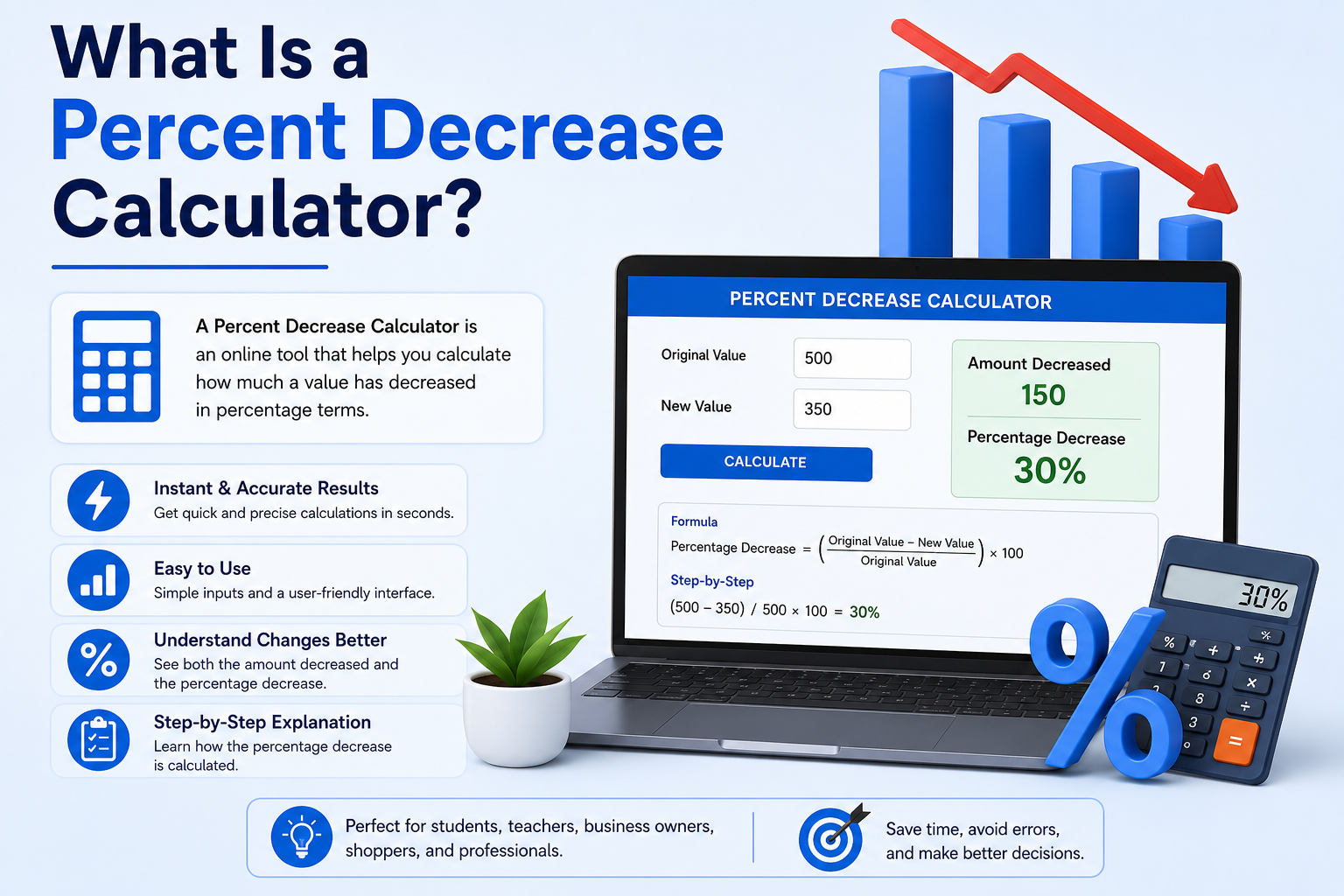
A Percent Decrease Calculator determines the percentage by which a value has gone down from its original amount. The calculator compares the starting value with the new value and expresses the reduction as a percentage of the original value.
For example, if an item originally costs $100 and its price falls to $80, the amount decreased is $20. Since $20 represents 20% of the original $100, the percentage decrease is 20%.
The important point is that the original value is used as the reference value. This makes percentage decrease different from simply subtracting one number from another.
What Is Percentage Decrease?
Percentage decrease describes the relative reduction between an original value and a lower new value. It tells you how large the reduction is compared with where the value started.
The calculation can be useful when the actual difference alone does not provide enough context. For example, a $20 decrease could be small for a $1,000 item but significant for a $50 item. Expressing both changes as percentages makes comparisons easier.
Percent Decrease Formula
The standard formula for percentage decrease is:
The formula has three main parts. First, subtract the new value from the original value to find the amount of the decrease. Next, divide the decrease by the original value. Finally, multiply the result by 100 to convert it into a percentage.
Amount Decreased Formula
The amount decreased tells you the numerical difference between the two values, while the percentage decrease tells you the relative size of that difference.
How to Calculate Percentage Decrease
You can calculate a percentage decrease manually by following these steps:
- Identify the original value.
- Identify the new value.
- Subtract the new value from the original value.
- Divide the decrease by the original value.
- Multiply the result by 100.
For example, suppose a product's price changes from $1,200 to $900.
Step 1: Find the decrease
$1,200 − $900 = $300
Step 2: Divide by the original value
$300 ÷ $1,200 = 0.25
Step 3: Convert to a percentage
0.25 × 100 = 25%
Therefore, the price decreased by 25%.
Percentage Decrease Example
Consider a monthly expense that decreases from $500 to $350.
The amount decreased is:
$500 − $350 = $150
Now divide the decrease by the original value:
$150 ÷ $500 = 0.30
Convert the decimal into a percentage:
0.30 × 100 = 30%
Therefore, the expense decreased by $150, which is a 30% decrease.
Percentage Decrease vs. Percentage Increase
Percentage decrease and percentage increase both measure changes between two values, but they describe opposite directions.
| Percentage Decrease | Percentage Increase |
|---|---|
| The new value is lower than the original value. | The new value is higher than the original value. |
| Measures a reduction. | Measures growth. |
| Uses Original − New. | Uses New − Original. |
For a percentage decrease, the new value must normally be lower than the original value. If the new value is greater than the original value, the change is an increase rather than a decrease.
Where Is Percentage Decrease Used?
Percentage decrease is a practical mathematical concept used in many areas of everyday life and professional work.
Shopping and Discounts
Shoppers can use percentage decrease calculations to understand price reductions. If a product's original price is known along with its sale price, the percentage decrease shows the size of the discount relative to the original price.
Business and Sales
Businesses use percentage decreases to monitor changes in sales, revenue, production, inventory, operating costs, and customer demand. Comparing percentage changes can make business reports easier to interpret.
Personal Budgeting
Percentage decrease can help people compare changes in household expenses, subscriptions, utility costs, transportation expenses, and other recurring payments.
Finance and Investments
Percentage changes are commonly used when reviewing financial figures and investment values. A percentage decrease can describe how much a value has fallen compared with its previous level.
Education
Students regularly encounter percentage decrease problems in mathematics, economics, business studies, and statistics. The calculator can be used to check calculations and understand the formula.
Science and Data Analysis
Researchers and analysts may use percentage decreases when comparing measurements, experimental results, quantities, or other numerical data over different periods.
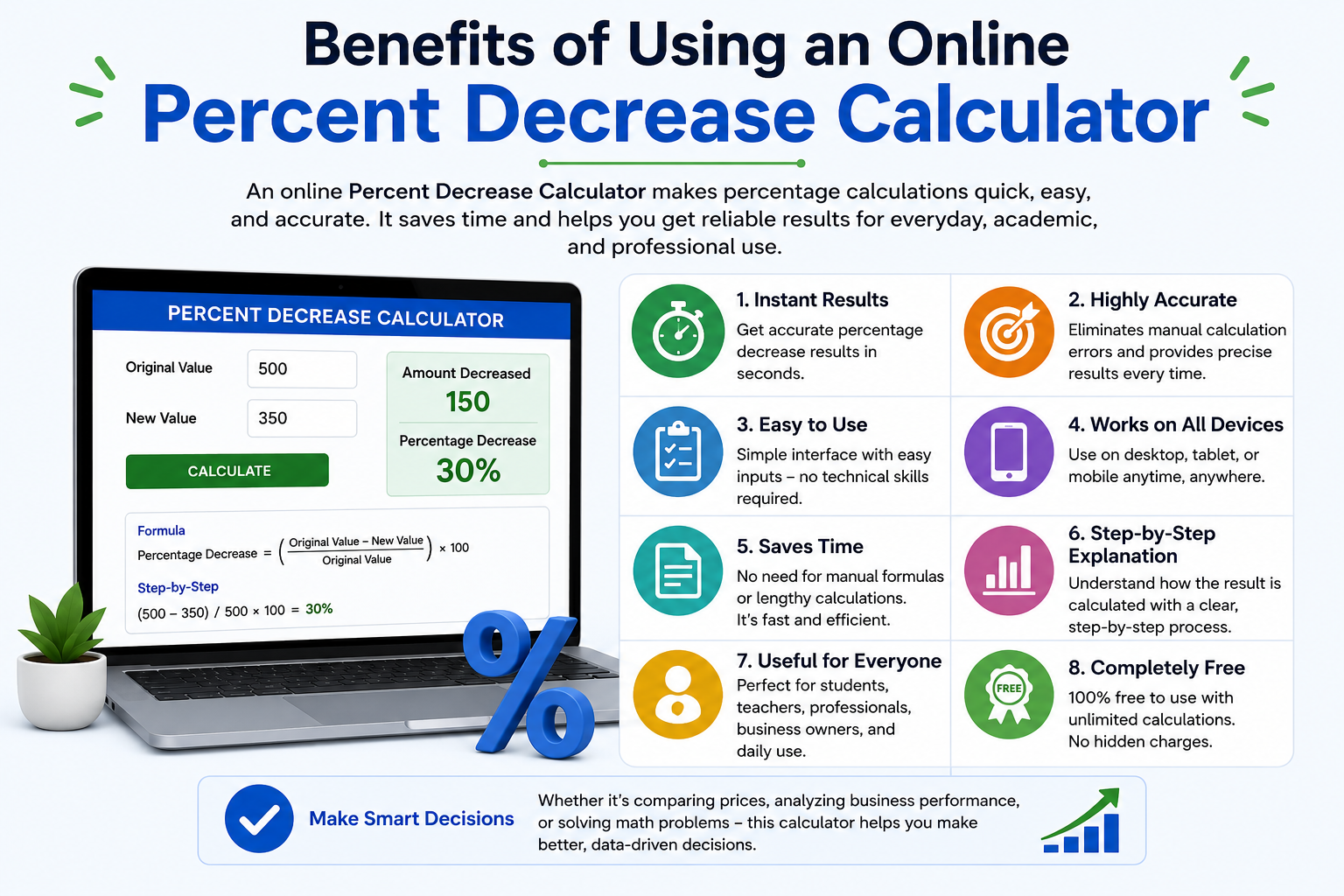
Benefits of Using an Online Percent Decrease Calculator
An online calculator makes percentage calculations faster and easier. Instead of repeatedly writing out the formula, you can enter two values and receive the result immediately.
- Provides instant percentage decrease calculations.
- Shows the amount decreased.
- Displays the percentage decrease clearly.
- Provides a step-by-step calculation.
- Reduces common arithmetic mistakes.
- Works with decimal values.
- Easy to use on computers, tablets, and smartphones.
- Useful for education, business, shopping, and personal calculations.
- Free to use without registration.
Common Mistakes When Calculating Percentage Decrease
Percentage calculations are simple, but a few common mistakes can lead to incorrect results.
Using the New Value as the Denominator
One of the most common mistakes is dividing the decrease by the new value. For a standard percentage decrease calculation, the decrease is divided by the original value.
Forgetting to Multiply by 100
Dividing the decrease by the original value produces a decimal. Multiplying that decimal by 100 converts it into a percentage.
Confusing Decrease With Increase
If the new value is greater than the original value, the change is an increase, not a decrease. Always compare the two values before applying the formula.
Rounding Too Early
Rounding intermediate calculations too early can slightly change the final result. When precision matters, keep additional decimal places during the calculation and round only the final answer.
Tips for Accurate Percentage Decrease Calculations
- Always identify the original value first.
- Make sure the new value is lower when calculating a decrease.
- Use the original value as the denominator.
- Keep the same units for both values.
- Avoid unnecessary rounding during intermediate steps.
- Double-check the numbers before calculating.
- Use an online calculator when performing repeated calculations.
Who Can Use This Percent Decrease Calculator?
This calculator is designed for anyone who needs to compare a starting value with a lower value. It can be particularly useful for:
- Students working on percentage problems.
- Teachers creating mathematics examples.
- Shoppers comparing discounts.
- Business owners reviewing sales and expenses.
- Professionals working with numerical reports.
- Researchers comparing measurements.
- People tracking personal expenses.
- Anyone who needs a quick percentage decrease calculation.
Does a Larger Numerical Decrease Always Mean a Larger Percentage Decrease?
No. The percentage decrease depends on both the amount of the decrease and the original value.
For example, a decrease of $50 from $100 represents a 50% decrease. However, a decrease of $50 from $1,000 represents only a 5% decrease.
This is why percentage calculations are useful when comparing changes involving different starting values.
Why Is the Original Value Important?
The original value provides the reference point for a percentage decrease. A percentage tells you how large the change is relative to the value from which the change began.
For example, reducing a price from $200 to $150 means a $50 decrease. Dividing $50 by the original $200 gives 0.25, or 25%. If the same $50 reduction occurred from a different starting price, the percentage would be different.
Frequently Asked Questions
1. What is a Percent Decrease Calculator?
A Percent Decrease Calculator is an online tool that determines how much a value has decreased compared with its original value. It can calculate both the numerical amount decreased and the percentage decrease.
2. What is the formula for percentage decrease?
The standard formula is ((Original Value − New Value) ÷ Original Value) × 100. The result expresses the reduction as a percentage of the original value.
3. How do I calculate a 20% decrease?
To reduce a value by 20%, multiply the original value by 0.80. For example, a 20% decrease from $100 results in $80. If you have the original and new values, you can also use the percentage decrease formula directly.
4. What is the difference between amount decreased and percentage decrease?
The amount decreased is the numerical difference between the original and new values. Percentage decrease expresses that difference relative to the original value.
5. Can percentage decrease be more than 100%?
Under the standard formula with a positive original value and a non-negative new value, a decrease from the original value down to zero reaches 100%. A value cannot normally decrease by more than 100% below a positive starting value.
6. What happens if the new value is higher than the original value?
If the new value is higher than the original value, the change is a percentage increase rather than a percentage decrease. This calculator is intended for situations where the new value is lower than the original value.
7. Can I enter decimal values?
Yes. The calculator accepts decimal values, which makes it suitable for prices, measurements, financial figures, and other calculations that are not whole numbers.
8. Why is the original value used in the formula?
The original value is used as the reference point because percentage decrease measures the reduction relative to where the value started.
9. Can I use this calculator for price discounts?
Yes. If you know the original price and the discounted price, you can use the calculator to determine the amount of the price reduction and the percentage decrease.
10. Is this Percent Decrease Calculator free?
Yes. This online Percent Decrease Calculator is designed as a free tool for quick percentage calculations without requiring registration.
Conclusion
A Percent Decrease Calculator provides a quick and convenient way to measure how much a value has decreased from its original amount. By entering the original value and the new value, you can instantly determine both the amount decreased and the percentage decrease.
Percentage decrease calculations are useful in many situations, including shopping discounts, business analysis, budgeting, financial comparisons, education, scientific research, and everyday decision-making. Understanding the difference between the numerical decrease and the percentage decrease also makes it easier to compare changes between values of different sizes.
This calculator uses the standard percentage decrease formula and provides a step-by-step calculation so you can see how the result is determined. Whether you are solving a math problem, checking a discount, comparing expenses, or analyzing numerical data, it offers a simple way to calculate percentage decreases accurately.