
Payroll Deductions Online Calculator Canada
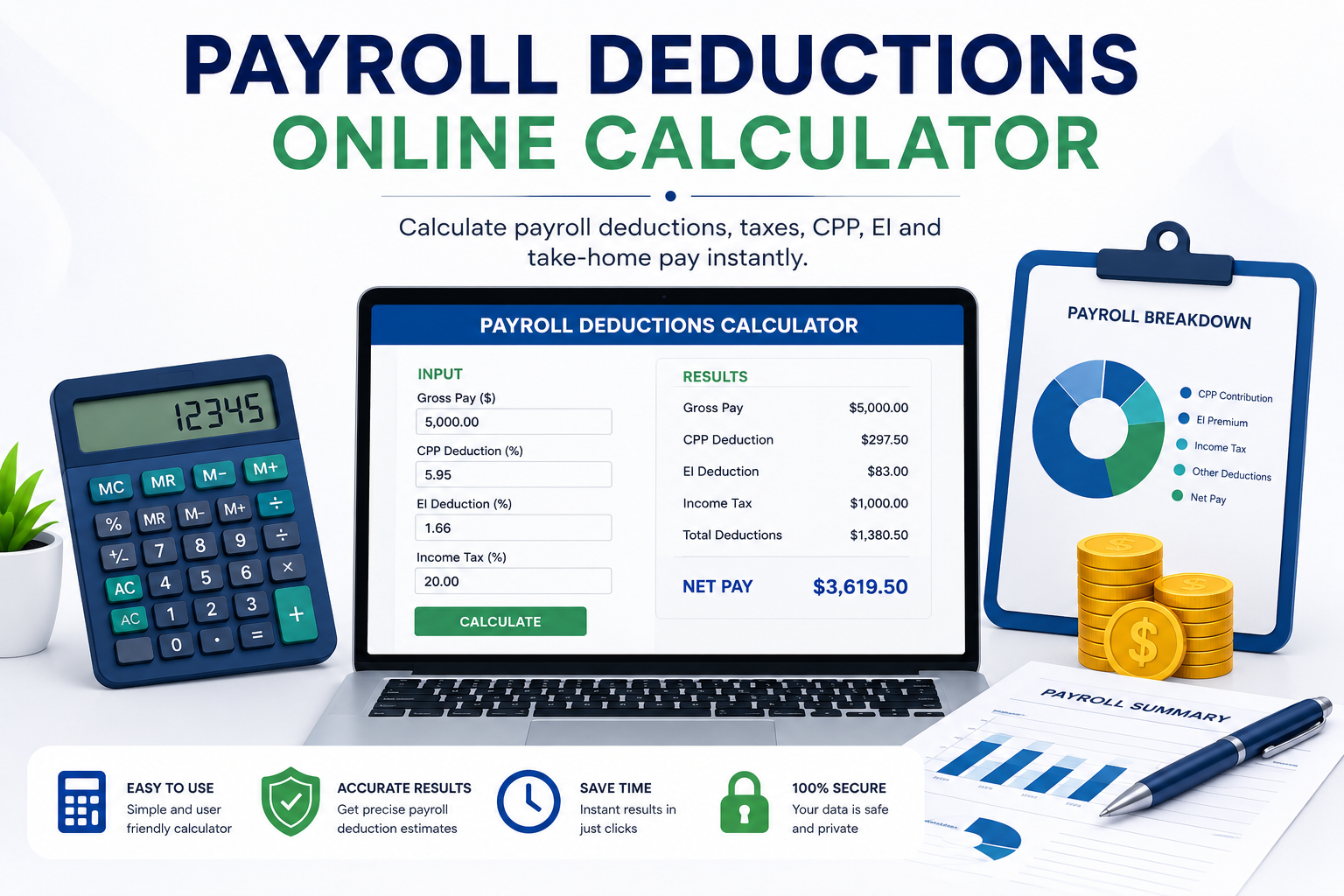
Estimate your payroll deductions and take-home pay using your gross pay, CPP rate, EI rate, and estimated income tax rate. This calculator provides a quick estimate for Canadian employees and is not a replacement for the official CRA Payroll Deductions Online Calculator.
Payroll Deductions Calculator
Payroll Deduction Results
| Payroll Item | Estimated Amount |
|---|---|
| Gross Pay | $0.00 |
| CPP Deduction | $0.00 |
| EI Deduction | $0.00 |
| Income Tax | $0.00 |
| Other Deductions | $0.00 |
| Total Deductions | $0.00 |
What Is a Payroll Deductions Online Calculator?
A Payroll Deductions Online Calculator is a convenient tool that helps employees estimate how much of their gross earnings may be deducted before they receive their take-home pay. Payroll deductions in Canada can include Canada Pension Plan (CPP) contributions, Employment Insurance (EI) premiums, income tax, and other deductions such as benefits, pension contributions, union dues, or workplace plans.
The calculator above provides a simple estimate based on the information entered by the user. It is designed to make payroll calculations easier to understand without requiring complicated manual calculations.
For official payroll calculations, the Canada Revenue Agency provides the Payroll Deductions Online Calculator (PDOC), which takes additional payroll information into account. CRA states that its PDOC can calculate federal, provincial, and territorial payroll deductions, except for Quebec. :contentReference[oaicite:2]{index=2}
How Does Payroll Deduction Calculation Work?
A basic payroll deduction estimate starts with gross pay. Individual deductions are then estimated using the applicable deduction rates. The total estimated deductions are subtracted from gross pay to arrive at estimated net pay.
CPP Deduction = Gross Pay × CPP Rate ÷ 100
EI Deduction = Gross Pay × EI Rate ÷ 100
Income Tax = Gross Pay × Estimated Tax Rate ÷ 100
Total Deductions = CPP + EI + Income Tax + Other Deductions
Net Pay = Gross Pay − Total Deductions
This simplified method is useful for an estimate, but Canadian payroll calculations can be more detailed than a simple percentage calculation. Actual CPP and EI deductions can be affected by annual maximums and other CRA rules.
CPP Payroll Deduction in Canada
The Canada Pension Plan (CPP) is one of the main payroll deductions for eligible employees in Canada. CPP contributions help fund benefits under the Canada Pension Plan.
For 2026, the CRA lists a combined employee and employer CPP contribution rate of 5.95% for the base and first additional CPP contribution. The 2026 Year’s Maximum Pensionable Earnings is $74,600 and the basic exemption is $3,500. The maximum employee contribution for the standard CPP contribution is $4,230.45. :contentReference[oaicite:3]{index=3}
The actual amount deducted from an employee's paycheque depends on pensionable earnings and the employee's position within the annual contribution limits. CPP2 may also apply to earnings in the additional pensionable earnings range. :contentReference[oaicite:4]{index=4}
EI Payroll Deduction in Canada
Employment Insurance (EI) premiums are another common payroll deduction. Eligible employees generally contribute EI premiums on insurable earnings, while employers also contribute.
For 2026, the employee EI premium rate outside Quebec is 1.63%, with maximum annual insurable earnings of $68,900 and a maximum annual employee premium of $1,123.07. :contentReference[oaicite:5]{index=5}
Because EI deductions stop once the applicable annual maximum is reached, simply multiplying every paycheque by the EI percentage may not reproduce an actual CRA payroll calculation throughout the entire year.
Income Tax Payroll Deduction
Income tax is normally withheld from employment income throughout the year. The actual amount can depend on taxable income, federal and provincial or territorial tax rates, tax credits, TD1 information, payroll frequency, and other factors.
For this reason, the calculator uses an estimated income tax percentage rather than attempting to reproduce the complete CRA income tax formula. Users can change the percentage to create a simple take-home-pay estimate.
Provincial Payroll Deductions in Canada
Payroll deductions can vary depending on the province or territory where the employee is employed. Federal income tax rules apply across Canada, while provincial and territorial income tax systems can differ.
CRA publishes payroll deduction tables for different provinces and territories and updates its payroll information as rates and amounts change. :contentReference[oaicite:6]{index=6}
Quebec is a special case because the province administers its own provincial income tax, Quebec Pension Plan (QPP), and Quebec Parental Insurance Plan (QPIP). CRA directs users to Revenu Québec's WebRAS for Quebec provincial payroll deductions. :contentReference[oaicite:7]{index=7}

What Is Gross Pay?
Gross pay is the amount an employee earns before payroll deductions are subtracted. Depending on the employee's compensation structure, gross pay can include regular wages, salary, overtime, commissions, bonuses, or other taxable employment income.
For example, if an employee earns $2,500 before deductions, $2,500 represents the gross amount for that calculation period. CPP, EI, income tax, and any other applicable deductions can then reduce the amount ultimately received by the employee.
What Is Net Pay?
Net pay is the amount that remains after applicable payroll deductions have been subtracted from gross earnings. It is commonly called take-home pay because it is the amount an employee receives after deductions.
Knowing the difference between gross pay and net pay is useful when planning a household budget, comparing employment offers, estimating monthly cash flow, or reviewing a pay stub.
Common Payroll Deductions in Canada
Depending on the employee and employer, payroll deductions may include:
- Canada Pension Plan (CPP) contributions
- Employment Insurance (EI) premiums
- Federal income tax
- Provincial or territorial income tax
- Registered pension plan contributions
- Employer benefit premiums
- Health and dental plan deductions
- Union dues
- Life insurance premiums
- Other authorized workplace deductions
How to Use the Payroll Deductions Online Calculator
- Enter your gross pay for the selected pay period.
- Select your pay frequency.
- Enter the applicable CPP deduction rate.
- Enter the EI deduction rate.
- Enter an estimated income tax percentage.
- Add other deductions if applicable.
- Click Calculate Payroll Deductions.
- Review the estimated deductions and net pay.
Why Use a Payroll Deductions Calculator?
- Estimate take-home pay quickly.
- Understand the difference between gross and net pay.
- Plan a personal or household budget.
- Compare different salary amounts.
- Understand common payroll deductions.
- Estimate the effect of additional deductions.
- Review payroll calculations before checking an actual pay stub.
- Get a quick payroll estimate without manual calculations.
Who Can Use This Payroll Calculator?
This calculator can be useful for employees, job seekers, freelancers, small business owners, payroll administrators, HR professionals, and anyone who wants a simple estimate of Canadian take-home pay.
It can also help someone compare salary offers by showing how gross earnings may differ from estimated net income after common deductions.
Payroll Deductions and Pay Frequency
Your pay frequency determines how often you receive your employment income. Common schedules include weekly, biweekly, semi-monthly, and monthly payroll. Annual salary can also be used for yearly planning.
The pay frequency selected in this calculator is displayed with your result to make the estimate easier to understand. However, selecting a pay frequency does not automatically reproduce the CRA's full payroll formula. Actual deductions may depend on year-to-date earnings, annual maximums, credits, and other payroll information.
2026 CPP and EI Rates
For reference, CRA's 2026 payroll information lists a CPP contribution rate of 5.95% for the employee and employer combined CPP contribution calculation, with the employee's maximum standard CPP contribution listed at $4,230.45. The 2026 EI employee rate outside Quebec is 1.63%, with a maximum employee premium of $1,123.07. :contentReference[oaicite:8]{index=8}
These figures are useful reference points, but they should not be treated as a complete substitute for an official payroll calculation because different annual limits and payroll circumstances can affect the actual deduction.
Payroll Deductions vs. Payroll Taxes
Payroll deductions are broader than income tax alone. Income tax is one component of payroll deductions, while CPP and EI are other common deductions from employment income. Employees may also have voluntary deductions for benefits, pensions, insurance, or other workplace programs.
Understanding each item separately makes it easier to read a pay stub and identify why the final net pay is different from the original gross pay.
Important Note About This Calculator
For official payroll deduction calculations, use the Canada Revenue Agency Payroll Deductions Online Calculator (PDOC).
Frequently Asked Questions About Payroll Deductions
1. What is a payroll deduction?
A payroll deduction is an amount withheld from an employee's earnings. Common deductions include income tax, CPP contributions, EI premiums, benefit premiums, pension contributions, and other authorized deductions.
2. What is the difference between gross pay and net pay?
Gross pay is the amount earned before deductions. Net pay is the amount remaining after applicable payroll deductions have been subtracted.
3. What is the CPP rate in Canada for 2026?
For 2026, the CRA lists a 5.95% CPP contribution rate for the standard CPP employee and employer contribution calculation. Actual employee deductions are subject to the applicable annual limits and rules. :contentReference[oaicite:9]{index=9}
4. What is the EI rate in Canada for 2026?
For 2026, the EI employee premium rate is 1.63% outside Quebec. The maximum annual employee EI premium is $1,123.07. :contentReference[oaicite:10]{index=10}
5. Does this calculator calculate exact CRA payroll deductions?
No. It provides an estimate using the rates entered by the user. Official CRA payroll calculations consider additional information such as annual limits, tax credits, payroll frequency, province or territory, and other payroll factors.
6. Does Quebec have different payroll deductions?
Yes. Quebec administers its own provincial income tax, Quebec Pension Plan (QPP), and Quebec Parental Insurance Plan (QPIP). CRA recommends using Revenu Québec's WebRAS for Quebec provincial payroll deductions. :contentReference[oaicite:11]{index=11}
7. Why is my actual paycheque different from this calculator?
Your actual paycheque may include annual CPP and EI limits, tax credits, provincial tax calculations, benefits, pension contributions, bonuses, year-to-date earnings, and other deductions that are not included in this simplified calculator.
8. Can I use this calculator for salary planning?
Yes. It can be useful for getting a quick estimate of take-home pay when comparing salary amounts or planning a personal budget.
9. Can employers use this calculator?
Employers and payroll professionals can use it for general estimation and educational purposes. For actual payroll processing and remittances, the applicable CRA payroll rules and official payroll tools should be used.
10. Is this Payroll Deductions Online Calculator free?
Yes. The calculator on this page is free to use and can be used to create quick payroll deduction estimates.
Conclusion
A Payroll Deductions Online Calculator can make it easier to understand the difference between gross earnings and estimated take-home pay. By entering gross pay, CPP, EI, estimated income tax, and other deductions, you can quickly see how payroll deductions may affect your final pay.
For 2026, CPP and EI rates and annual limits are set by the applicable Canadian payroll rules, and CRA regularly updates its payroll deduction tables and online calculator. :contentReference[oaicite:12]{index=12}
Use the calculator above for a quick estimate, and use the official CRA Payroll Deductions Online Calculator when you need a more detailed payroll calculation based on your specific employment and tax information.