
Modulo Group Calculator
Calculate the remainder of a division problem quickly and accurately.
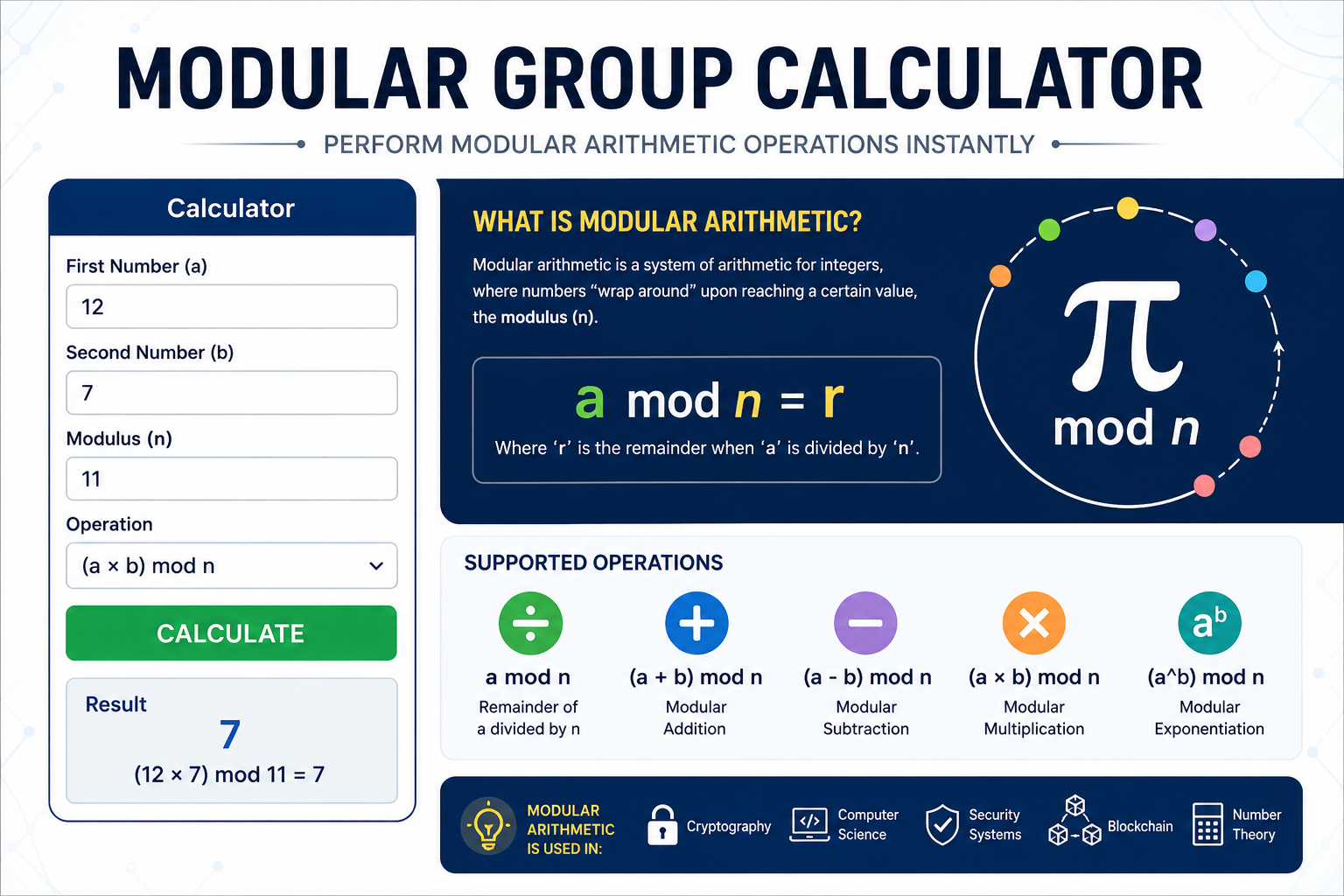
Use this free Modulo Group Calculator to calculate the remainder when one number is divided by another number. Modulo arithmetic is widely used in mathematics, computer science, programming, cryptography, number theory, and many digital systems.

What Is a Modulo Group Calculator?
A Modulo Group Calculator is an online mathematical tool used to calculate the remainder left after dividing one number by another. This operation is called the modulo operation and is commonly represented using the word mod or the percent symbol in many programming languages.
For example:
This means that when 17 is divided by 5, the quotient is 3 and the remainder is 2. Therefore, the modulo result is 2.
Modulo arithmetic is an important concept in mathematics and computer science. It is used in programming, number theory, cryptography, cybersecurity, algorithms, digital systems, and problems involving repeating cycles.
How Does the Modulo Operation Work?
The modulo operation finds the remainder that remains after a division. The basic relationship can be written as:
Some simple examples are:
| Calculation | Result |
|---|---|
| 10 mod 3 | 1 |
| 25 mod 4 | 1 |
| 100 mod 10 | 0 |
| 77 mod 6 | 5 |
| 17 mod 5 | 2 |
If the dividend is exactly divisible by the divisor, the remainder is zero. For example, 100 divided by 10 leaves no remainder, so 100 mod 10 = 0.
Understanding Modular Arithmetic
Modular arithmetic is a mathematical system in which values repeat after reaching a particular modulus. This is sometimes described as "clock arithmetic" because a clock provides a familiar example of numbers cycling through a fixed range.
On a 12-hour clock, adding 12 hours brings you back to the same position. For example:
- 13 o'clock corresponds to 1 o'clock.
- 14 o'clock corresponds to 2 o'clock.
- 15 o'clock corresponds to 3 o'clock.
This repeating behavior can be described using modulo 12 arithmetic. For example:
The same basic idea appears in many mathematical and computing systems where values repeat after reaching a defined boundary.
Modulo Group Theory and Mathematical Applications
Modulo arithmetic is closely connected with concepts in number theory and abstract algebra. Modular systems can be used to study relationships between integers according to a selected modulus.
In mathematics, modular arithmetic is used when studying:
- Group theory
- Abstract algebra
- Number theory
- Congruence relations
- Finite mathematical systems
- Cryptography
- Mathematical proofs
For example, two integers can be considered congruent modulo n when their difference is divisible by n. This provides a useful framework for studying repeating numerical patterns.
Why Is Modulo Arithmetic Important?
Modulo arithmetic has applications far beyond basic remainder calculations. It is an important mathematical operation in programming and digital technology because computers frequently need to work with repeating sequences, cycles, positions, and fixed ranges of values.
Common examples include:
- Digital clocks
- Calendar calculations
- Computer programming
- Cryptographic algorithms
- Cybersecurity systems
- Hashing algorithms
- Data structures
- Repeating patterns
Common Uses of a Modulo Calculator
1. Programming
The modulo operator is commonly used by programmers when they need to determine whether a number divides evenly or when they need to create repeating patterns.
- Checking whether numbers are odd or even
- Creating repeating loops
- Working with array positions
- Generating repeating patterns
- Managing cyclic values
2. Cryptography
Modular arithmetic is an important mathematical component of many cryptographic systems. Cryptographic algorithms can use modular operations to perform calculations over defined numerical ranges.
3. Mathematics
Students and researchers use modulo calculations in number theory, algebra, discrete mathematics, and problems involving divisibility and congruences.
4. Computer Science
Modulo calculations can help with algorithms involving cycles, indexing, hashing, scheduling, and data organization.
How to Use This Modulo Group Calculator
Step 1: Enter the Dividend
Enter the number you want to divide in the Dividend field.
Step 2: Enter the Divisor
Enter the number you want to divide by in the Divisor field. The divisor cannot be zero.
Step 3: Click Calculate Modulo
Click the Calculate Modulo button. The calculator will determine the remainder and display the modulo equation.
Step 4: Read the Result
The result section shows the original dividend, divisor, and calculated remainder so that you can easily check the calculation.
Examples of Modulo Calculations
| Calculation | Explanation | Remainder |
|---|---|---|
| 15 mod 4 | 15 = 4 × 3 + 3 | 3 |
| 20 mod 6 | 20 = 6 × 3 + 2 | 2 |
| 35 mod 7 | 35 = 7 × 5 + 0 | 0 |
| 50 mod 9 | 50 = 9 × 5 + 5 | 5 |
| 77 mod 6 | 77 = 6 × 12 + 5 | 5 |
Modulo Formula
The standard division relationship can be written as:
Here, a is the dividend, b is the divisor, q is the quotient, and r is the remainder.
Therefore:
For example, if 29 is divided by 5:
Therefore, 29 mod 5 = 4.
Modulo and Odd or Even Numbers
One of the simplest programming applications of modulo is checking whether a number is odd or even.
An even number has a remainder of zero when divided by 2:
An odd number has a remainder of one when divided by 2:
This simple property makes the modulo operator useful in many programming tasks.
Benefits of Using an Online Modulo Calculator
- Provides quick remainder calculations
- Reduces manual arithmetic
- Easy to use for students
- Useful for programming practice
- Helps verify mathematical answers
- Useful for number theory exercises
- Works with positive and negative numbers
- Provides an immediate result
Who Uses Modulo Calculators?
A modulo calculator can be useful for anyone working with remainder-based calculations or modular arithmetic.
- Students
- Teachers
- Mathematicians
- Programmers
- Software developers
- Computer science students
- Data analysts
- Cybersecurity learners
- Researchers working with number theory
Frequently Asked Questions About Modulo
What is a modulo operation?
A modulo operation calculates the remainder left after one number is divided by another number. For example, 17 mod 5 equals 2.
What does mod mean in mathematics?
"Mod" refers to the modulo operation, which determines the remainder after division.
Can the modulo result be zero?
Yes. When the dividend is exactly divisible by the divisor, the remainder is zero. For example, 100 mod 10 equals 0.
Can the divisor be zero?
No. Division by zero is undefined, so a modulo operation with a zero divisor cannot be calculated.
Is modulo the same as division?
No. Division determines the quotient, while modulo determines the remainder left after the division.
Where is modulo used in programming?
Modulo is commonly used for checking odd and even numbers, repeating patterns, loops, array indexing, cyclic calculations, and various algorithms.
What is modular arithmetic?
Modular arithmetic is a mathematical system in which numbers are considered according to a fixed modulus. It is often compared with clock arithmetic because values repeat in cycles.
What is a modulus?
In a modulo calculation, the modulus is the number by which the dividend is divided. For example, in 17 mod 5, the modulus is 5.
What is 10 mod 3?
10 divided by 3 gives a remainder of 1. Therefore, 10 mod 3 = 1.
Who can use a modulo calculator?
Students, programmers, teachers, mathematicians, computer science learners, and anyone working with modular arithmetic can use a modulo calculator.
Final Thoughts
The Modulo Group Calculator provides a quick and convenient way to calculate the remainder of a division problem. Modulo arithmetic may look simple, but it is an important mathematical concept with applications in number theory, programming, computer science, cryptography, and many digital systems.
Whether you are checking a homework calculation, learning modular arithmetic, writing a programming algorithm, or exploring number theory, calculating the remainder can help you understand how numbers behave within repeating systems.
Enter your dividend and divisor above and use the calculator to obtain the modulo result instantly.
Note: This calculator is provided for educational and mathematical reference purposes. The divisor cannot be zero.