
Macro Calculator
Calculate your estimated daily calories and recommended protein, carbohydrates, and fat based on your body details, activity level, and fitness goal.
Your Daily Nutrition Plan
Daily Calories
0 kcal/dayBMR
0 kcal/dayTDEE
0 kcal/dayRecommended Daily Macros
| Nutrient | Grams | Calories | % |
|---|---|---|---|
| Protein | 0 g | 0 | 30% |
| Carbohydrates | 0 g | 0 | 40% |
| Fat | 0 g | 0 | 30% |
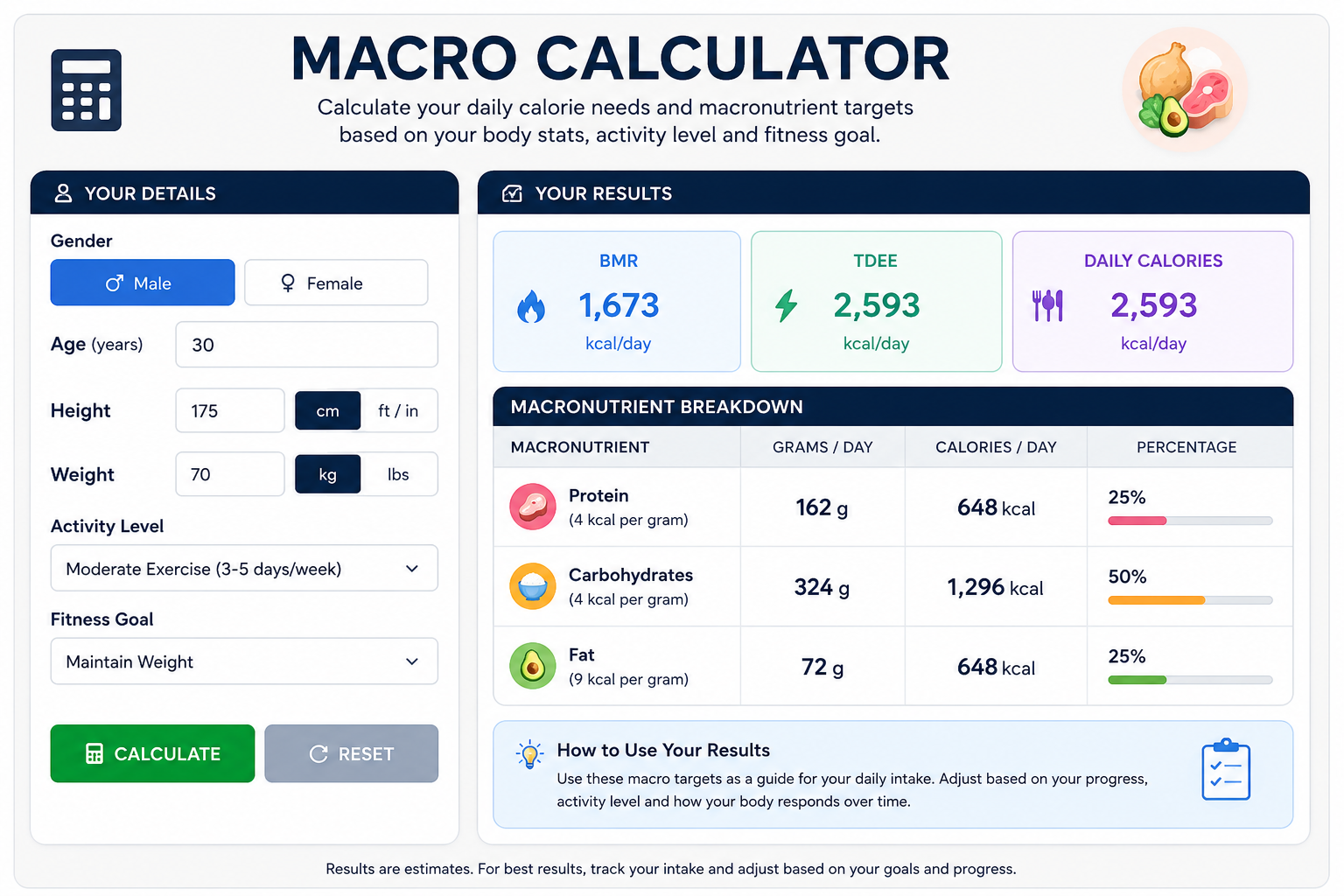
What Is a Macro Calculator?
A Macro Calculator is an online nutrition tool that estimates how many calories, protein, carbohydrates, and fats you may need each day. The calculation is based on personal information such as age, gender, height, weight, activity level, and fitness goal.
The word "macro" is short for macronutrient. The three primary macronutrients are protein, carbohydrates, and fat. They provide energy and play important roles in maintaining body functions, supporting physical activity, repairing tissues, and helping the body use essential nutrients.
A regular calorie calculator mainly estimates your daily energy requirement. A Macro Calculator goes a step further by dividing the calorie target into protein, carbohydrate, and fat recommendations. This can make nutrition planning easier for people who want to manage their weight, support exercise performance, or structure their daily food intake.
How Does a Macro Calculator Work?
A Macro Calculator generally starts by estimating your Basal Metabolic Rate (BMR). BMR represents the approximate amount of energy your body uses at rest to support essential functions such as breathing, circulation, and maintaining normal body processes.
This calculator uses the Mifflin-St Jeor Equation to estimate BMR. Your estimated BMR is then multiplied by an activity factor to estimate Total Daily Energy Expenditure (TDEE).
TDEE represents the approximate number of calories your body may use during a typical day after accounting for your activity level. The calculator then adjusts the estimated calorie target according to your selected goal.
- Lose Weight: uses a moderate calorie reduction.
- Maintain Weight: keeps calories close to estimated TDEE.
- Gain Muscle: uses a moderate calorie increase.
After the calorie target is determined, those calories are distributed among protein, carbohydrates, and fat. In this calculator, the default distribution is approximately 30% protein, 40% carbohydrates, and 30% fat.
What Are Macronutrients?
Macronutrients are nutrients that the body requires in relatively large amounts. They provide energy and contribute to many important functions. The three main macronutrients are protein, carbohydrates, and fat.
Protein
Protein is made up of amino acids and is important for maintaining and repairing body tissues. It is particularly important for people who perform resistance training or other forms of exercise because adequate protein intake supports muscle maintenance and recovery.
Protein provides approximately 4 calories per gram. Common protein-rich foods include eggs, poultry, fish, dairy products, beans, lentils, tofu, and other protein-containing foods.
Carbohydrates
Carbohydrates are an important source of energy. They are particularly useful during physical activity because the body can break down carbohydrates to provide energy for exercise and everyday movement.
Carbohydrates provide approximately 4 calories per gram. Foods containing carbohydrates include fruits, vegetables, grains, rice, potatoes, oats, legumes, and many other foods.
Fat
Dietary fat is another important source of energy. Fat also plays roles in cell structure, hormone production, and absorption of fat-soluble vitamins.
Fat provides approximately 9 calories per gram, making it more calorie-dense than protein or carbohydrates. Sources include nuts, seeds, oils, avocados, fish, and other foods containing dietary fat.
Calories vs Macros: What Is the Difference?
Calories measure energy, while macros describe where that energy comes from. For example, protein and carbohydrates each provide approximately 4 calories per gram, while fat provides approximately 9 calories per gram.
This means two meals can contain similar numbers of calories while having very different amounts of protein, carbohydrates, and fat. Tracking calories can help with overall energy balance, while tracking macros can help you understand the nutritional composition of your diet.
For many people, combining sensible calorie awareness with a balanced macronutrient intake can be more useful than focusing on only one number.
Why Is Protein Important for Fitness?
Protein is especially relevant for people who participate in strength training, resistance exercise, sports, or other demanding physical activities. Exercise creates a need for recovery, and protein supplies amino acids used by the body for tissue maintenance and repair.
However, eating more protein is not automatically better for everyone. Individual requirements depend on factors such as body size, activity level, training type, dietary pattern, and overall health. The protein value generated by this calculator should therefore be treated as a starting estimate rather than a medical prescription.
How Can a Macro Calculator Help With Weight Loss?
Weight loss generally requires an energy deficit over time, meaning that energy intake is lower than energy expenditure. A Macro Calculator can help estimate a reasonable starting calorie target rather than relying entirely on guesswork.
The calculator's weight-loss setting uses a moderate reduction from estimated TDEE. The resulting calorie target is then divided among protein, carbohydrates, and fat.
A useful nutrition plan should also consider food quality, fibre, hydration, micronutrients, meal timing, sleep, and physical activity. The calculator should be used as one planning tool rather than as the only factor in a weight-management strategy.
Can a Macro Calculator Help With Muscle Gain?
Yes. The muscle-gain option provides a calorie target above estimated TDEE and distributes those calories among protein, carbohydrates, and fat.
Muscle development is influenced by several factors, including progressive resistance training, adequate nutrition, sufficient protein, recovery, sleep, and consistency. Simply increasing calories without appropriate training does not guarantee muscle gain.
For people with specific medical, dietary, or performance requirements, individualized guidance from a registered dietitian, sports nutrition professional, or healthcare provider may be more appropriate.
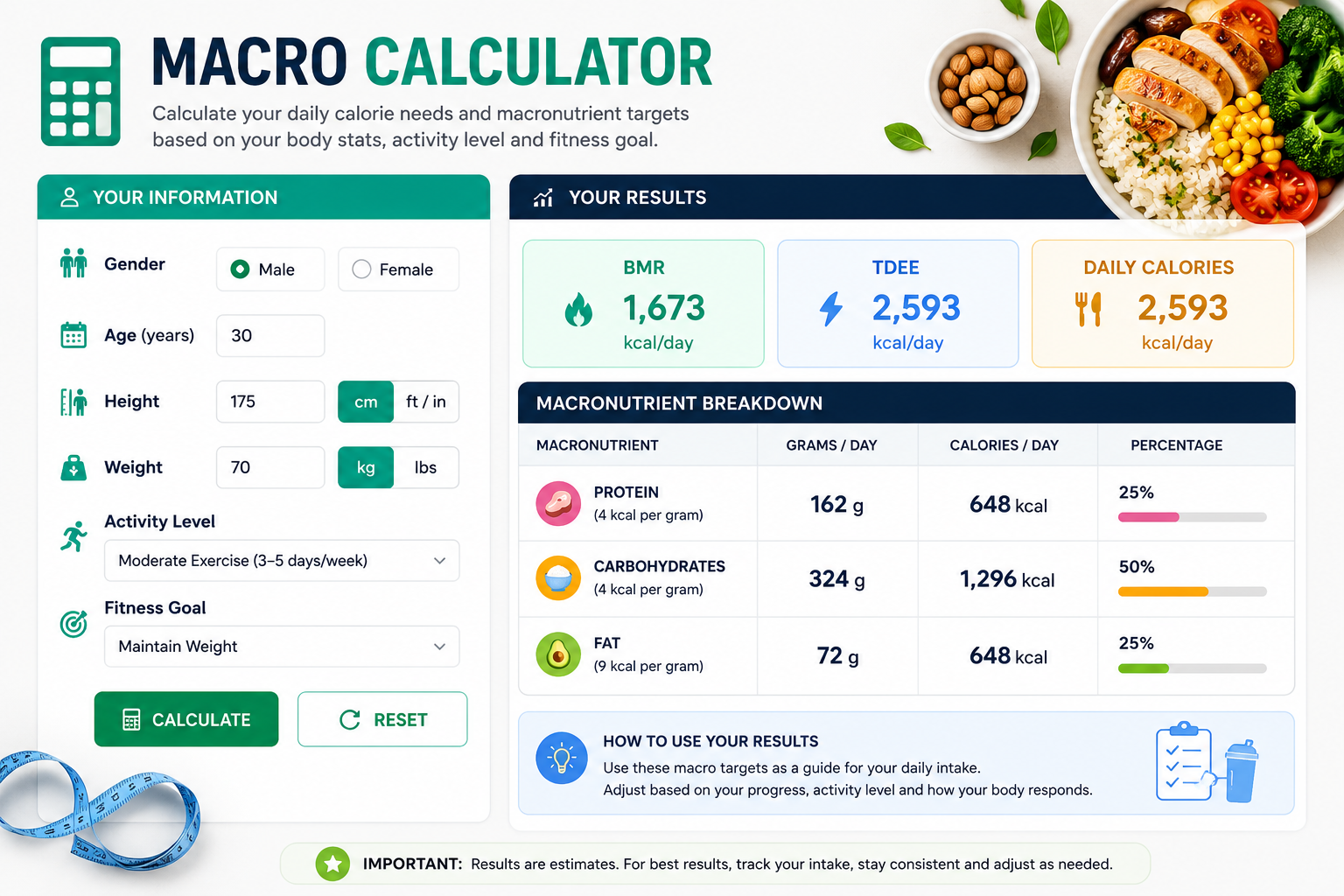
What Is BMR?
Basal Metabolic Rate (BMR) is an estimate of the energy your body uses while at rest to maintain essential physiological functions. BMR does not represent your complete daily calorie requirement because most people move, work, exercise, digest food, and perform other activities throughout the day.
That is why a Macro Calculator combines BMR with an activity multiplier to estimate TDEE. BMR is therefore a starting point rather than the final daily calorie target.
What Is TDEE?
Total Daily Energy Expenditure (TDEE) is an estimate of the total energy your body uses in a typical day. It includes the energy needed for basic body functions as well as physical activity and other daily processes.
Because activity levels vary considerably between individuals, selecting the most appropriate activity category is important. If your actual activity is very different from the selected category, the estimated TDEE may not closely match your real-world calorie expenditure.
Understanding the Activity Levels
The calculator provides five activity categories:
- Sedentary: little or no regular exercise.
- Lightly Active: light exercise or activity around 1–3 days per week.
- Moderately Active: moderate exercise around 3–5 days per week.
- Very Active: frequent exercise or physical activity around 6–7 days per week.
- Extra Active: very demanding training or highly active lifestyles.
These categories are estimates. Your actual energy expenditure can differ because of occupation, daily walking, training intensity, body composition, sleep, and other factors.
How to Use This Macro Calculator
- Select your gender.
- Enter your age in years.
- Enter your weight and select kilograms or pounds.
- Enter your height in centimetres or feet and inches.
- Select the activity level that best represents your routine.
- Choose your fitness goal.
- Click Calculate Macros.
- Review your estimated BMR, TDEE, daily calories, protein, carbohydrates, and fat.
Example of Macro Calculation
Suppose an adult enters their age, body weight, height, gender, activity level, and selects the maintenance goal. The calculator first estimates BMR using the Mifflin-St Jeor equation. It then applies the selected activity factor to estimate TDEE.
If the estimated daily energy requirement is 2,400 calories and the selected macro distribution is 30% protein, 40% carbohydrates, and 30% fat, the calculator converts those percentages into calories and then into grams. Protein and carbohydrates use approximately 4 calories per gram, while fat uses approximately 9 calories per gram.
This illustrates why macro targets are usually expressed both as a percentage and as grams. Percentages show the calorie distribution, while grams provide a practical target for food tracking.
Benefits of Using a Macro Calculator
- Provides a personalized starting estimate.
- Combines calorie and macronutrient planning in one tool.
- Helps you understand protein, carbohydrate, and fat targets.
- Can support weight-management planning.
- Can help structure nutrition around exercise goals.
- Reduces the need for manual calculations.
- Allows you to compare different fitness goals.
- Provides BMR and TDEE estimates for better context.
- Works with both metric and imperial weight and height inputs.
Important Things to Remember
Macro calculations are estimates, not exact measurements of your metabolism. Your actual calorie needs can be higher or lower than the calculator's estimate. Body composition, genetics, daily movement, exercise intensity, occupation, sleep, and other factors can influence energy expenditure.
Instead of treating the result as a fixed prescription, consider it a starting point. If your body weight or fitness progress changes over time, your calorie and macro targets may also need adjustment.
Who Can Use a Macro Calculator?
A Macro Calculator can be useful for adults who want a simple starting point for nutrition planning. It may be particularly useful for:
- People beginning a fitness program.
- Individuals working toward weight loss.
- People trying to maintain their current weight.
- Strength-training enthusiasts.
- People working toward muscle gain.
- Recreational athletes.
- People interested in tracking daily macros.
- Anyone who wants to understand calorie and macro relationships.
People who are pregnant or breastfeeding, have a medical condition, have a history of disordered eating, are under 15, or have specialized dietary requirements should seek individualized advice from an appropriate healthcare professional rather than relying only on an online calculator.
Macro Calculator for Beginners
For beginners, tracking every nutrient can initially feel complicated. A calculator can simplify the process by providing an estimated daily target. Instead of trying to calculate every number manually, you can use the result as a framework for planning meals.
You do not necessarily need to hit every macro target perfectly every day. Consistency over time is generally more useful than trying to achieve absolute precision with every meal. Food quality, variety, fibre, hydration, and overall dietary balance also matter.
Frequently Asked Questions About Macro Calculators
1. What is a Macro Calculator?
A Macro Calculator is an online tool that estimates your daily calorie and macronutrient requirements. It uses information such as age, gender, height, weight, activity level, and fitness goal to estimate calories and recommend amounts of protein, carbohydrates, and fat.
2. What are the three main macronutrients?
The three primary macronutrients are protein, carbohydrates, and dietary fat. Protein and carbohydrates provide approximately 4 calories per gram, while fat provides approximately 9 calories per gram.
3. How does this Macro Calculator calculate BMR?
This calculator uses the Mifflin-St Jeor equation to estimate Basal Metabolic Rate. The result is then combined with an activity multiplier to estimate Total Daily Energy Expenditure.
4. What is the difference between BMR and TDEE?
BMR estimates the energy your body needs at rest for essential functions. TDEE estimates your total daily energy expenditure after accounting for your activity level. TDEE is therefore generally higher than BMR for an active person.
5. Can I use this Macro Calculator for weight loss?
Yes. Select Lose Weight as your fitness goal. The calculator uses a moderate calorie reduction from estimated TDEE and then distributes the resulting calories among protein, carbohydrates, and fat.
6. Can I use this calculator for muscle gain?
Yes. Select Gain Muscle to receive an estimated calorie target above your calculated TDEE, along with protein, carbohydrate, and fat targets. Resistance training and adequate recovery are also important for muscle development.
7. How many calories does protein contain?
Protein provides approximately 4 calories per gram. Therefore, 100 grams of protein provides approximately 400 calories before considering other nutrients in the food.
8. How many calories do carbohydrates contain?
Carbohydrates provide approximately 4 calories per gram. The actual calories in a food depend on its complete nutritional composition.
9. How many calories does fat contain?
Fat provides approximately 9 calories per gram, which makes it more calorie-dense than protein and carbohydrates.
10. How accurate is a Macro Calculator?
A Macro Calculator can provide a useful starting estimate, but it cannot measure your exact metabolism. Actual calorie needs vary between individuals. Your results should therefore be treated as estimates rather than exact nutritional prescriptions.
11. Should I recalculate my macros when my weight changes?
It can be useful to recalculate your targets when your body weight changes significantly, your activity level changes, or your fitness goal changes. This can help keep your estimated calorie and macro targets aligned with your current situation.
12. Is this Macro Calculator free?
Yes. This online Macro Calculator is designed to be free to use. You can enter your information and calculate your estimated daily calories and macronutrients without manually performing the calculations.
Conclusion
A Macro Calculator provides a convenient way to estimate your daily calorie, protein, carbohydrate, and fat requirements. By using your age, gender, height, weight, activity level, and fitness goal, it gives you a personalized starting point for nutrition planning.
Whether your goal is to lose weight, maintain your current weight, or support muscle gain, understanding the relationship between calories and macronutrients can make your eating plan easier to organize. BMR and TDEE estimates also help explain why calorie requirements differ from one person to another.
Remember that calculator results are estimates. Your actual nutritional requirements can change with body weight, activity, training, lifestyle, and other individual factors. Use the results as a starting guide and make reasonable adjustments based on your progress. For medical conditions, specialized diets, pregnancy, breastfeeding, or individualized nutrition planning, consult a qualified healthcare professional or registered dietitian.
Use this Macro Calculator whenever your circumstances or fitness goals change, and combine the results with a balanced diet, regular physical activity, adequate recovery, and healthy long-term habits.