
Gold Calculator
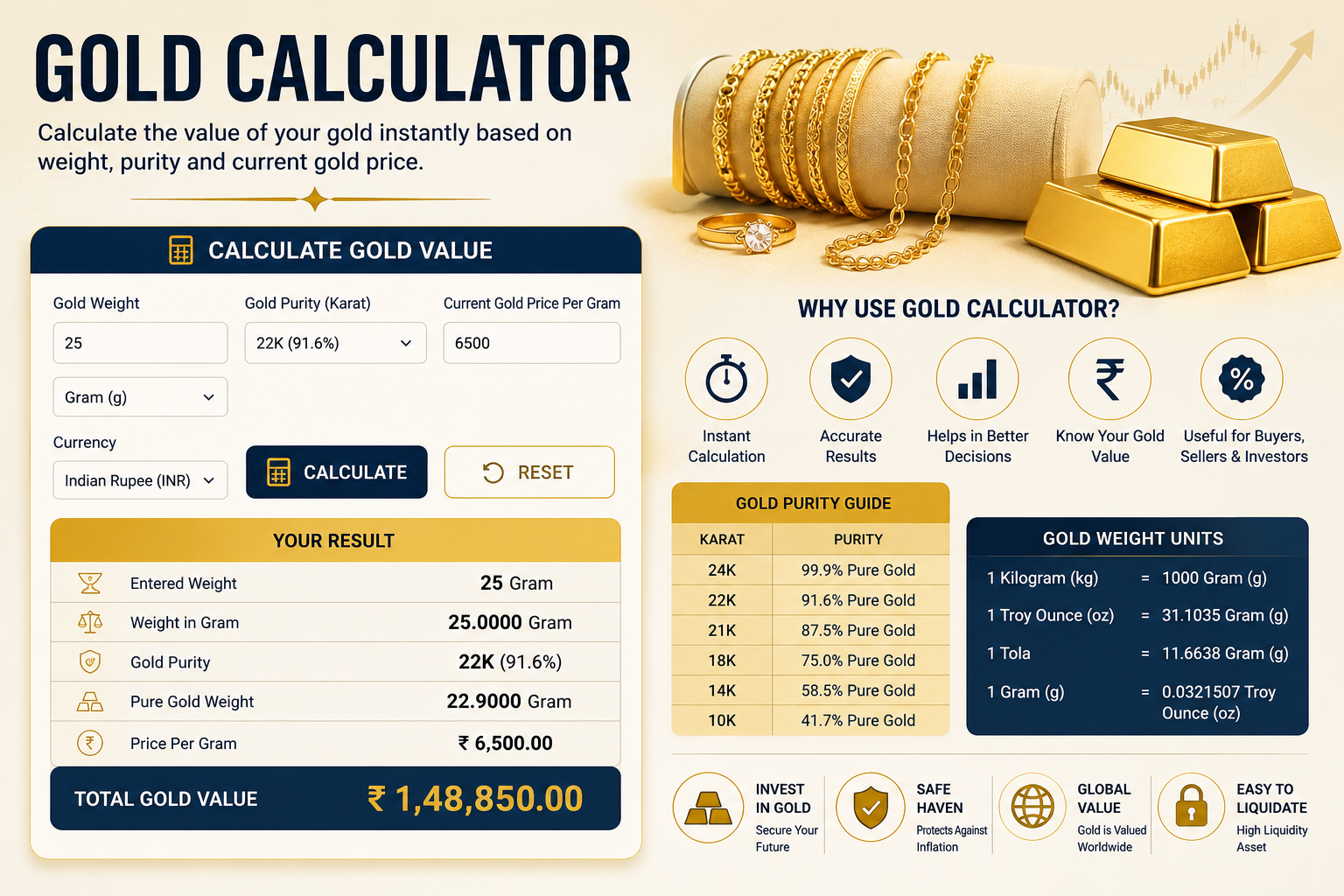
Calculate the estimated value of your gold based on weight, purity, and the current price of 24K gold per gram.
| Entered Weight | |
|---|---|
| Weight in Grams | |
| Gold Purity | |
| Pure Gold Content | |
| 24K Price Per Gram | |
| Estimated Gold Value |
How to Use This Gold Calculator

Using this Gold Calculator is simple. You only need the weight of your gold, its karat purity, and the current 24K gold price per gram.
- Enter the weight of your gold item.
- Select the correct weight unit: grams, kilograms, troy ounces, or tola.
- Select the gold purity, such as 24K, 22K, 21K, 18K, 14K, or 10K.
- Enter the current 24K gold price per gram in your selected currency.
- Select the currency you are using.
- Click Calculate Gold Value.
- The calculator will show the converted weight, pure gold content, and estimated gold value.
What Is a Gold Calculator?
A Gold Calculator is an online tool that helps estimate the value of gold using three important pieces of information: the weight of the gold, its purity, and the current market price of gold. Instead of doing the calculations manually, users can enter their details and receive an estimated gold value within seconds.
Gold is commonly measured by weight and valued according to its fine gold content. The purity of jewellery or other gold items is normally expressed in karats. For example, 24K represents very high-purity gold, while 22K, 18K and 14K contain progressively larger proportions of other metals. The World Gold Council explains that 18K gold contains 75% gold, while 22K is approximately 91.7% gold. :contentReference[oaicite:3]{index=3}
A Gold Calculator converts the selected weight into grams, applies the selected purity percentage, and then calculates the estimated value using the entered 24K gold price per gram.
Gold Value = Weight in Grams × Purity Percentage × 24K Gold Price Per Gram
This makes the tool useful for people who want to estimate the intrinsic metal value of jewellery, coins, bullion, bars, or other gold items before comparing prices or offers.
It is important to understand that the calculator estimates the metal value only. A jewellery item's actual selling price may be different because jewellery can include craftsmanship, design, retailer margins, taxes, refining costs, commissions, and other charges.
Gold Purity and Karat Explained
Gold purity describes how much of an item is actually gold compared with other metals in the alloy. Karat, written as K, is commonly used to express this purity. Gold purity is based on 24 parts, so 24K represents the highest standard in the karat scale.
The World Gold Council notes that fineness is another way of expressing gold purity, usually in parts per thousand. Common examples include .750 for 18K gold and .999 or .9999 for very high-purity gold. :contentReference[oaicite:4]{index=4}
| Gold Karat | Approximate Gold Purity | Gold Content |
|---|---|---|
| 24K | 99.9% | Very high-purity gold |
| 22K | 91.7% | 22 parts gold out of 24 |
| 21K | 87.5% | 21 parts gold out of 24 |
| 18K | 75% | 18 parts gold out of 24 |
| 14K | 58.3% | 14 parts gold out of 24 |
| 10K | 41.7% | 10 parts gold out of 24 |
The actual fineness marking on jewellery can vary slightly by market and manufacturing standard. For valuation purposes, it is best to use the purity or hallmark shown on the item, invoice, certificate, or professional assay rather than relying only on appearance.
Gold Weight Units
Gold can be measured using several different units depending on the country and market. This calculator supports grams, kilograms, troy ounces, and tola.
Gram
The gram is one of the most convenient units for everyday gold calculations, particularly for jewellery and smaller quantities.
Kilogram
Kilograms are generally more useful when dealing with larger quantities of precious metals. The calculator automatically converts kilograms into grams before calculating the value.
Troy Ounce
Precious metals are normally traded using the troy ounce, rather than the ordinary avoirdupois ounce used for many everyday goods. One troy ounce equals approximately 31.1034768 grams. :contentReference[oaicite:5]{index=5}
Tola
Tola is a traditional unit commonly encountered in South Asian gold markets. For this calculator, one tola is treated as approximately 11.6638125 grams.
Understanding the Gold Price Per Gram
Gold prices can be quoted in different ways, including price per gram and price per troy ounce. International gold markets commonly use the troy ounce as a pricing unit. The LBMA Gold Price is an internationally recognised benchmark and is quoted in US dollars per fine troy ounce. :contentReference[oaicite:6]{index=6}
To calculate the value of a particular gold item, the price must be matched to the correct unit. This is why the calculator asks for a price per gram. If your available market price is quoted per troy ounce, it should first be converted to a per-gram price.
Price Per Gram = Price Per Troy Ounce ÷ 31.1034768
When using this calculator, enter the price of 24K or pure gold per gram. The calculator then adjusts that price according to the purity selected for your gold item.
Gold prices can change frequently because of global market conditions, currency movements, interest rates, investor demand, central-bank activity, economic expectations, and geopolitical developments. Therefore, an estimated value can change whenever the underlying gold price changes.
Gold Calculator Example
Suppose you have a 22K gold item weighing 10 grams and the current 24K gold price is $100 per gram.
Because 22K gold is approximately 91.7% pure, the estimated pure gold content is:
The estimated intrinsic value would then be approximately:
This is only an example. The actual value depends on the current gold price, the verified purity, the actual weight, and the terms offered by the buyer or seller.
How to Calculate the Value of Gold Jewellery
Gold jewellery often contains a mixture of gold and other metals. Therefore, the item's total weight is not necessarily equal to its pure gold weight.
For example, if a 22K gold bracelet weighs 20 grams, it contains approximately 91.7% gold. The estimated fine gold content would therefore be about 18.34 grams before considering any stones, non-gold components, or measurement differences.
Jewellery valuation can become more complicated when an item contains gemstones, diamonds, clasps, springs, solder, enamel, or other materials. In such cases, the gross weight may not represent the actual weight of gold.
For a more reliable valuation, use the net gold weight and verified purity whenever those details are available.
Gold as an Investment
Gold is used by investors as a portfolio diversification asset and is also widely viewed as a store of value. Investors can gain exposure to gold through physical bullion, coins, bars, exchange-traded products, mining companies, and other financial instruments.
Physical Gold
Physical gold includes bars, coins, and jewellery. Ownership is tangible, but storage, insurance, premiums, and transaction costs can affect the overall investment outcome.
Gold Bars
Gold bars are available in many sizes. Larger bars may have different premiums and transaction costs compared with smaller products. Professional bullion markets use defined purity and weight standards.
Gold Coins
Gold coins may have both metal value and additional collectible or premium value. The actual resale price can therefore be different from the simple melt value calculated from weight and purity.
Gold ETFs and Other Financial Products
Gold-related exchange-traded products allow investors to gain exposure to movements in gold prices without necessarily storing physical gold themselves. These products have their own fees, structures, risks, and market characteristics.
A Gold Calculator is useful for estimating the underlying metal value, but it should not be treated as a complete investment-return calculator.
Factors That Can Affect the Value of Gold
The value of gold is influenced by more than just its weight. Several factors can affect the market price and the amount a buyer is willing to pay.
- Current international gold prices
- Gold purity and fineness
- Total and net gold weight
- Currency exchange rates
- Market supply and demand
- Interest-rate expectations
- Inflation expectations
- Investor demand
- Central-bank activity
- Geopolitical and economic conditions
- Dealer premiums and commissions
- Taxes and transaction costs
- Jewellery making or craftsmanship charges
Gold Buying and Selling Tips
A Gold Calculator can help you understand the approximate intrinsic value before entering a transaction. However, the calculator should be used together with other information when buying or selling gold.
- Check the purity or hallmark of the gold item.
- Confirm the actual net gold weight.
- Check a current and reliable gold price.
- Compare prices from more than one reputable dealer.
- Ask about commissions, refining charges, taxes, or other deductions.
- Keep purchase invoices and certificates where applicable.
- Do not assume jewellery resale value equals its original purchase price.
- For high-value items, consider professional testing or appraisal.
Frequently Asked Questions About Gold Calculator
1. What is a Gold Calculator?
A Gold Calculator is an online tool that estimates the value of gold using its weight, purity, and a current gold price. It converts different weight units into grams and adjusts the calculation according to the selected karat purity.
2. How does a Gold Calculator work?
The calculator first converts the entered weight into grams. It then applies the purity percentage of the selected karat and multiplies the resulting pure gold weight by the entered 24K gold price per gram.
3. What gold price should I enter?
Enter the current price of 24K or pure gold per gram in your selected currency. If you only have a price per troy ounce, convert it to a per-gram price before entering it.
4. How many grams are in one troy ounce of gold?
One troy ounce equals approximately 31.1034768 grams. Precious metals such as gold are normally measured using troy ounces rather than ordinary household ounces. :contentReference[oaicite:7]{index=7}
5. Is 24K gold pure gold?
24K represents the highest karat purity. In practical jewellery and bullion markets, very high-purity gold is commonly represented by fineness values such as 999 or 999.9 rather than literally 100% chemically pure gold. :contentReference[oaicite:8]{index=8}
6. What is the difference between 22K and 24K gold?
24K gold has a higher gold content, while 22K gold contains approximately 91.7% gold with the remainder consisting mainly of other metals. Therefore, the same weight of 24K gold generally has a higher intrinsic gold value than 22K gold at the same market price basis. :contentReference[oaicite:9]{index=9}
7. Can I use this calculator for gold jewellery?
Yes. You can use it to estimate the intrinsic gold value of jewellery such as rings, necklaces, bracelets, chains, earrings, and bangles. However, jewellery may contain gemstones or non-gold components, so the net gold weight should be used whenever possible.
8. Does the calculator include making charges?
No. The calculator estimates the underlying gold value only. Jewellery making charges, design charges, dealer margins, taxes, commissions, and other costs are not included.
9. Does the calculator use a live gold price?
No. You enter the gold price manually. This means you can use the calculator with the current price from your preferred reliable market or pricing source.
10. Why is my jewellery's selling price different from the calculator result?
A calculator estimates the intrinsic metal value, while an actual transaction can include dealer spreads, refining costs, taxes, commissions, jewellery condition, craftsmanship, gemstones, and other factors. The amount offered by a buyer may therefore be lower or otherwise different from the calculated metal value.
Conclusion
A Gold Calculator provides a quick way to estimate the intrinsic value of gold using weight, purity, and the current 24K gold price per gram. By converting different weight units and adjusting the calculation for karat purity, it removes much of the manual work involved in basic gold valuation.
Whether you are checking gold jewellery, coins, bars, bullion, or another precious-metal item, understanding the relationship between weight, purity, and market price can help you make better-informed decisions. Remember that the calculator provides an estimate of the metal value and does not automatically include making charges, dealer premiums, taxes, commissions, gemstones, or other transaction costs.
Gold prices can change frequently, and international gold markets commonly quote prices using the troy ounce. Using a current and appropriate gold price is therefore important when estimating value. For high-value transactions, always verify the purity, weight, market price, and final buying or selling terms with a reputable professional.