
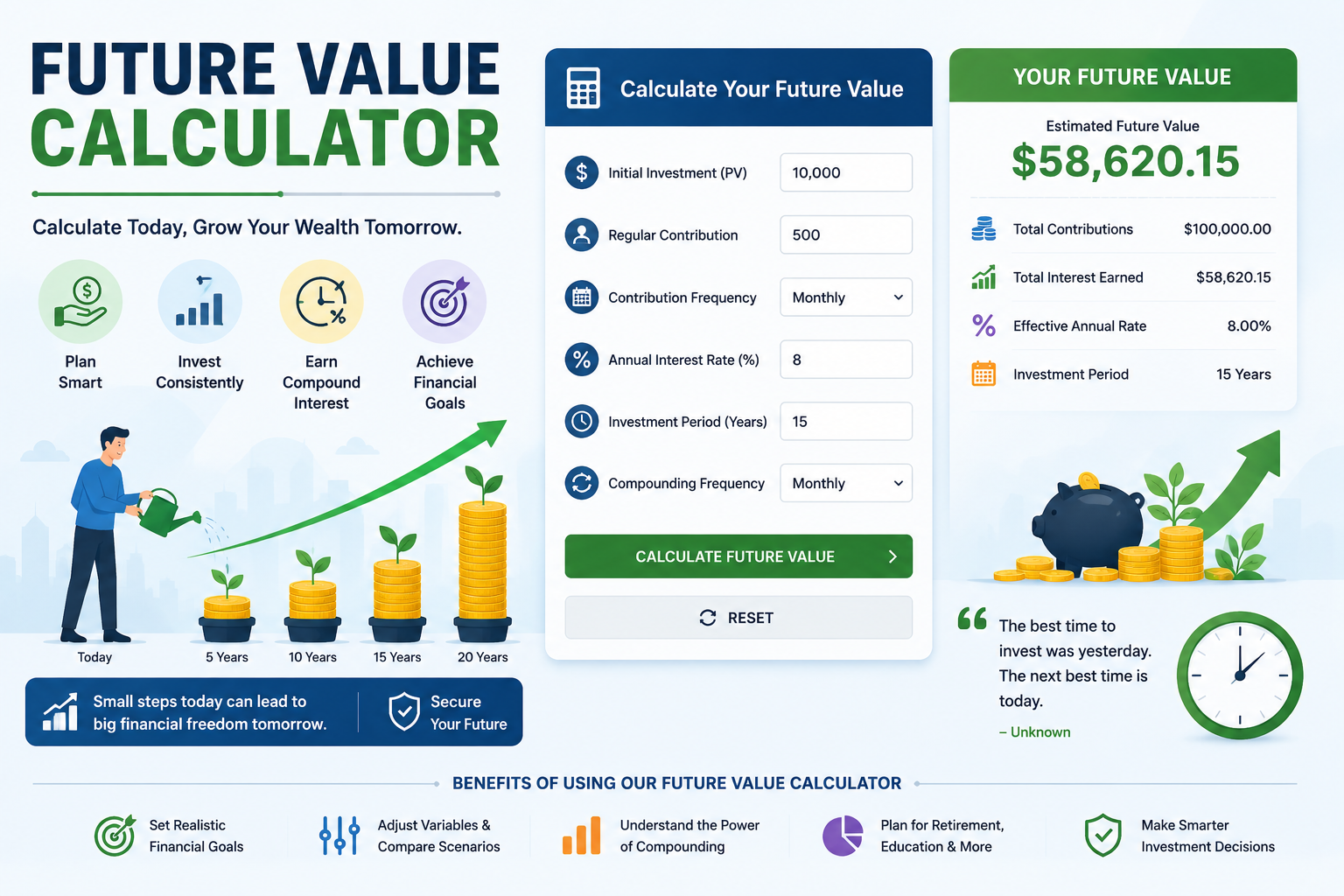
Estimate how your investment could grow over time using compound interest. Enter your initial investment, regular contributions, interest rate, investment period, and compounding frequency to calculate the estimated future value.
Investment Summary
| Annual Interest Rate | 0% |
|---|---|
| Investment Period | 0 years |
| Contribution Frequency | Monthly |
| Compounding Frequency | Monthly |
Future Value Formula
Where:
- FV = Future Value
- PV = Present Value or initial investment
- r = Annual interest rate as a decimal
- n = Compounding periods per year
- t = Investment period in years
When regular contributions are included, the calculator also calculates the future value of those recurring deposits.
Step-by-Step Calculation
How to Use This Future Value Calculator
- Enter your initial investment amount.
- Enter a regular contribution if you plan to invest periodically.
- Select the contribution frequency.
- Enter the expected annual interest rate.
- Enter the investment period in years.
- Select the compounding frequency.
- Click Calculate Future Value.
- Review your estimated future value, total investment, and interest earned.
What Is a Future Value Calculator?
A Future Value Calculator is an online financial planning tool that estimates how much an investment could be worth at a future date. It uses information such as your initial investment, regular contributions, expected interest rate, investment period, and compounding frequency to estimate potential investment growth.
Future value is an important concept in personal finance because money invested today may grow over time when it earns a return. A calculator makes it easier to see how compound interest and recurring contributions can affect the potential value of an investment over several years.
Whether you are planning for retirement, building an education fund, saving for a home, or simply exploring long-term investment strategies, a Future Value Calculator can help you compare different financial scenarios without performing complex calculations manually.
Why Is Future Value Important?
Understanding future value can help you connect today's financial decisions with your long-term goals. An amount invested today can have a very different value after 5, 10, 20, or 30 years depending on the rate of return and how often the investment compounds.
Future value calculations can help you:
- Plan for retirement.
- Estimate long-term investment growth.
- Set realistic savings targets.
- Compare different investment scenarios.
- Plan education savings.
- Estimate the impact of regular contributions.
- Understand the effect of compound interest.
- Prepare for major future purchases.
How Does a Future Value Calculator Work?
A Future Value Calculator uses a mathematical formula to estimate what an investment may become after a specified period. The calculation generally starts with the present value, or the amount invested today. The calculator then applies the expected annual rate of return and the selected compounding frequency.
If you make regular contributions, those deposits are also included in the projection. Because each contribution may be invested for a different length of time, recurring contributions are calculated separately and then combined with the growth of the original investment.
The result is an estimated future value, along with the total amount contributed and the estimated interest or investment growth.
Future Value Formula
The standard compound-interest future value formula for a single investment is:
FV = PV × (1 + r/n)nt
In this formula:
- FV represents future value.
- PV represents present value.
- r represents the annual interest rate in decimal form.
- n represents the number of compounding periods per year.
- t represents the investment period in years.
When regular contributions are made, an additional future-value calculation is included for those recurring deposits.
What Is Compound Interest?
Compound interest means earning a return not only on your original investment but also on the accumulated interest or investment growth from previous periods.
For example, suppose you invest $10,000 and earn an annual return of 8%. After one year, the investment would be approximately $10,800 before considering taxes, fees, or other factors. If the return continues, future growth is calculated on the larger balance rather than only on the original $10,000.
Over long periods, this compounding effect can become significant. This is why time is an important factor in long-term investing.
How to Use This Future Value Calculator
- Enter the amount of your initial investment.
- Enter your regular contribution, if applicable.
- Choose how frequently you make contributions.
- Enter your expected annual interest rate.
- Enter the number of years you plan to invest.
- Choose the compounding frequency.
- Click Calculate Future Value.
- Review the estimated future value and investment breakdown.
Example of Future Value Calculation
Suppose an investor starts with an initial investment of $15,000, contributes $250 per month, expects an annual return of 7%, and plans to invest for 20 years.
By entering these figures into the calculator, you can estimate the potential future account value, total contributions, and investment growth. The actual result will depend on the assumptions used and real-world investment performance.
This type of scenario demonstrates why combining regular contributions with a long investment period can be powerful for long-term financial planning.
Compounding Frequency Explained
Compounding frequency determines how often interest is added to an investment balance. Common compounding frequencies include annual, semi-annual, quarterly, monthly, and daily.
| Compounding Frequency | Times Per Year |
|---|---|
| Annually | 1 |
| Semi-Annually | 2 |
| Quarterly | 4 |
| Monthly | 12 |
| Daily | 365 |
More frequent compounding can produce a somewhat higher result when other assumptions remain the same. However, the difference depends on the interest rate, investment period, and other factors.
Factors That Affect Future Value
Several important variables can significantly influence the projected future value of an investment.
- Initial Investment: A larger starting amount gives compound growth more money to work with.
- Interest Rate: Higher returns can increase future value, although higher expected returns generally involve different levels of risk.
- Investment Period: A longer period gives compound growth more time to accumulate.
- Regular Contributions: Consistent deposits can substantially increase the amount invested over time.
- Compounding Frequency: The frequency with which returns are compounded can affect the final projection.
Future Value vs Present Value
Future value and present value are related financial concepts, but they answer different questions.
| Future Value | Present Value |
|---|---|
| Estimates what money today could become in the future. | Estimates what future money is worth today. |
| Commonly used for investment and savings planning. | Commonly used for valuation and financial analysis. |
| Focuses on future growth. | Focuses on current value. |
Why Starting Early Matters
Time can have a major impact on compound growth. Starting an investment earlier allows returns to remain invested for a longer period.
For example, an investor who begins saving in their twenties may have several additional years for compound growth compared with someone who starts in their forties. Even when the initial contribution is modest, a long investment period can make a meaningful difference.
This is one reason long-term investors often focus on consistency and time rather than attempting to predict short-term market movements.
Benefits of Regular Contributions
Regular investing can help make saving more consistent. Instead of relying entirely on a single large investment, investors can add money periodically according to their budget and financial plan.
- Builds consistent saving habits.
- Increases total invested capital over time.
- Allows more money to benefit from compound growth.
- Supports long-term financial goals.
- Can make investing easier to manage through automated contributions.
Choosing an Interest Rate for Future Value Estimates
The interest rate used in a future value calculation should be a reasonable assumption rather than an unrealistic expectation. Different financial products and investments can have very different historical returns and levels of risk.
Depending on the investment, people may consider savings accounts, guaranteed investments, bonds, mutual funds, exchange-traded funds, stocks, or retirement investments. However, past performance does not guarantee future results.
For better planning, you can calculate several scenarios using conservative, moderate, and optimistic assumptions instead of relying on a single projected rate.
Common Uses of a Future Value Calculator
- Retirement planning.
- Education savings.
- Long-term investment planning.
- Emergency fund planning.
- Home purchase planning.
- Wealth accumulation.
- Comparing savings strategies.
- Financial goal setting.
- Investment scenario analysis.
Common Investment Mistakes to Avoid
A future value calculator can help with planning, but good financial decisions also require realistic assumptions and disciplined investing.
- Waiting too long to start saving or investing.
- Assuming investment returns are guaranteed.
- Ignoring inflation.
- Ignoring investment fees and taxes.
- Using unrealistically high expected returns.
- Making emotional decisions during market volatility.
- Failing to diversify when appropriate.
- Withdrawing long-term investments without considering the impact.
Tips for Increasing Long-Term Investment Growth
- Start investing as early as practical.
- Contribute consistently.
- Increase contributions when your income increases.
- Reinvest investment earnings where appropriate.
- Keep investment costs in mind.
- Maintain a long-term perspective.
- Review your financial plan periodically.
- Consider inflation when setting long-term goals.
Limitations of Future Value Calculations
A Future Value Calculator provides a mathematical projection based on the assumptions entered. It does not predict the actual future performance of an investment.
Real-world results can be affected by changing interest rates, market performance, inflation, taxes, investment fees, withdrawals, and other factors. Therefore, calculator results should be treated as estimates for educational and planning purposes.
Why Use Our Future Value Calculator?
Our Future Value Calculator is designed to make investment growth calculations simple and accessible. It supports an initial investment, recurring contributions, different contribution frequencies, multiple compounding frequencies, and flexible investment periods.
Within seconds, you can estimate your potential future value, total investment, and estimated interest earned. The calculator is free, mobile-friendly, easy to use, and does not require registration.
Frequently Asked Questions (FAQs)
1. What is a Future Value Calculator?
A Future Value Calculator is an online financial tool that estimates how much an investment could be worth in the future. It considers factors such as the initial investment, regular contributions, interest rate, investment period, and compounding frequency.
2. How is future value calculated?
Future value is commonly calculated using the compound interest formula FV = PV × (1 + r/n)nt. When regular contributions are included, the future value of those recurring deposits is also calculated and added to the projected investment balance.
3. What is compound interest?
Compound interest is the process of earning returns on your original investment as well as on previously accumulated interest or growth. Over a long period, compounding can have a significant effect on investment growth.
4. Can I use this calculator with monthly contributions?
Yes. You can enter a recurring contribution and select monthly, quarterly, semi-annual, or annual contribution frequency. The calculator then includes those recurring deposits in the future value projection.
5. Why does compounding frequency matter?
Compounding frequency determines how often investment growth is added to the balance. More frequent compounding can produce a somewhat higher future value when the other assumptions remain unchanged.
6. Can this calculator be used for retirement planning?
Yes. A Future Value Calculator can be useful for retirement planning because it allows you to estimate how current savings and regular contributions could grow over a selected period. You can compare different contribution amounts and return assumptions.
7. Does a higher interest rate always produce a higher future value?
Mathematically, a higher assumed interest rate produces a higher projected future value when all other inputs remain the same. However, real-world investments do not guarantee a particular return, and higher potential returns can involve greater risk.
8. How does investment time affect future value?
A longer investment period generally gives compound growth more time to work. Extending the investment period can therefore have a substantial effect on the projected future value, especially when regular contributions are also made.
9. Are Future Value Calculator results guaranteed?
No. The results are estimates based on the assumptions entered into the calculator. Actual investment results can differ because of market conditions, changing returns, inflation, fees, taxes, and other factors.
10. Is this Future Value Calculator free?
Yes. This Future Value Calculator is free to use and can be used to explore different investment scenarios without registration.
Conclusion
A Future Value Calculator is a useful tool for understanding how an investment may grow over time through compound interest. By entering an initial investment, regular contributions, expected interest rate, investment period, and compounding frequency, you can create a simple projection of your potential future investment value.
One of the most important lessons from future value calculations is the relationship between time, consistency, and compound growth. Regular contributions combined with a long investment period can potentially make a significant difference to long-term wealth accumulation.
However, future value projections are estimates rather than guarantees. Actual returns can be affected by investment performance, inflation, taxes, fees, economic conditions, and other factors. For important financial decisions, consider your individual circumstances and seek professional financial advice when appropriate.
Use this calculator to explore different investment scenarios and understand how changes in contribution amounts, interest rates, and investment periods can affect potential future growth.