
Factor Calculator
Enter a positive whole number to find its factors, factor pairs, number of factors, sum of factors, and whether it is prime or composite.
What Is a Factor Calculator?
A Factor Calculator is an online mathematical tool that quickly identifies all the factors of a given positive whole number. Instead of manually dividing a number by every possible integer, the calculator determines which numbers divide evenly without leaving a remainder. It can also display factor pairs, the total number of factors, the sum of the factors, and whether the number is a prime number or composite number.
Factors are an important part of mathematics because they form the foundation of multiplication, division, fractions, ratios, algebra, and number theory. Students commonly work with factors when simplifying fractions, finding the Greatest Common Factor (GCF), calculating the Least Common Multiple (LCM), and learning prime factorization.
An online Factor Calculator makes these calculations faster and easier. It is useful for students checking homework, teachers preparing examples, parents helping children with mathematics, and anyone who wants to verify factor calculations quickly.
What Are Factors?
A factor is a whole number that divides another whole number exactly, leaving no remainder. In simple terms, if one number can be divided evenly into another number, it is a factor of that number.
For example, the factors of 24 are:
1, 2, 3, 4, 6, 8, 12, and 24
Each of these numbers divides 24 without producing a remainder. Numbers such as 5, 7, and 10 are not factors of 24 because they do not divide 24 evenly.
How Does a Factor Calculator Work?
A Factor Calculator checks which positive integers divide the entered number evenly. An efficient calculation method only needs to test possible divisors up to the square root of the number. When a divisor is found, its corresponding quotient is also a factor.
For example, if the number is 36 and the calculator finds that 4 divides 36 evenly, the corresponding factor is 9 because:
4 × 9 = 36
The calculator continues this process until all factor pairs have been identified.
- Lists all factors in ascending order.
- Counts the total number of factors.
- Displays factor pairs.
- Calculates the sum of all positive factors.
- Determines whether the number is prime or composite.
Example of Finding Factors
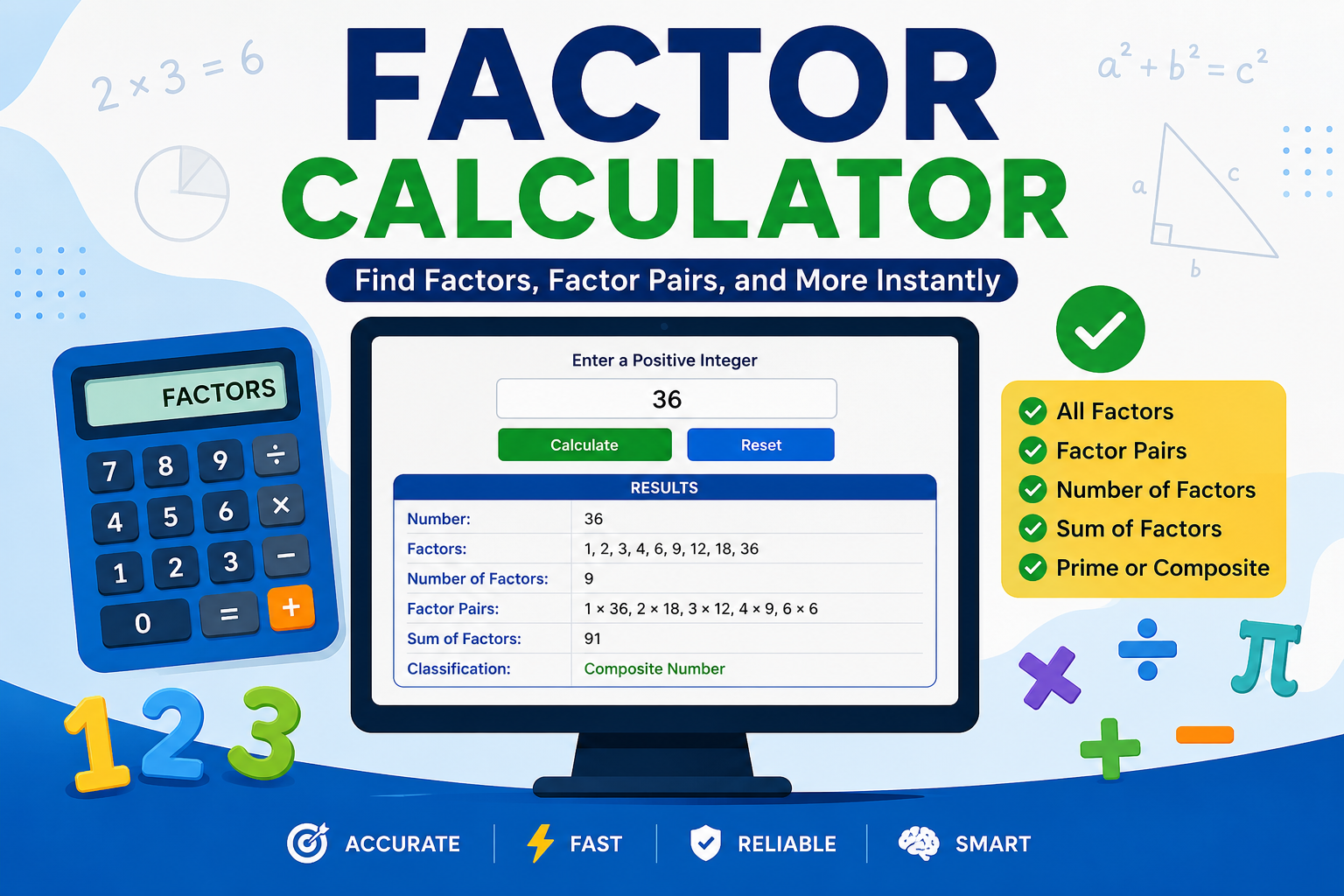
Suppose you enter the number 36 into the Factor Calculator.
The result is:
- Factors: 1, 2, 3, 4, 6, 9, 12, 18, 36
- Total Factors: 9
- Sum of Factors: 91
- Classification: Composite Number
The factor pairs are:
- 1 × 36
- 2 × 18
- 3 × 12
- 4 × 9
- 6 × 6
Factor Pairs Explained
Factor pairs are two numbers that multiply together to produce the original number. Every positive whole number has at least one factor pair.
For example, the factor pairs of 20 are:
- 1 × 20
- 2 × 10
- 4 × 5
Factor pairs are useful for understanding multiplication and division. They are also helpful when solving algebraic equations, simplifying expressions, and learning prime factorization.
Prime Numbers and Composite Numbers
A Factor Calculator can also determine whether a number is prime or composite by examining its factors.
Prime Numbers
A prime number is a positive whole number greater than 1 that has exactly two distinct positive factors: 1 and itself.
Examples include:
2, 3, 5, 7, 11, 13, 17, 19
Composite Numbers
A composite number is a positive whole number greater than 1 that has more than two positive factors.
Examples include:
4, 6, 8, 9, 10, 12, 15, 18
The number 1 is neither prime nor composite because it has only one positive factor.
Benefits of Using a Factor Calculator
- Finds factors instantly.
- Reduces manual calculation errors.
- Saves time when working with larger numbers.
- Displays factor pairs automatically.
- Identifies prime and composite numbers.
- Counts the total number of factors.
- Calculates the sum of positive factors.
- Helps students understand multiplication and division.
- Supports fraction and algebra problems.
- Useful for learning number theory.
Who Can Use a Factor Calculator?
A Factor Calculator can be useful for people at different levels of mathematical study.
- Elementary school students
- Middle school students
- High school students
- College students
- Teachers
- Tutors
- Parents helping children with homework
- Competitive exam candidates
- Anyone learning mathematics
Applications of Factors in Mathematics
Factors are used throughout elementary and advanced mathematics. Some important applications include:
- Simplifying fractions
- Finding the Greatest Common Factor (GCF)
- Finding the Least Common Multiple (LCM)
- Prime factorization
- Solving algebraic equations
- Working with ratios and proportions
- Number theory
- Geometry problems
- Probability calculations
- Mathematical proofs
Why Is Factorization Important?
Factorization allows a number or algebraic expression to be broken into smaller components. This can make mathematical problems easier to understand and solve.
For example, the number 60 can be written as:
60 = 2 × 2 × 3 × 5
This prime factorization can then be used to determine common factors, simplify fractions, and calculate the GCF or LCM of numbers.
Advanced Guide to Factors and Factor Calculations
Understanding factors goes beyond simply finding numbers that divide another number. Factors are fundamental to arithmetic, algebra, number theory, and many mathematical problem-solving techniques.
A Factor Calculator provides a convenient way to explore these relationships. It can help users see how factor pairs are connected and how the number of factors changes depending on the mathematical structure of a number.
Prime Factorization Explained
Prime factorization is the process of expressing a composite number as a product of prime numbers. Every integer greater than 1 has a unique prime factorization apart from the order of the factors.
Examples include:
- 24 = 2 × 2 × 2 × 3
- 36 = 2 × 2 × 3 × 3
- 90 = 2 × 3 × 3 × 5
- 120 = 2 × 2 × 2 × 3 × 5
Prime factorization is particularly useful when finding GCF and LCM and when simplifying fractions.
Greatest Common Factor (GCF)
The Greatest Common Factor (GCF), also known as the Highest Common Factor (HCF), is the largest positive number that divides two or more numbers exactly.
For example:
- Factors of 24: 1, 2, 3, 4, 6, 8, 12, 24
- Factors of 36: 1, 2, 3, 4, 6, 9, 12, 18, 36
The greatest common factor is 12.
GCF is commonly used when simplifying fractions, comparing quantities, and solving mathematical problems involving common divisors.
Least Common Multiple (LCM)
The Least Common Multiple (LCM) is the smallest positive number that is a multiple of two or more numbers.
For example, the multiples of 6 include 6, 12, 18, 24, and 30, while the multiples of 8 include 8, 16, 24, and 32. Therefore, the LCM of 6 and 8 is 24.
LCM is useful when adding fractions with different denominators and when solving problems involving repeating schedules or intervals.
Even and Odd Numbers
Even Numbers
An even number is divisible by 2 without a remainder. Examples include 2, 4, 6, 8, 10, and 12.
Odd Numbers
An odd number is not divisible by 2 without a remainder. Examples include 1, 3, 5, 7, 9, and 11.
Recognizing whether a number is even or odd can make factor calculations faster because even numbers always have 2 as one of their positive factors.
Perfect Numbers
A perfect number is a positive integer that equals the sum of its proper positive factors, excluding the number itself.
For example, the proper factors of 6 are 1, 2, and 3:
1 + 2 + 3 = 6
Therefore, 6 is a perfect number.
Another example is 28:
1 + 2 + 4 + 7 + 14 = 28
Common Factor Problems
Factor-related questions appear frequently in school mathematics and standardized tests. Common examples include:
- Find all factors of a number.
- Find factor pairs.
- Determine whether a number is prime or composite.
- Find the Greatest Common Factor.
- Calculate the Least Common Multiple.
- Perform prime factorization.
- Simplify fractions using common factors.
Examples of Factor Calculations
Example 1: Factors of 18
The factors of 18 are:
1, 2, 3, 6, 9, 18
Factor pairs:
- 1 × 18
- 2 × 9
- 3 × 6
Example 2: Factors of 49
The factors of 49 are:
1, 7, 49
Factor pairs:
- 1 × 49
- 7 × 7
Since 49 has more than two positive factors, it is composite.
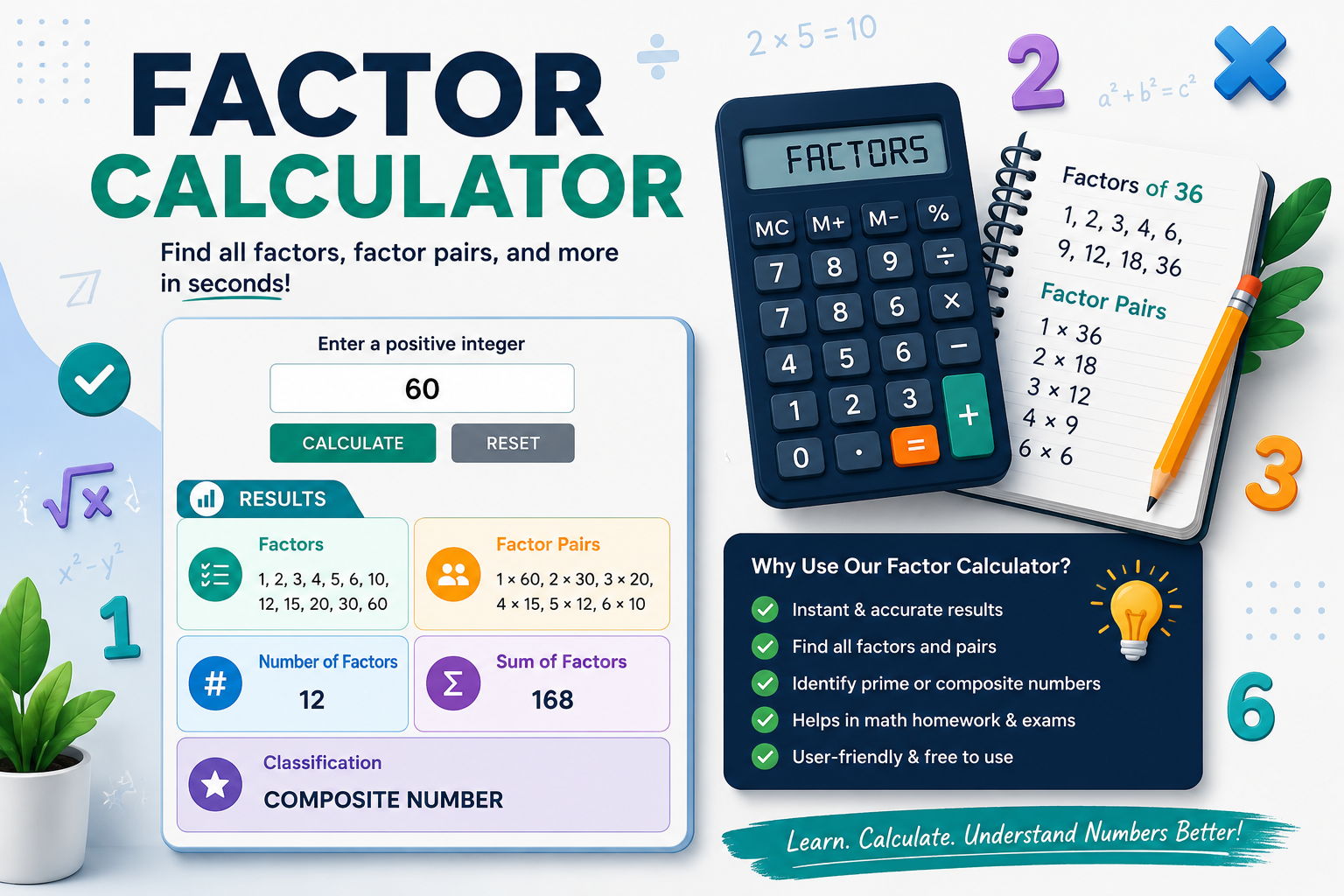
Example 3: Factors of 60
The factors of 60 are:
1, 2, 3, 4, 5, 6, 10, 12, 15, 20, 30, 60
Factor pairs:
- 1 × 60
- 2 × 30
- 3 × 20
- 4 × 15
- 5 × 12
- 6 × 10
Mathematical Properties of Factors
- Every positive integer has at least one positive factor: 1.
- Every positive integer is divisible by itself.
- A prime number has exactly two positive factors.
- A composite number has more than two positive factors.
- Perfect squares have an odd number of positive factors.
- Non-square positive integers have an even number of positive factors.
- Factor pairs multiply to produce the original number.
How to Find Factors Manually
You can find factors manually by testing whole numbers that may divide the number evenly. For a positive integer, it is not necessary to test every number all the way to the original number. Once you reach the square root, the corresponding factor pairs have already been identified.
For example, the square root of 36 is 6. By checking divisors from 1 through 6, you can identify the pairs:
- 1 and 36
- 2 and 18
- 3 and 12
- 4 and 9
- 6 and 6
Combining these pairs gives all nine positive factors of 36.
Tips for Finding Factors Quickly
- Start with 1 and the number itself.
- Check divisibility by 2 for even numbers.
- Use divisibility rules for 3, 5, 9, and 10.
- Look for factor pairs.
- Check possible divisors only up to the square root.
- Use prime factorization for more complex calculations.
- Verify manual results with an online Factor Calculator.
Why Students Use a Factor Calculator
Students often use a Factor Calculator to check homework, verify manual calculations, and understand how numbers are related through multiplication and division. Instead of repeatedly performing long division, students can enter a number and immediately see its complete factor list.
The tool is particularly helpful when working with larger integers where manually checking every possible divisor would take considerable time. It can also help learners understand the difference between prime and composite numbers and see how factor pairs work.
Frequently Asked Questions (FAQs)
1. What is a Factor Calculator?
A Factor Calculator is an online math tool that finds all the positive factors of a whole number. It can also display factor pairs, count the factors, calculate their sum, and classify the number as prime or composite.
2. How do you find the factors of a number?
To find factors, divide the number by positive whole numbers and check whether the division produces a remainder of zero. An efficient approach is to check divisors up to the square root of the number and record the corresponding factor pairs.
3. What is the difference between factors and multiples?
Factors are numbers that divide another number exactly. Multiples are numbers produced by multiplying a number by whole numbers. For example, the factors of 12 are 1, 2, 3, 4, 6, and 12, while multiples of 12 include 12, 24, 36, 48, and so on.
4. What is a prime number?
A prime number is a positive integer greater than 1 with exactly two distinct positive factors: 1 and the number itself. Examples include 2, 3, 5, 7, 11, and 13.
5. What are factor pairs?
Factor pairs are two numbers that multiply together to produce the original number. For example, the factor pairs of 24 are 1 × 24, 2 × 12, 3 × 8, and 4 × 6.
6. Can this calculator find factors of large numbers?
Yes. The calculator checks possible divisors efficiently and can find the positive factors of many whole numbers quickly. Extremely large integers may require more computational resources than ordinary numbers.
7. Why are factors important in mathematics?
Factors are used in prime factorization, GCF, LCM, fractions, ratios, algebra, geometry, and number theory. Understanding factors provides a strong foundation for many later mathematical concepts.
8. Can a number have an odd number of factors?
Yes. Perfect square numbers have an odd number of positive factors because one factor pair contains the same number twice. For example, 36 has nine positive factors, with 6 × 6 forming the middle pair.
9. Is 1 a prime number?
No. The number 1 is neither prime nor composite because it has only one positive factor. A prime number must have exactly two distinct positive factors.
10. Is this Factor Calculator free?
Yes. This online Factor Calculator is free to use. Enter a positive whole number and select Calculate to view its factors, factor pairs, number of factors, sum of factors, and classification.
11. What is the largest factor of a number?
For every positive whole number, the largest positive factor is the number itself. For example, the largest positive factor of 36 is 36.
12. What is the smallest factor of a positive integer?
The smallest positive factor of every positive integer is 1.
Conclusion
A Factor Calculator is a simple and useful mathematical tool for finding the positive factors of a whole number quickly and accurately. Instead of manually checking every possible divisor, users can enter a number and instantly view its complete list of factors, factor pairs, total number of factors, sum of factors, and prime or composite classification.
Factors are fundamental to many areas of mathematics, including multiplication, division, fractions, prime factorization, Greatest Common Factor (GCF), Least Common Multiple (LCM), algebra, ratios, and number theory. Learning how factors work can make many mathematical problems easier to understand and solve.
While an online Factor Calculator is useful for checking answers and saving time, practicing factor calculations manually is also valuable for developing mathematical reasoning. By combining practice with a reliable online calculator, students and other learners can improve their accuracy, speed, and confidence when working with numbers.