
Dog Age Group Calculator
Ready for WordPress: Copy everything inside <body> into your page editor if desired.
About
This calculator estimates a dog's equivalent human age using a modern approximation that also considers size. Smaller dogs generally age more slowly in later life than giant breeds.

Dog Age Group Calculator: Estimate Your Dog's Human Age in Seconds
Dogs are much more than pets—they are loyal companions, trusted friends, and beloved members of the family. As dog owners, we often wonder how old our dogs would be if they were humans. While the old belief that one dog year equals seven human years is still widely known, modern veterinary research has shown that the aging process is far more complex. A puppy grows rapidly during its first two years of life, while adult dogs age at different rates depending on their breed, body size, genetics, and overall health.
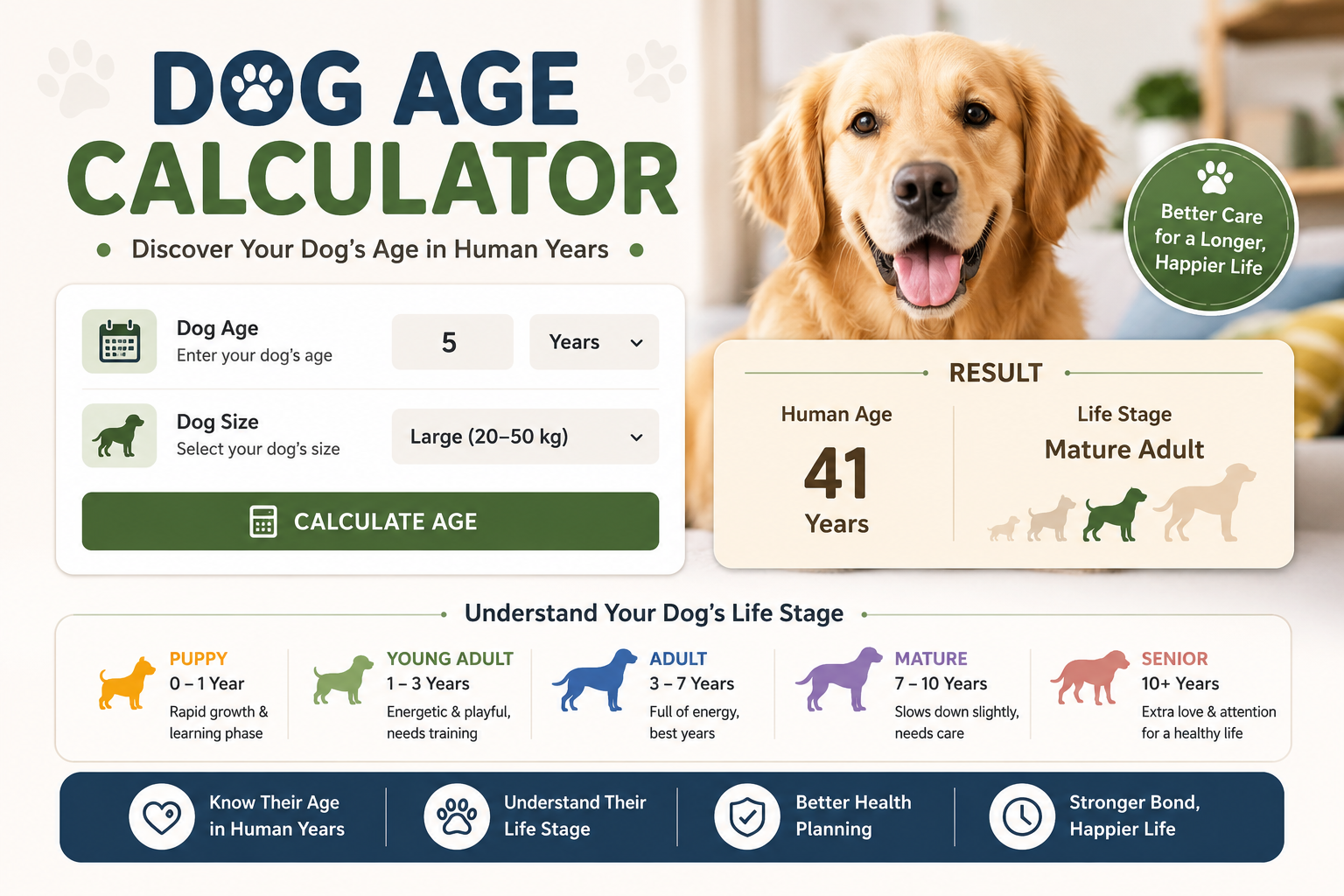
Our Dog Age Group Calculator helps you estimate your dog's equivalent human age using a more realistic approach. Simply enter your dog's age, select the appropriate age unit, and choose your dog's size category. Within seconds, the calculator provides an estimated human age and identifies your dog's current life stage, making it easier to understand their physical and behavioral development.
Whether you own a playful Chihuahua, an energetic Labrador Retriever, a loyal German Shepherd, or a gentle Great Dane, this calculator provides useful insights for every dog owner. It is designed to be quick, simple, and easy to use on desktop computers, tablets, and mobile devices.
Why Calculate Your Dog's Age?
Understanding your dog's age in human years is about much more than satisfying curiosity. Dogs experience significant physical and emotional changes throughout their lives. Knowing which life stage your dog is in can help you provide better nutrition, exercise, training, and veterinary care.
For example, puppies require frequent vaccinations and socialization, while senior dogs often benefit from joint support, regular health screenings, and a diet tailored to aging bodies. By estimating your dog's human age, you gain a better understanding of their changing needs.
How to Use the Dog Age Group Calculator
Using this calculator is simple and takes less than a minute.
- Enter your dog's current age.
- Select whether the age is entered in years or months.
- Choose your dog's size category:
- Small
- Medium
- Large
- Giant
- Click the Calculate button.
- View your dog's estimated human age and life stage instantly.
The calculator automatically adjusts the estimate based on your dog's size because larger breeds generally age faster than smaller breeds.
How Is Dog Age Calculated?
Many people still believe that multiplying a dog's age by seven provides the equivalent human age. While this rule is easy to remember, it is not scientifically accurate.
Modern research suggests that dogs age very quickly during the first two years of life. After that, the aging rate becomes slower and varies depending on the dog's size and breed.
For example:
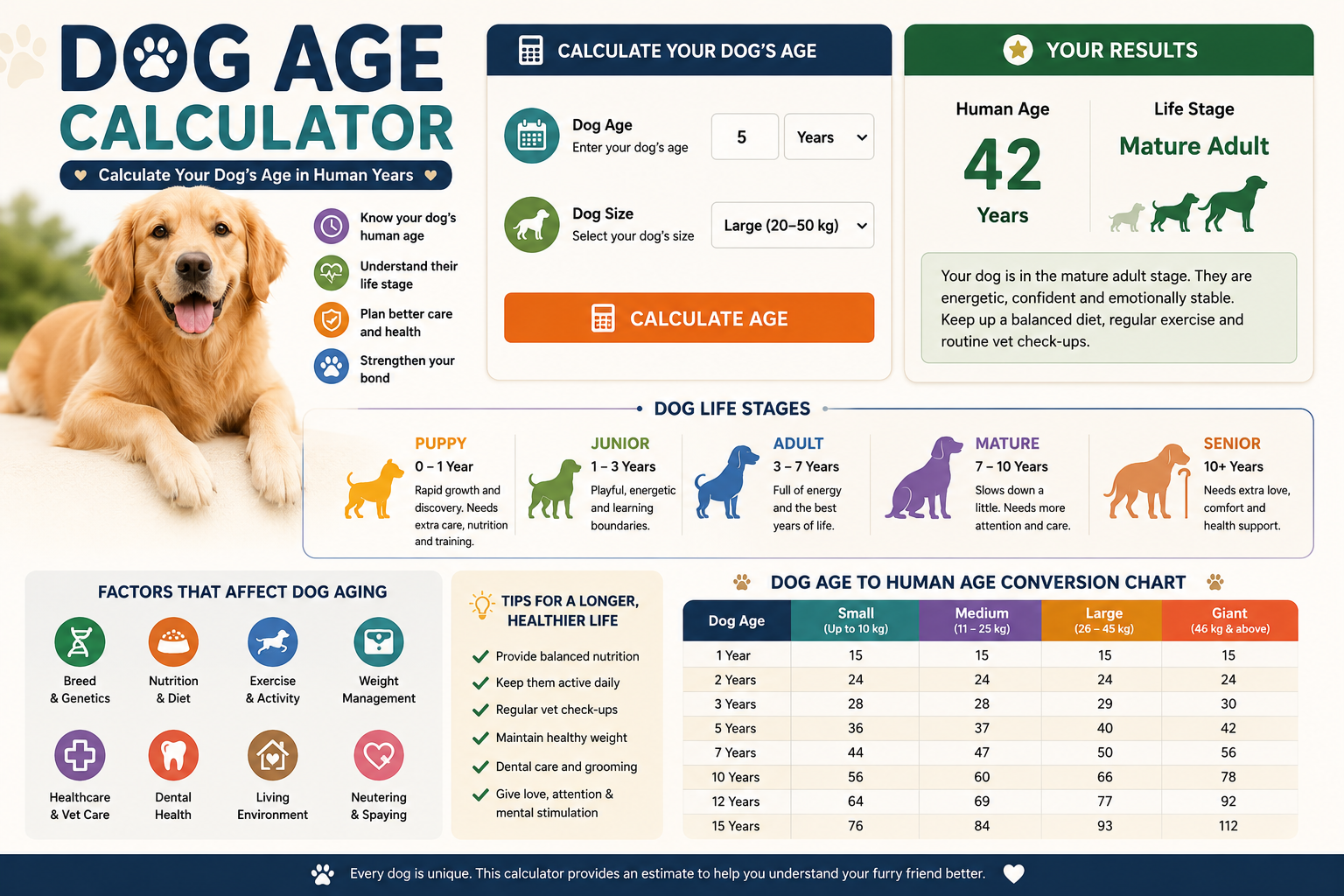
- A one-year-old dog is roughly similar to a 15-year-old human.
- A two-year-old dog is comparable to a 24-year-old adult.
- After two years, additional human years are estimated differently depending on whether the dog is small, medium, large, or giant.
This approach gives a more realistic estimate than the traditional seven-year rule.
Dog Age Conversion Chart
| Dog Age | Approximate Human Age | Life Stage |
|---|---|---|
| 1 Year | 15 Years | Puppy / Young Dog |
| 2 Years | 24 Years | Young Adult |
| 3 Years | 28–30 Years | Adult |
| 5 Years | 36–40 Years | Adult |
| 7 Years | 48–52 Years | Mature |
| 10 Years | 60–66 Years | Senior |
| 12 Years | 70–78 Years | Senior |
| 15 Years | 80–90 Years | Senior |
Understanding Dog Life Stages
Puppy Stage
The puppy stage is filled with rapid growth, curiosity, and learning. Puppies develop physically and mentally at an incredible pace. Proper nutrition, vaccinations, obedience training, and social interaction are especially important during this period.
Young Adult Stage
Young adult dogs are energetic, playful, and highly active. This is usually the best time for advanced training, outdoor adventures, and maintaining a healthy exercise routine.
Adult Stage
Adult dogs generally have stable energy levels and predictable behavior. Maintaining a balanced diet, regular exercise, and annual veterinary checkups helps keep them healthy during these years.
Mature Stage
As dogs become mature, they may slow down slightly. Owners should monitor their weight, joint health, and dental condition while continuing regular physical activity appropriate for their age.
Senior Stage
Senior dogs deserve extra attention and care. They may experience reduced mobility, hearing or vision changes, arthritis, and other age-related conditions. Regular veterinary visits, comfortable sleeping areas, and senior-specific nutrition can greatly improve their quality of life.
Dog Size and Aging
Not all dogs age at the same rate. Body size is one of the most important factors affecting canine aging.
Small Dogs
Small breeds such as Chihuahuas, Yorkshire Terriers, and Toy Poodles often live 14 to 18 years. They usually age more slowly after reaching adulthood.
Medium Dogs
Medium-sized breeds like Border Collies, Beagles, and Cocker Spaniels typically have balanced aging patterns and often live between 12 and 15 years.
Large Dogs
Large breeds such as Labrador Retrievers, Golden Retrievers, and German Shepherds generally have shorter lifespans than smaller breeds and may begin showing signs of aging earlier.
Giant Dogs
Giant breeds, including Great Danes, Saint Bernards, and Mastiffs, often age the fastest. Although they grow quickly and become impressive in size, their average lifespan is usually shorter than that of smaller breeds.

FAQs
1. Is this exact?
No, it is an estimate.
2. Why choose size?
Large breeds age faster.
3. Can puppies use it?
Yes.
4. Is it free?
Yes.
5. Does breed matter?
Breed can influence aging.
6. Can I use it on mobile?
Yes.