
Differentiation Calculator
Calculate the derivative of a mathematical function instantly.
Derivative Result
| Original Function | |
|---|---|
| Derivative f'(x) | |
| Simplified Result |
Step-by-Step Solution
How to Use This Differentiation Calculator
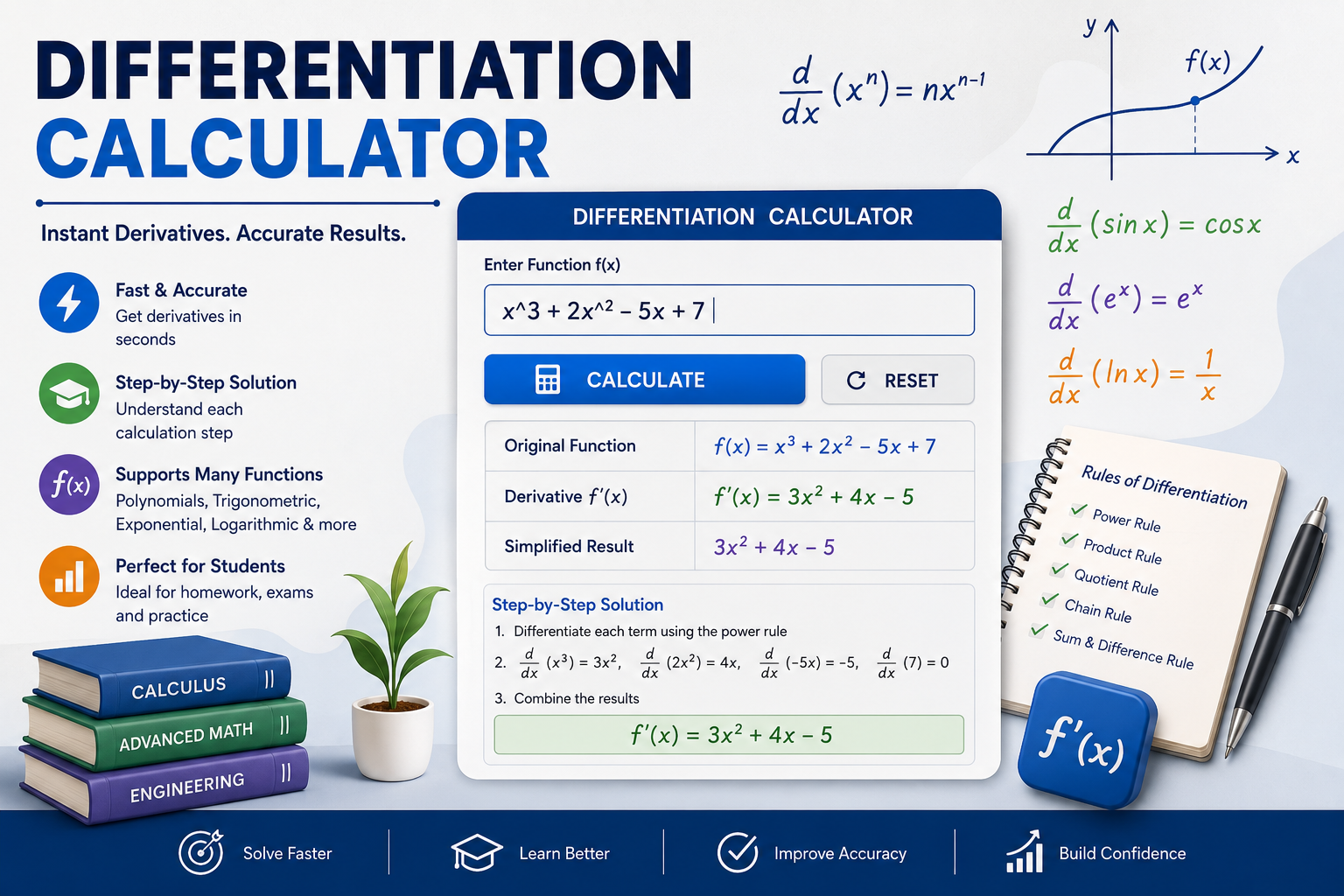
- Enter your mathematical function in the input box.
- Use x as the variable.
- Use the ^ symbol for powers, such as x^2 or x^3.
- Use functions such as sin(x), cos(x), tan(x), ln(x), and sqrt(x) where required.
- Click Calculate Derivative.
- View the derivative and simplified result.
- Review the step-by-step explanation to understand the differentiation process.
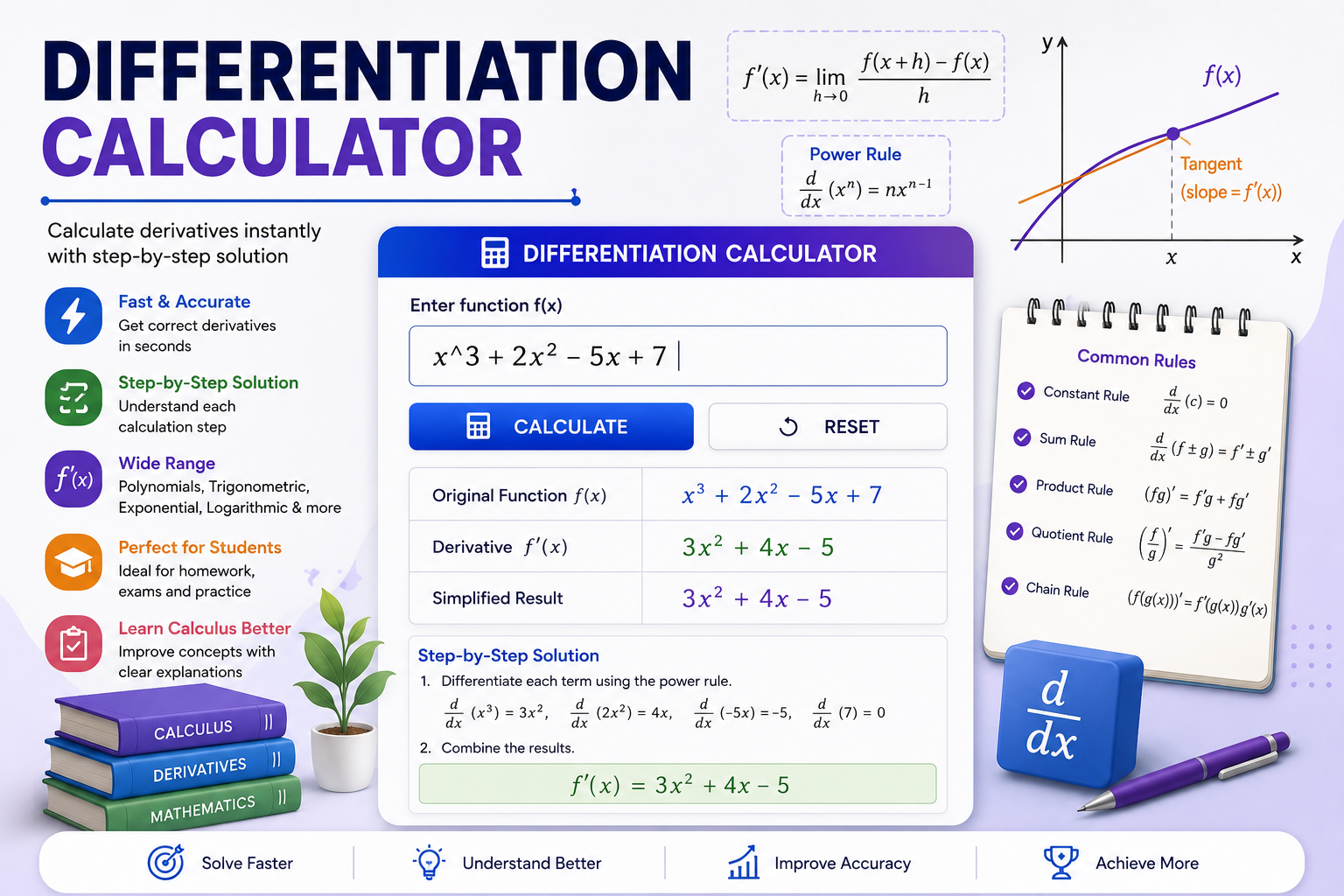
For example, enter x^3 + 2x^2 - 5x + 7. The calculator differentiates each term and returns the derivative.
What Is a Differentiation Calculator?
A Differentiation Calculator is an online mathematical tool that calculates the derivative of a function with respect to a variable, usually x. Instead of applying calculus rules manually to every term, users can enter a mathematical expression and receive its derivative quickly.
Differentiation is one of the fundamental operations of calculus. A derivative describes how quickly a quantity changes with respect to another quantity. Geometrically, the derivative can represent the slope of a curve at a particular point.
For example, if a function represents the position of an object over time, its derivative can represent velocity. If velocity is differentiated again with respect to time, the resulting derivative represents acceleration.
An online differentiation calculator can be particularly useful when working with polynomial, trigonometric, logarithmic, exponential, and other common mathematical expressions.
What Does Differentiation Mean?
Differentiation is the mathematical process of finding the derivative of a function. The derivative measures the instantaneous rate of change of one quantity relative to another.
Suppose a function is written as:
Using the power rule, the derivative is:
This means that the rate of change of x² with respect to x is 2x. Differentiation is therefore useful for understanding how mathematical functions behave as their inputs change.
Common Differentiation Rules
Understanding the basic differentiation rules makes it easier to verify results produced by a calculator. The most frequently used rules include the constant rule, power rule, sum rule, product rule, quotient rule, and chain rule.
| Rule | Formula |
|---|---|
| Constant Rule | d/dx(c) = 0 |
| Power Rule | d/dx(xⁿ) = n·xⁿ⁻¹ |
| Sum Rule | (f + g)' = f' + g' |
| Difference Rule | (f - g)' = f' - g' |
| Product Rule | (fg)' = f'g + fg' |
| Quotient Rule | (f/g)' = (f'g - fg') / g² |
| Chain Rule | (f(g(x)))' = f'(g(x))g'(x) |
1. Constant Rule
The derivative of a constant is zero because a constant does not change as x changes.
Similarly, the derivative of 25, 100, or any other fixed number is zero.
2. Power Rule
The power rule is one of the most important rules used in elementary differentiation. It states that when a power of x is differentiated, the exponent is multiplied by the coefficient and then reduced by one.
For example:
Another example is:
3. Sum and Difference Rules
When a function contains multiple terms connected by addition or subtraction, each term can be differentiated separately.
For example:
The derivative is:
The constant 8 disappears because its derivative is zero.
4. Product Rule
The product rule is used when two functions are multiplied together. If f(x) and g(x) are differentiable functions, the product rule is:
This rule is useful when a function cannot conveniently be separated into individual terms for direct differentiation.
5. Quotient Rule
The quotient rule is used when one differentiable function is divided by another.
It is commonly used for rational functions where the numerator and denominator are both functions of x.
6. Chain Rule
The chain rule is used when one function is contained inside another function. It is especially important for composite functions.
For example:
The outer function and inner function must both be differentiated. The chain rule combines those derivatives to produce the final result.
The chain rule can also be used for expressions involving trigonometric functions, logarithms, square roots, and other composite functions.
Derivatives of Common Trigonometric Functions
Trigonometric differentiation is widely used in mathematics, physics, engineering, and other technical subjects.
| Function | Derivative |
|---|---|
| sin(x) | cos(x) |
| cos(x) | -sin(x) |
| tan(x) | sec²(x) |
These formulas are among the standard derivatives students learn when studying differential calculus.
Exponential and Logarithmic Differentiation
Exponential and logarithmic functions are important in mathematics, science, finance, statistics, and many other fields.
- d/dx(eˣ) = eˣ
- d/dx(ln x) = 1/x
- d/dx(aˣ) = aˣ ln(a)
For a logarithmic function, the domain also matters. For example, ln(x) is defined for positive real values of x.
Examples of Differentiation
Example 1: Polynomial
Function:
Derivative:
Example 2: Simple Power
Function:
Derivative:
Example 3: Trigonometric Function
Function:
Derivative:
Example 4: Logarithmic Function
Function:
Derivative:
Applications of Differentiation
Differentiation is not limited to classroom mathematics. It is used to analyse changing quantities and solve optimization problems in many real-world situations.
- Calculating velocity and acceleration
- Finding maximum and minimum values
- Business profit and cost analysis
- Engineering optimization
- Physics and motion problems
- Economic modelling
- Machine learning optimization
- Robotics and control systems
- Computer graphics
- Scientific modelling
- Population growth analysis
- Financial and mathematical modelling
Why Are Derivatives Important?
Derivatives help explain how a function changes. A normal function tells us the value of one quantity for a particular input, while its derivative gives information about the rate at which that value is changing.
This makes derivatives particularly important when studying motion, growth, decline, optimization, and changing systems.
For example, businesses can use mathematical derivatives to identify points where profit may be maximized or costs minimized. Engineers can use derivatives when optimizing designs, while physicists use them to describe motion.
Benefits of Using an Online Differentiation Calculator
- Provides derivative calculations quickly.
- Reduces repetitive manual calculations.
- Helps users check their calculus work.
- Useful for polynomial functions.
- Supports common trigonometric functions.
- Can handle logarithmic and exponential expressions.
- Helps students understand differentiation rules.
- Saves time when checking multiple problems.
- Useful for homework practice and revision.
- Provides a convenient way to verify mathematical results.
Common Mistakes When Differentiating Functions
Differentiation becomes easier with practice, but students commonly make several mistakes while learning calculus.
- Forgetting to multiply by the original exponent.
- Reducing the exponent incorrectly.
- Ignoring coefficients.
- Forgetting that the derivative of a constant is zero.
- Using the wrong sign for a negative term.
- Forgetting the Chain Rule for composite functions.
- Applying the Product Rule incorrectly.
- Making mistakes with the denominator when using the Quotient Rule.
- Failing to simplify the final derivative.
An online calculator can be useful for checking a manually calculated answer and identifying where a mistake may have occurred.
Who Can Use a Differentiation Calculator?
A Differentiation Calculator can be useful for anyone studying or working with calculus. Students can use it to practise derivative problems, while teachers can use it as a quick reference when demonstrating examples.
It may also be useful for university students and professionals working with mathematical models in areas such as engineering, economics, physics, computer science, data science, and applied mathematics.
Why Use Our Differentiation Calculator?
Our Differentiation Calculator is designed to make derivative calculations simple and accessible. Instead of performing every differentiation step manually, you can enter a supported mathematical expression and receive the derivative in a clear format.
The calculator is designed for common calculus expressions including polynomial functions, powers, trigonometric functions, logarithmic expressions, exponential functions, square roots, multiplication, and division.
It is suitable for students, teachers, learners, and anyone who wants to quickly check a differentiation problem while studying calculus.
Frequently Asked Questions About Differentiation
1. What is a Differentiation Calculator?
A Differentiation Calculator is an online mathematical tool that calculates the derivative of a function with respect to a variable, usually x. It helps users obtain derivative results without performing every calculation manually.
2. What is the derivative of x²?
Using the power rule, the derivative of x² is 2x. The exponent 2 is multiplied by the coefficient and then reduced by one.
3. What is the derivative of x³?
The derivative of x³ is 3x². This follows directly from the power rule: d/dx(xⁿ) = n·xⁿ⁻¹.
4. What is the derivative of sin(x)?
The derivative of sin(x) is cos(x).
5. What is the derivative of cos(x)?
The derivative of cos(x) is -sin(x).
6. What is the derivative of ln(x)?
The derivative of ln(x) is 1/x, for values of x where the logarithm is defined.
7. What is the Power Rule in differentiation?
The Power Rule states that the derivative of xⁿ is n·xⁿ⁻¹. It is one of the most commonly used differentiation rules for polynomial and power functions.
8. When is the Chain Rule used?
The Chain Rule is used when a function contains another function inside it. Examples include expressions such as sin(3x), (x² + 1)⁵, and ln(2x + 3).
9. What is the difference between differentiation and integration?
Differentiation finds the rate of change or derivative of a function, while integration is generally used to find accumulated quantities, antiderivatives, and areas under curves. They are closely related operations in calculus.
10. Can I use this calculator to check my calculus homework?
Yes. A differentiation calculator can be useful for checking derivative calculations, practising calculus problems, and comparing a manually calculated answer with the calculator's result. It is best used as a learning and verification tool rather than as a replacement for understanding the underlying rules.
Conclusion
A Differentiation Calculator provides a convenient way to calculate derivatives of common mathematical functions. Differentiation is an essential part of calculus and is used to understand rates of change, slopes, motion, optimization, and many other mathematical and real-world problems.
Understanding fundamental rules such as the Power Rule, Product Rule, Quotient Rule, Sum Rule, Difference Rule, and Chain Rule makes it easier to solve and verify derivative problems. An online calculator can save time while also helping students check their work and understand how different differentiation rules are applied.
Whether you are studying polynomial functions, trigonometric expressions, logarithms, exponentials, or other supported functions, this free online Differentiation Calculator provides a simple way to work with derivatives and improve your calculus practice.