
Decking Calculator
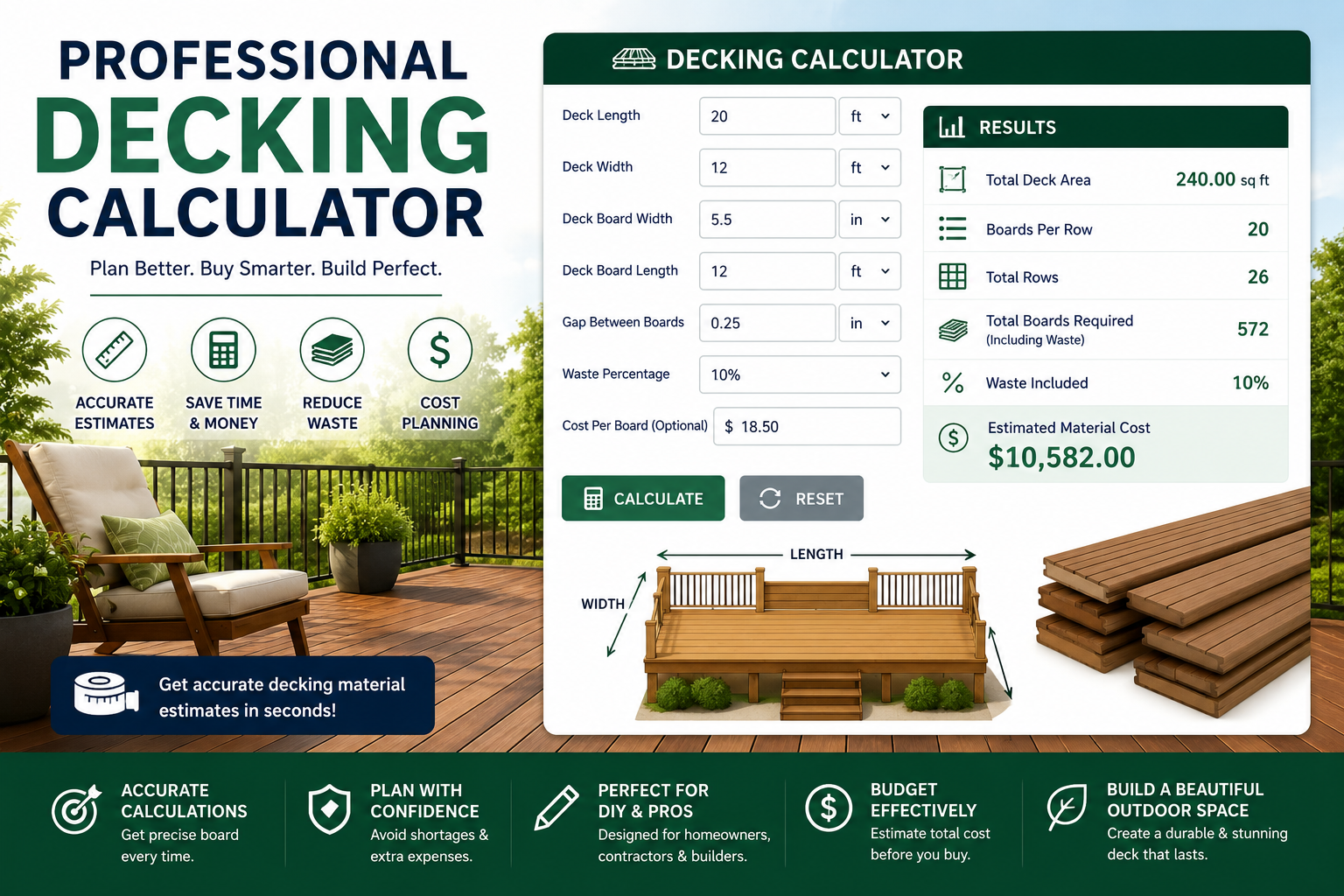
Calculate deck area, decking boards, waste allowance and estimated board cost.
What Is a Decking Calculator?
A Decking Calculator is an online planning tool that helps homeowners, contractors, builders, landscapers, and DIY enthusiasts estimate the amount of decking material required for an outdoor deck. By entering the deck length, deck width, board dimensions, board spacing, waste allowance, and optional board price, you can quickly estimate the deck area, number of rows, boards required, and approximate board cost.
Building a deck requires careful planning because purchasing too little material can cause delays, while purchasing significantly more than necessary can increase the project budget. A Deck Board Calculator reduces this guesswork by converting your measurements into a practical material estimate before you purchase the boards.
Whether you are planning a small backyard deck, a raised platform, a patio deck, or a larger outdoor entertainment area, a decking calculator can make the initial estimating process faster and easier.
How Does a Decking Calculator Work?
A Decking Calculator uses several measurements to estimate how many boards are required to cover the deck surface. The basic information normally includes:
- Deck length
- Deck width
- Decking board width
- Decking board length
- Gap between boards
- Waste allowance
- Optional cost per board
First, the calculator converts the measurements into a consistent unit. It then calculates the total deck surface area. Next, it determines how many boards fit across the deck width while accounting for the selected gap between boards.
The calculator also determines how many board lengths are required along the deck length. These two figures are multiplied to produce a basic board estimate. Finally, the selected waste percentage is added to account for cutting, trimming, damaged boards, and other installation-related losses.
Deck Area Formula
The basic formula used to calculate a rectangular deck area is:
Deck Area = Deck Length × Deck Width
For example, if a deck is 20 feet long and 12 feet wide:
20 × 12 = 240 square feet
Therefore, the deck has a surface area of approximately 240 square feet. The number of boards needed depends on the width, length, and spacing of the decking boards.
How to Calculate Deck Boards
Calculating decking boards requires more than simply dividing the deck area by the board area. Board orientation and the gap between boards also affect the quantity.
For boards running across the deck width, the approximate number of rows can be estimated using:
Rows = Deck Width ÷ (Board Width + Board Gap)
The result is rounded upward because a partial row still requires material.
The number of boards required for each row can then be estimated using:
Boards Per Row = Deck Length ÷ Board Length
The calculator rounds this value upward as well. The estimated rows and boards per row are then multiplied to determine the basic board quantity before waste.
Why Board Spacing Matters
Board spacing is an important part of deck planning. Deck boards are generally installed with a small gap between them to allow water drainage and accommodate movement associated with temperature and moisture changes.
Commonly used deck gaps include approximately:
- 1/8 inch
- 3/16 inch
- 1/4 inch
- Approximately 3–6 mm
The appropriate spacing depends on the decking material, board manufacturer, installation conditions, climate, and moisture content. Always follow the installation instructions for the specific decking product you are using.
Why Add Waste to a Decking Estimate?
A decking project rarely uses every board with zero material loss. Boards may need to be cut, trimmed, joined, or discarded because of defects or damage. This is why a waste allowance is commonly added to a material estimate.
Typical planning allowances may include:
- 5%: Simple layouts with relatively few cuts.
- 10%: A practical general-purpose planning allowance.
- 15%: More complex layouts or projects with additional cuts.
- 20%: Highly complex layouts or projects where additional material is desirable.
These percentages are planning estimates rather than universal requirements. A professional installer may recommend a different allowance depending on the deck design.
Choosing the Right Deck Board Size
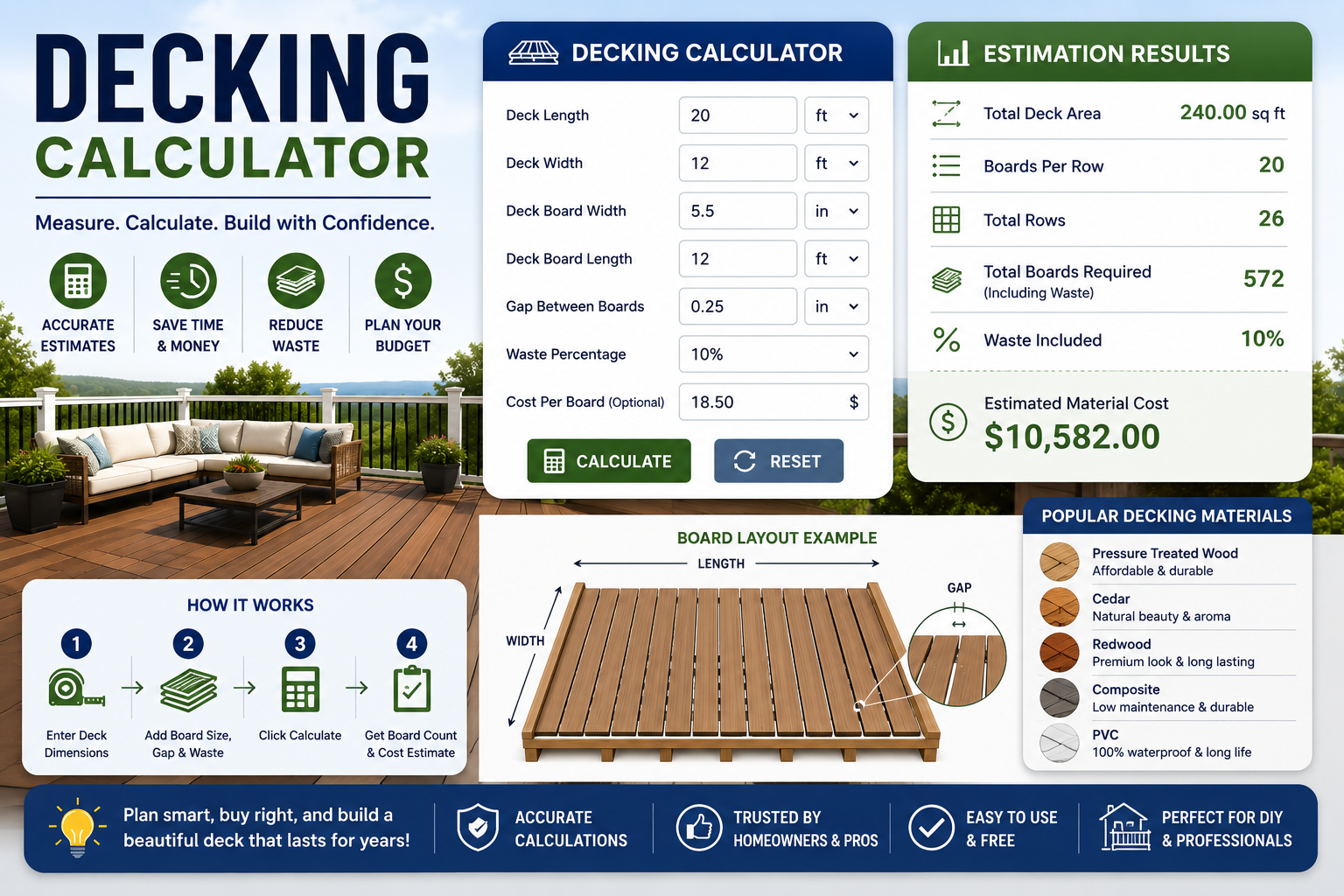
Decking boards are available in different widths and lengths. The correct size depends on the material, design, framing layout, appearance, and manufacturer specifications.
Common decking board widths include approximately:
- 5.5 inches
- 6 inches
- 140 mm
- 145 mm
Common board lengths may include 8, 10, 12, 16, and 20 feet, although availability varies by material and supplier.
Longer boards can reduce the number of visible joints in some designs, but longer material can also be harder to transport and handle. Your final selection should be based on the deck layout and manufacturer's recommendations.
Types of Decking Materials
Choosing the right decking material affects appearance, maintenance, durability, installation requirements, and project cost. A Decking Calculator helps estimate quantities, while material selection determines what those boards will cost and how they will perform.
Pressure-Treated Wood Decking
Pressure-treated lumber is widely used because it is generally affordable and readily available. Treatment helps protect the wood from decay and insects, but the material still requires appropriate maintenance and installation practices.
- Generally affordable
- Widely available
- Suitable for many residential applications
- Requires ongoing maintenance
Cedar Decking
Cedar is a popular natural decking option because of its appearance and natural resistance characteristics. It can provide an attractive outdoor finish but requires maintenance to preserve its appearance.
- Natural appearance
- Lightweight
- Easy to work with
- Requires periodic maintenance
Redwood Decking
Redwood is valued for its natural appearance and durability characteristics. It is often selected for projects where appearance is an important consideration.
- Premium natural appearance
- Good resistance to decay
- Attractive colour
- Usually more expensive than basic lumber
Composite Decking
Composite decking is manufactured from a combination of materials such as wood fibres and polymers. It is popular with homeowners who want a wood-like appearance with less routine maintenance than many traditional wood decks.
- Low routine maintenance
- Resistant to many common outdoor conditions
- Available in many colours and finishes
- Usually has a higher initial material cost than basic treated lumber
PVC Decking
PVC decking is made primarily from plastic rather than wood fibres. Its resistance to moisture makes it useful for many outdoor applications where water exposure is a concern.
- Moisture resistant
- Low maintenance
- Lightweight compared with some hardwoods
- Available in different finishes
Hardwood Decking
Hardwood species such as Ipe and other dense outdoor-rated woods are used for premium deck projects. They can provide excellent durability and an attractive natural appearance, but they may cost considerably more and can require specialized tools or installation methods.
Wood vs Composite Decking
Wood and composite decking are two popular choices for residential projects. The better option depends on budget, desired appearance, maintenance preferences, expected lifespan, and local conditions.
| Feature | Wood | Composite |
|---|---|---|
| Initial Cost | Often lower | Often higher |
| Maintenance | Usually higher | Usually lower |
| Appearance | Natural | Wood-like options |
| Moisture Resistance | Depends on species and treatment | Generally high |
| Maintenance Needs | Regular care may be needed | Generally less routine maintenance |
How to Estimate Deck Material Cost
The total cost of a decking project is influenced by much more than the decking boards themselves. Important cost factors include:
- Total deck area
- Decking material
- Board dimensions
- Number of boards
- Waste allowance
- Framing lumber
- Fasteners and screws
- Railings
- Stairs
- Foundation or footings
- Finishing products
- Labour and installation
- Local material prices
The cost field in this calculator estimates the cost of the decking boards only. It should not be interpreted as the complete cost of building a deck.
Common Deck Sizes
Residential decks can have many different dimensions depending on the available space and intended use. Some common rectangular examples include:
- 8 × 10 feet
- 10 × 10 feet
- 10 × 12 feet
- 12 × 12 feet
- 12 × 16 feet
- 16 × 20 feet
- 20 × 20 feet
You can enter your own measurements into the calculator rather than relying on a standard deck size.
Benefits of Using a Decking Calculator
A Decking Calculator can simplify the early planning stage of a construction project. Some of the main benefits include:
- Quick deck area calculation
- Estimated board quantity
- Waste allowance calculation
- Optional material cost estimate
- Support for feet and metres
- Support for inches and centimetres
- Useful for DIY planning
- Helpful for preliminary contractor estimates
- Reduces manual calculation work
Who Should Use a Decking Calculator?
This tool can be useful for anyone who needs a preliminary estimate for a deck project, including:
- Homeowners
- DIY builders
- Deck contractors
- Carpenters
- Landscape designers
- Construction estimators
- Property developers
- Renovation planners
Deck Maintenance Tips
Proper maintenance can help preserve the appearance and performance of a deck. The exact maintenance routine depends on the decking material and manufacturer's instructions.
- Keep the deck surface free from leaves and debris.
- Clean spills and stains promptly.
- Check boards periodically for damage.
- Inspect fasteners and connections.
- Check railings and stairs regularly.
- Keep drainage areas clear.
- Follow the manufacturer's maintenance instructions.
- Use suitable cleaners and finishes for the selected material.
Common Deck Building Mistakes
Careful planning can help prevent common mistakes that increase material costs or create installation problems.
- Incorrectly measuring the deck
- Forgetting board spacing
- Not including waste
- Buying boards without checking actual dimensions
- Ignoring the direction of board installation
- Failing to plan for stairs and railings
- Using unsuitable fasteners
- Ignoring drainage requirements
- Not checking local building requirements
Planning a Successful Deck Project
Before purchasing materials, measure the proposed deck carefully and determine the layout. Decide which direction the boards will run, choose the board dimensions, and select an appropriate waste allowance.
After calculating the decking boards, remember that a complete deck project may also require structural framing, joists, beams, posts, footings, stairs, railings, fascia, fasteners, flashing, and other components.
Professional Deck Installation Considerations
A material estimate is only one part of a successful deck project. Installation should follow the decking manufacturer's instructions and applicable local requirements.
- Verify all measurements before ordering materials.
- Check the actual dimensions of the boards you are purchasing.
- Plan board direction before calculating quantities.
- Allow for cuts and trimming.
- Use appropriate fasteners for the selected decking material.
- Maintain consistent spacing.
- Provide appropriate drainage.
- Inspect framing before installing decking.
- Check applicable local building requirements.
Frequently Asked Questions About Decking Calculators
1. What is a Decking Calculator?
A Decking Calculator is an online tool that estimates the deck surface area, number of decking boards, waste allowance, and optional board cost. It helps homeowners and builders create a preliminary material estimate before purchasing decking.
2. How do I calculate how many deck boards I need?
Start by measuring the deck length and width. Then enter the board width, board length, and spacing between boards. The calculator estimates the number of rows and boards required and adds the selected waste allowance.
3. What formula is used to calculate deck area?
For a rectangular deck, the basic formula is Length × Width. For example, a 20-foot by 12-foot deck has an area of 240 square feet.
4. How much waste should I add to decking?
A common planning allowance is around 5% to 15%, although the appropriate amount depends on the deck design. Simple rectangular layouts may need less waste, while diagonal patterns, curves, multiple sections, and complex cuts may require more.
5. Does board spacing affect the number of decking boards?
Yes. A wider gap means fewer boards may be required across a given width, while a smaller gap generally requires more boards. Always use the spacing recommended for your specific decking product.
6. Can I use this calculator for composite decking?
Yes. You can use the calculator for composite, PVC, pressure-treated wood, cedar, redwood, hardwood, and other decking materials as long as you enter the appropriate board dimensions.
7. Can I use metres instead of feet?
Yes. The calculator supports both feet and metres for deck dimensions. Board width can be entered in inches or centimetres, while board length can be entered in feet or metres.
8. Can the Decking Calculator calculate the total project cost?
The calculator can estimate the cost of the decking boards when you enter a price per board. It does not calculate the complete project cost, which may also include framing, labour, fasteners, railings, stairs, foundation work, and other materials.
9. What size deck boards are commonly used?
Common decking boards are available in several widths and lengths. A frequently encountered board width is approximately 5.5 inches, but the actual size varies by product and supplier. Always measure the boards you intend to purchase.
10. What is the best decking material?
There is no single best material for every project. Pressure-treated wood can be economical, cedar offers a natural appearance, composite can reduce routine maintenance, PVC provides strong moisture resistance, and hardwoods can provide a premium natural finish.
11. Does the calculator include framing materials?
No. This calculator focuses on the decking boards. Framing components such as joists, beams, posts, footings, and other structural materials require separate calculations based on the deck design and structural requirements.
12. Does the calculator include stairs and railings?
No. Stairs and railings are not included in the board estimate. These components should be measured and estimated separately because their material requirements depend on the specific design.
13. How accurate is a Decking Calculator?
The calculator can provide a useful preliminary estimate when accurate measurements and board specifications are entered. Actual requirements may differ because of cuts, board defects, deck shape, installation pattern, framing design, stairs, and other project details.
14. Can I use this calculator for a small backyard deck?
Yes. The calculator can be used for small residential decks as well as larger rectangular decking projects. Simply enter the actual dimensions and board specifications.
15. Is this Decking Calculator free to use?
Yes. This online Decking Calculator is designed as a free planning tool. You can change the dimensions, board size, spacing, waste percentage, and optional price to create different estimates.
Conclusion
A Decking Calculator makes the initial planning process much easier by estimating deck area, board quantities, waste allowance, and optional decking material cost. Instead of performing multiple calculations manually, you can enter your project measurements and receive an estimate within seconds.
Accurate measurements are important when using any Deck Board Calculator. Measure the deck carefully, confirm the actual dimensions of the boards you plan to purchase, select the appropriate board gap, and include a reasonable waste allowance. Remember that a decking board estimate does not represent the complete construction material list.
For a successful deck project, also consider framing, footings, fasteners, stairs, railings, drainage, local requirements, and the installation instructions provided by the decking manufacturer. With careful planning and accurate material estimates, you can reduce waste, improve budgeting, and make more informed purchasing decisions.
Use this Decking Calculator whenever you need a quick preliminary estimate for a new deck, deck replacement, renovation, or DIY outdoor project.