Cube Surface Area Calculator
Calculate the total surface area of a cube instantly. Enter the side length, select the measurement unit, and get the answer with the formula and calculation steps.
Calculation Result
Side Length:
Formula Used:
Calculation:
Cube Surface Area Formula
Where:
- s = length of one side or edge of the cube.
- A cube has six equal square faces.
- The area of one square face is s².
- Multiplying one face by six gives the total surface area.
Quick Reference Examples
| Side Length | Surface Area |
|---|---|
| 2 cm | 24 cm² |
| 4 cm | 96 cm² |
| 5 cm | 150 cm² |
| 8 cm | 384 cm² |
| 10 cm | 600 cm² |
What Is a Cube Surface Area Calculator?
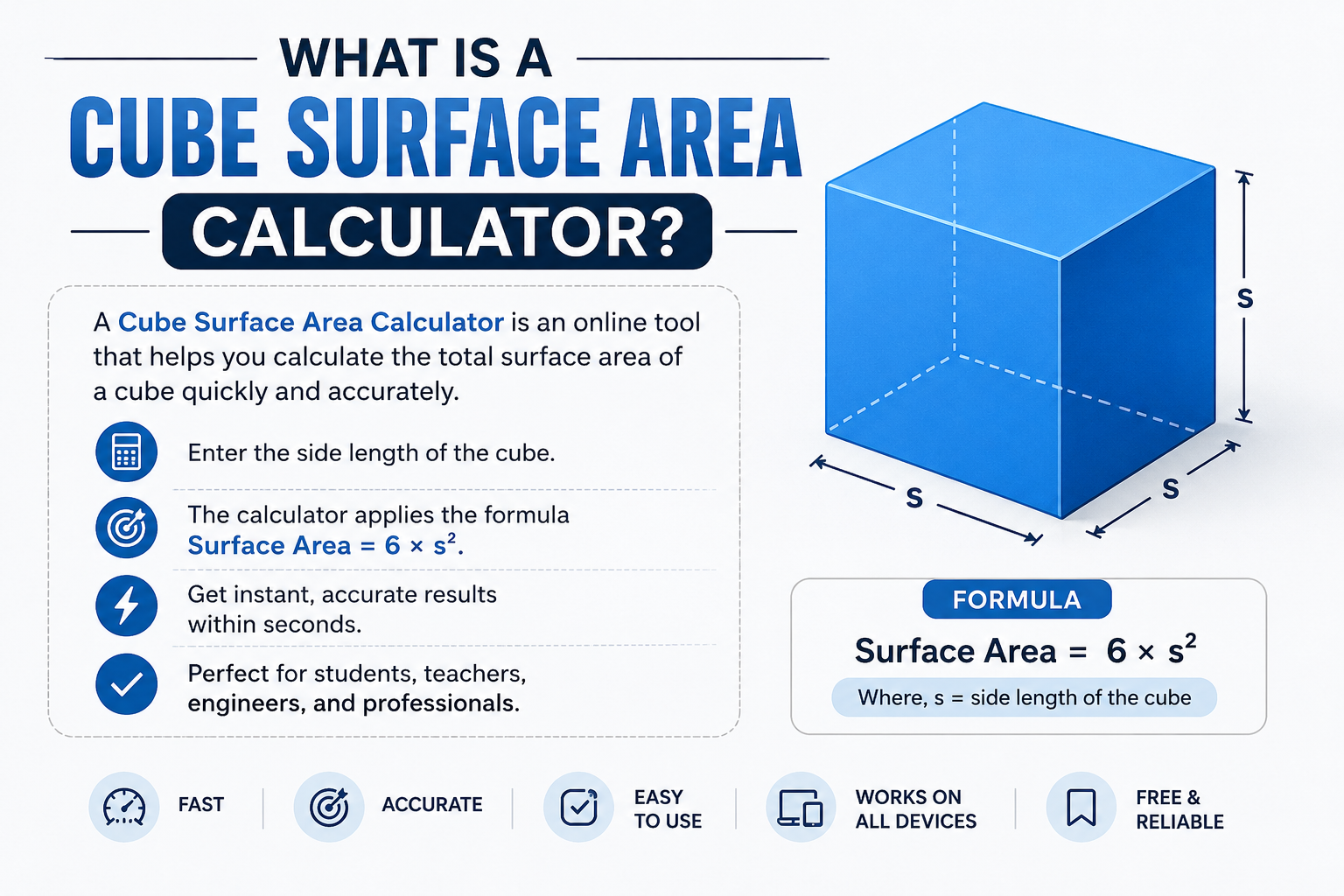
A Cube Surface Area Calculator is an online tool designed to calculate the total outside area of a cube from the length of one of its edges. Because every face of a cube is an identical square, the calculation can be completed using one simple formula: Surface Area = 6 × s².
Instead of calculating the square of the side length manually and then multiplying it by six, you can enter the measurement into the calculator and receive an instant result. The tool also shows the formula and calculation steps, making it useful not only for obtaining an answer but also for understanding how cube surface area is calculated.
This calculator can be useful for students studying geometry, teachers preparing examples, engineers, architects, designers, construction professionals, and anyone working with cube-shaped objects.
What Is the Surface Area of a Cube?
The surface area of a cube is the combined area of all six faces that make up its exterior. A cube has six square faces, and every face has the same side length.
If one edge of the cube measures s, the area of one square face is:
Face Area = s × s = s²
Since a cube has six identical faces, the total surface area is:
Total Surface Area = 6 × s²
Surface area is a two-dimensional measurement, so the final answer is always written in square units. For example, a side measured in centimeters produces a surface area in square centimeters.
- Square millimeters (mm²)
- Square centimeters (cm²)
- Square meters (m²)
- Square inches (in²)
- Square feet (ft²)
Cube Surface Area Formula
SA = 6s²
In this formula:
- SA represents the total surface area.
- s represents the length of one edge of the cube.
- s² represents the area of one square face.
- 6 represents the six faces of a cube.
The formula works because all six faces of a cube have exactly the same dimensions. Once the side length is known, no other measurement is required to find the total surface area.
How to Calculate the Surface Area of a Cube
Calculating cube surface area manually is straightforward. You only need the length of one edge.
Step 1: Find the Side Length
Measure or identify the length of one edge of the cube. Make sure the measurement is expressed in a consistent unit.
Step 2: Square the Side Length
Multiply the side length by itself. For example, if the side length is 7 cm:
7² = 7 × 7 = 49 cm²
Step 3: Multiply by Six
Multiply the area of one face by six because the cube has six identical faces:
6 × 49 = 294 cm²
Step 4: Include Square Units
The final result should always use square units. Therefore, a cube with a 7 cm side has a total surface area of 294 cm².
Worked Examples of Cube Surface Area
Example 1: Side Length of 4 cm
Suppose each edge of a cube measures 4 cm.
SA = 6 × 4²
SA = 6 × 16
SA = 96 cm²
Example 2: Side Length of 5 cm
For a cube with a side length of 5 cm:
SA = 6 × 5²
SA = 6 × 25
SA = 150 cm²
Example 3: Side Length of 10 cm
If each edge measures 10 cm:
SA = 6 × 10²
SA = 6 × 100
SA = 600 cm²
Example 4: Side Length of 12 Inches
A cube with a 12-inch edge has:
SA = 6 × 12²
SA = 6 × 144
SA = 864 in²
Cube Surface Area vs. Cube Volume
Surface area and volume are two different measurements. Surface area describes the total area covering the outside of the cube, while volume describes the amount of three-dimensional space inside it.
| Feature | Surface Area | Volume |
|---|---|---|
| What it measures | Outside area | Inside space |
| Formula | 6 × s² | s³ |
| Units | Square units | Cubic units |
| Example unit | cm² | cm³ |
| Common use | Covering or coating | Storage capacity |
A useful way to remember the difference is that surface area tells you how much material may be needed to cover the outside, while volume tells you how much space the cube contains.
Properties of a Cube
A cube is a three-dimensional geometric solid with several distinctive properties. These properties also explain why its surface area formula is so simple.
- A cube has six square faces.
- It has 12 edges.
- It has 8 vertices or corners.
- All 12 edges have the same length.
- Each interior angle is 90 degrees.
- Opposite faces are parallel.
- All six faces have equal area.
Because all edges are equal, knowing a single side length is enough to determine both the surface area and volume of a cube.
Why Is Cube Surface Area Important?
Surface area is useful whenever you need to determine how much material is required to cover or treat the exterior of a cube-shaped object. This can include paint, wrapping paper, labels, coatings, insulation, or other covering materials.
In mathematics, cube surface area is also an important concept in geometry. Understanding the formula helps students learn how two-dimensional areas combine to describe the exterior of a three-dimensional object.
Real-World Applications of Cube Surface Area
Packaging and Boxes
Cube-shaped boxes are common in packaging. Surface area can help estimate the amount of cardboard, printed material, labels, or wrapping paper required to cover the exterior of a package.
Painting and Coating
If a cube-shaped object needs to be painted or coated, its surface area gives an estimate of the total exterior area that may need treatment.
Construction
Surface area calculations can be useful for estimating materials for cube-shaped structures, decorative features, storage units, and other construction elements.
Manufacturing
Manufacturers may use surface area when designing or finishing cube-shaped products and components. It can help with material estimates and surface treatments.
Education
Students regularly encounter cube surface area problems in geometry, mathematics assignments, tests, and examination preparation.
3D Design and Modeling
Surface measurements can also be useful in computer-aided design, 3D modeling, engineering visualization, and product development.
Common Mistakes When Calculating Cube Surface Area
1. Forgetting to Square the Side
The formula is 6 × s², not 6 × s. The side length must be multiplied by itself before multiplying by six.
2. Using the Volume Formula
The volume of a cube is calculated using s³, while the surface area is calculated using 6s². These formulas should not be confused.
3. Using Linear Units for the Final Answer
Surface area is measured in square units. If the side is measured in feet, the surface area should be reported in square feet (ft²), not simply feet.
4. Mixing Units
Measurements should be converted into a consistent unit before performing calculations. Mixing centimeters and meters without conversion can produce an incorrect result.
5. Rounding Too Early
When measurements contain decimals, it is generally better to keep sufficient precision during the calculation and round the final result rather than rounding too early.
How to Get More Accurate Results
- Measure the cube's edge carefully.
- Confirm that the measurement unit is correct.
- Use the formula 6 × s².
- Keep the same unit throughout the calculation.
- Use square units for the final answer.
- Check decimal calculations before using the result professionally.
- Use an online calculator to verify manual calculations.
Quick Cube Formula Reference
| Calculation | Formula | Units |
|---|---|---|
| One Face Area | s² | Square units |
| Total Surface Area | 6s² | Square units |
| Volume | s³ | Cubic units |
| Number of Faces | 6 | — |
| Number of Edges | 12 | — |
| Number of Vertices | 8 | — |
Benefits of Using This Cube Surface Area Calculator
This calculator is designed to make cube surface area calculations quick and easy. Instead of repeatedly applying the formula manually, you can enter the side length and receive the result immediately.
- Fast and easy to use.
- Provides the total surface area instantly.
- Shows the mathematical formula.
- Displays calculation steps.
- Supports multiple measurement units.
- Works with decimal measurements.
- Useful for school and college geometry.
- Helpful for engineering and design calculations.
- Responsive on smartphones, tablets, and computers.
- No software installation is required.
Frequently Asked Questions About Cube Surface Area
1. What is the formula for the surface area of a cube?
The total surface area of a cube is calculated using SA = 6 × s², where s is the length of one edge. The factor six is used because a cube has six identical square faces.
2. How do I calculate the surface area of a cube manually?
First, square the side length by multiplying it by itself. Then multiply that result by six. For example, a 5 cm cube has a surface area of 6 × 5² = 150 cm².
3. What is the surface area of a cube with a side of 10 cm?
Using the formula 6 × s², the calculation is 6 × 10² = 6 × 100. Therefore, the total surface area is 600 cm².
4. What units are used for cube surface area?
Surface area is expressed in square units, such as mm², cm², m², in², or ft². The unit depends on the unit used for the cube's side length.
5. Is cube surface area the same as cube volume?
No. Surface area measures the total outside area and uses the formula 6s². Volume measures the space inside the cube and uses the formula s³.
6. How many faces does a cube have?
A cube has six equal square faces. This is why the surface area formula multiplies the area of one face by six.
7. Can this calculator calculate decimal side lengths?
Yes. You can enter decimal values such as 2.5, 7.25, or 10.75. The calculator uses the entered value to calculate the surface area.
8. Can I use inches or feet instead of centimeters?
Yes. The calculator supports millimeters, centimeters, meters, inches, and feet. The result is automatically displayed using the corresponding square unit.
9. Why is the final answer written in square units?
Surface area measures a two-dimensional region. Since the formula squares the side length, the resulting unit is also squared. For example, centimeters become square centimeters (cm²).
10. Who can use a Cube Surface Area Calculator?
The calculator can be used by students, teachers, engineers, architects, designers, construction professionals, manufacturers, and anyone who needs to calculate the surface area of a cube.
11. What is the difference between the area of one face and total surface area?
The area of one face is s², while the total surface area includes all six faces and is therefore 6s².
12. Does changing the cube's side length affect surface area?
Yes. Surface area increases with the square of the side length. This means that if the side length doubles, the surface area becomes four times larger because the calculation depends on s².
Conclusion
The Cube Surface Area Calculator provides a quick and convenient way to determine the total outside area of a cube. Since every cube has six identical square faces, the calculation is based on the simple formula 6 × s².
Whether you are working on a geometry assignment, checking an examination problem, estimating material for packaging, planning a coating project, or working with a cube-shaped design, knowing the surface area can be useful. Enter the side length into the calculator above to get an instant result together with the calculation steps.
Remember that surface area is always expressed in square units. Keeping the measurement unit consistent and using the correct formula will help ensure accurate results. This makes the calculator useful for both learning the underlying geometry and completing everyday surface-area calculations.