
Canada CRS Points Calculator
Estimate your Comprehensive Ranking System (CRS) score for Canada's Express Entry system.
Spouse / Common-Law Partner Factors
What Is a CRS Points Calculator?
A CRS Points Calculator is an online tool that helps estimate a candidate's Comprehensive Ranking System (CRS) score for Canada's Express Entry system. The CRS is used by Immigration, Refugees and Citizenship Canada (IRCC) to assess and rank eligible candidates in the Express Entry pool.
Express Entry manages applications for three federal economic immigration programs: the Canadian Experience Class (CEC), Federal Skilled Worker Program (FSWP), and Federal Skilled Trades Program (FSTP). Candidates who are eligible for an Express Entry program can enter the pool, where their profiles are ranked using CRS points.
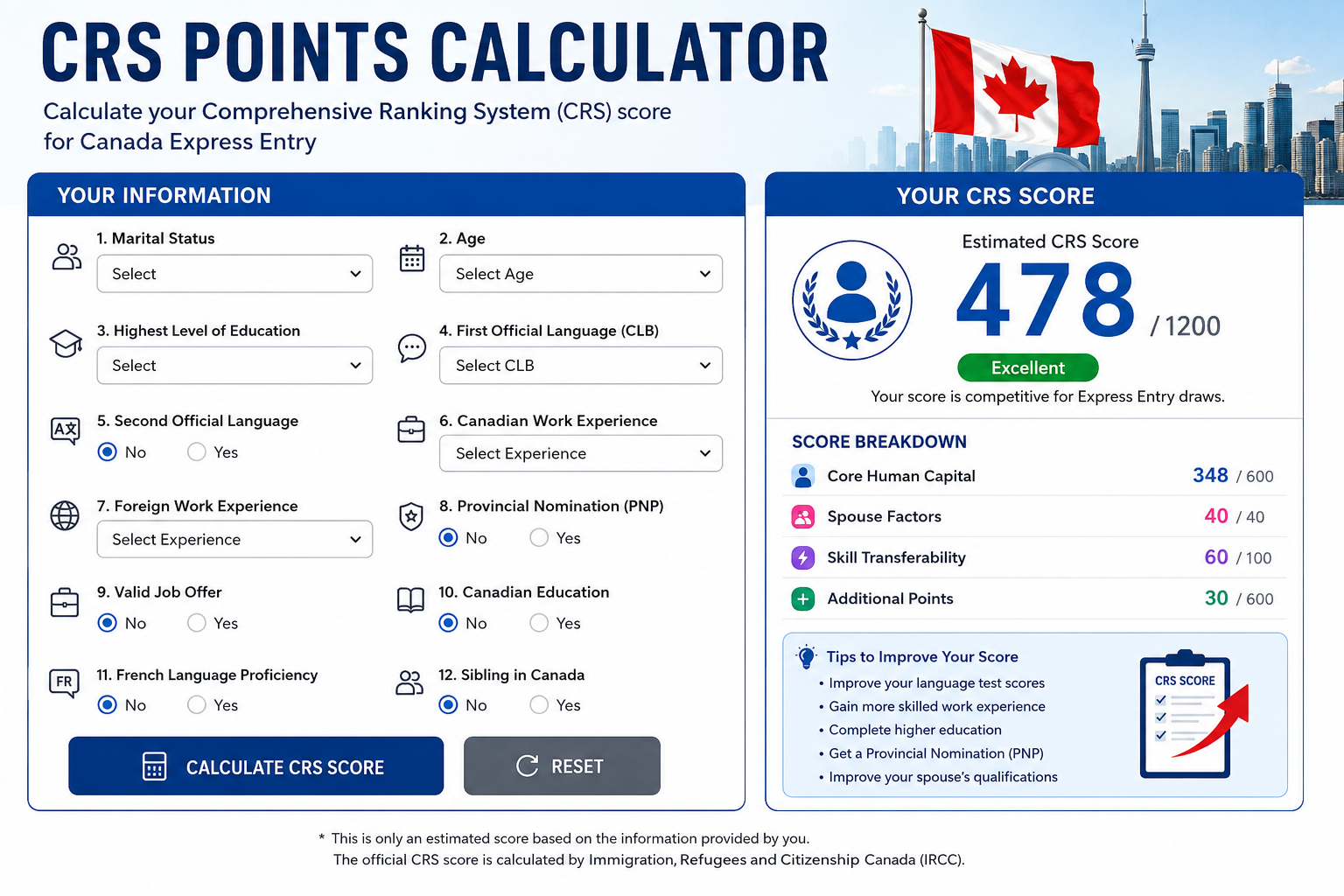
Our CRS Points Calculator Canada is designed to provide a quick estimate based on major CRS factors such as age, education, official language proficiency, Canadian work experience, foreign work experience, spouse factors and additional CRS points.
How Does the Canada CRS Points Calculator Work?
The Comprehensive Ranking System assigns points to different parts of an Express Entry profile. These points are grouped into core or human capital factors, spouse or common-law partner factors, skill transferability factors and additional points.
The maximum CRS score is 1,200 points. The exact number of points available in each category depends on whether the applicant has an accompanying spouse or common-law partner and on the qualifications entered in the Express Entry profile.
CRS Score Breakdown
1. Core Human Capital Factors
Core human capital factors include age, education, first official language, second official language and Canadian work experience. Applicants without an accompanying spouse or common-law partner can receive up to 500 points in this broad category, while applicants with an accompanying spouse or common-law partner have a different allocation.
2. Spouse or Common-Law Partner Factors
If your spouse or common-law partner is accompanying you, their education, official language proficiency and Canadian work experience can contribute additional CRS points. These spouse factors can provide up to 40 points.
3. Skill Transferability Factors
Skill transferability rewards combinations of education, language ability and work experience. For example, strong official language results combined with post-secondary education or foreign work experience may produce additional points.
Skill transferability factors are capped at 100 points. This means that even when several combinations apply, the total points in this category cannot exceed the applicable maximum.
4. Additional CRS Points
Additional points can make a substantial difference to an Express Entry ranking. Current CRS criteria include points for a provincial or territorial nomination, eligible Canadian post-secondary education, French-language proficiency and an eligible sibling living in Canada.
- Provincial or territorial nomination: up to 600 points
- French-language proficiency: up to 50 points
- Canadian post-secondary education: up to 30 points
- Eligible sibling in Canada: up to 15 points
Does a Job Offer Still Give CRS Points?
This is an important update for anyone using an older CRS calculator. As of March 25, 2025, IRCC removed CRS points for job offers. Previously, certain qualifying job offers could provide 50 or 200 CRS points.
A job offer can still matter for eligibility under certain immigration programs or streams, but it no longer adds CRS points to the Express Entry ranking score. Therefore, this calculator does not add job-offer points to the estimated CRS score.
How Age Affects Your CRS Score
Age is one of the core CRS factors. Applicants in the 20-to-29 age range generally receive the highest age-related CRS points. Points gradually decrease as an applicant gets older, and applicants aged 45 or older receive no CRS points for age.
Although age cannot be changed, candidates can potentially improve other parts of their profile, such as language results, education, Canadian work experience or qualifying additional factors.
How Education Affects CRS Points
Education is another major component of the CRS. Higher educational qualifications generally receive more points than a high school credential alone.
Educational credentials completed outside Canada may need an Educational Credential Assessment (ECA) to establish their Canadian equivalency for Express Entry purposes. The exact CRS points depend on the Canadian equivalency of the credential.
How Language Test Results Affect CRS
Official language proficiency is one of the most important areas of the CRS. English and French results can affect core language points as well as skill transferability points.
Approved language tests can include IELTS General Training, CELPIP-General, PTE Core, TEF Canada and TCF Canada, depending on the language and current IRCC requirements. Your individual reading, writing, listening and speaking results determine the applicable Canadian Language Benchmark (CLB) or NCLC level.
How to Improve Your CRS Score
If your estimated CRS score is lower than you would like, there are several areas worth reviewing. The most practical options depend on your personal profile and eligibility.
- Improve your English or French language test results.
- Gain additional eligible skilled work experience.
- Complete additional eligible education.
- Gain qualifying Canadian work experience.
- Consider eligible Canadian education options.
- Explore provincial or territorial nomination opportunities.
- Check whether you qualify for French-language additional points.
- Check whether you have an eligible sibling in Canada.
- Review your spouse or common-law partner's qualifications.
Why Use a CRS Points Calculator?
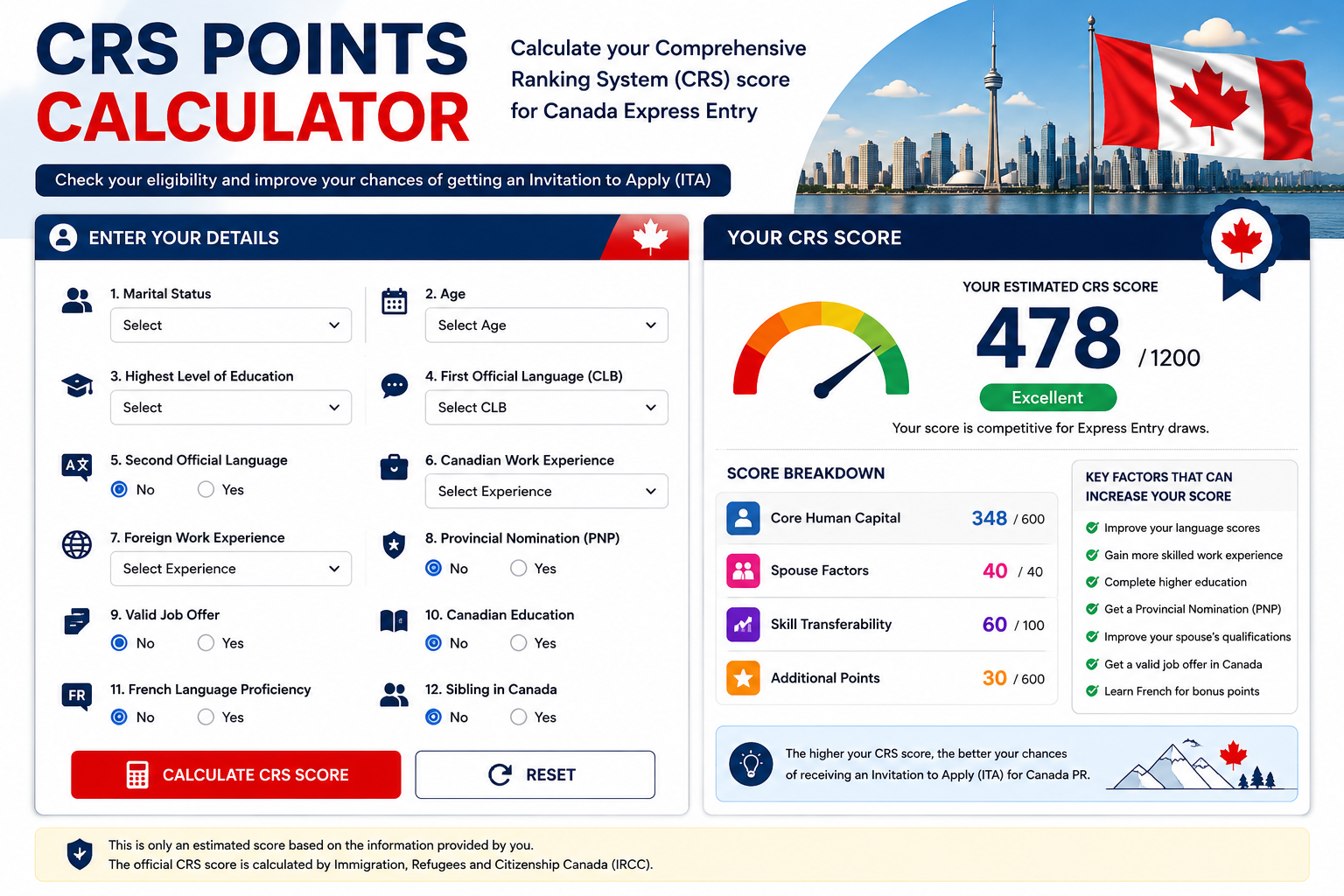
Calculating CRS points manually can be confusing because the system contains several categories and combinations. A CRS calculator provides a convenient way to estimate your score before creating or updating an Express Entry profile.
- Quickly estimates your CRS score.
- Shows the main components contributing to your score.
- Helps identify areas where your profile may be improved.
- Makes it easier to compare different immigration scenarios.
- Helps candidates prepare before entering the Express Entry pool.
- Provides a useful starting point for immigration planning.
CRS Score and Express Entry Invitations
Express Entry candidates are ranked in the pool according to their CRS scores. IRCC conducts rounds of invitations and establishes a minimum CRS score for each applicable round. The cut-off can change from one round to another depending on the type of draw, number of invitations and the candidates in the pool.
Because CRS cut-off scores can change, there is no single CRS score that guarantees an Invitation to Apply (ITA). A calculator can help you understand your current position, but it cannot predict the result of a future Express Entry draw.
CRS Calculator Canada: Important Limitations
This online CRS calculator is intended for estimation and educational purposes. It is not an official IRCC calculator and does not create an Express Entry profile or immigration application.
The simplified language inputs assume the same CLB level for all four abilities. In an actual Express Entry profile, reading, writing, listening and speaking scores can be different. Your official CRS calculation may therefore be different from the result shown here.
Always verify your score and eligibility against the latest information published by Immigration, Refugees and Citizenship Canada before making an immigration decision.
Frequently Asked Questions About CRS Points Calculator
1. What is a CRS Points Calculator?
A CRS Points Calculator estimates your Comprehensive Ranking System score for Canada's Express Entry system using factors such as age, education, language proficiency, work experience, spouse factors and additional points.
2. What does CRS stand for?
CRS stands for Comprehensive Ranking System. It is the points-based ranking system used by IRCC to assess and rank eligible Express Entry candidates.
3. What is the maximum CRS score?
The maximum CRS score is 1,200 points. The score is divided among core human capital factors, spouse factors, skill transferability and additional points.
4. Does age affect CRS points?
Yes. Age is an important CRS factor. Applicants aged 20 to 29 generally receive the highest age-related points, while applicants aged 45 or older receive no points for age.
5. Does IELTS increase CRS points?
Yes. Your approved English language test results can affect your CRS language points. Higher CLB levels can also help with certain skill transferability combinations.
6. Does a provincial nomination increase CRS points?
Yes. An eligible provincial or territorial nomination can provide up to 600 additional CRS points.
7. Do job offers still give CRS points?
No. IRCC removed CRS points for job offers effective March 25, 2025. However, job-offer requirements can still matter for eligibility under certain immigration programs or streams.
8. Can I improve my CRS score?
Yes. Depending on your circumstances, improving language results, gaining eligible work experience, completing education, obtaining qualifying Canadian credentials, receiving a provincial nomination or qualifying for additional points may improve your CRS score.
9. Is this CRS calculator official?
No. This is an independent estimation tool. Your official CRS score is determined by IRCC using the information and documents in your Express Entry profile.
10. Can I use this calculator before creating an Express Entry profile?
Yes. An estimated CRS score can help you understand your potential ranking before creating or updating an Express Entry profile. You should still confirm eligibility and scoring requirements through the official IRCC website.
Conclusion
The CRS Points Calculator Canada is a useful planning tool for people considering permanent residence through Canada's Express Entry system. By entering information about your age, education, language ability, Canadian and foreign work experience, spouse factors and additional qualifications, you can get an estimate of your potential CRS score.
Your CRS score is only one part of the immigration process. Express Entry eligibility, the type of invitation round, current CRS cut-off, document requirements and other IRCC rules can all affect your immigration journey. Because CRS rules can change, candidates should always verify important information with the latest official IRCC guidance.
Use this calculator as a starting point to understand your profile, identify possible areas for improvement and prepare more effectively for Canada's Express Entry process.