
Estimate your Canada Express Entry Comprehensive Ranking System (CRS) score using your age, education, language results, Canadian and foreign work experience, spouse factors and additional CRS points.
1. Personal Information
2. Education
3. First Official Language
Select your CLB/NCLC level for each language ability. Use the benchmark corresponding to your approved language test.
4. Second Official Language
5. Work Experience
7. Additional CRS Points
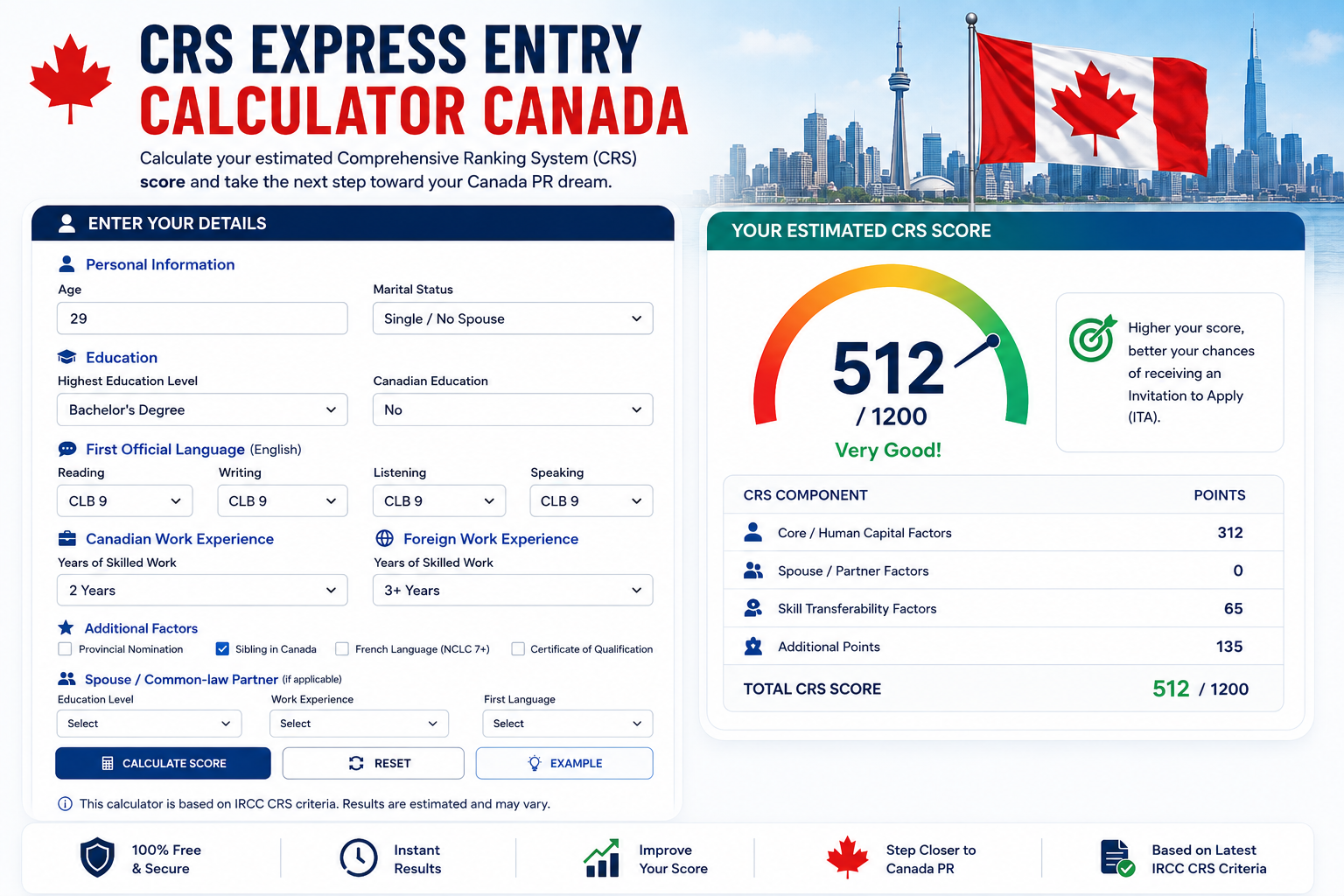
What Is the CRS Express Entry Calculator Canada?
The CRS Express Entry Calculator Canada is an online tool that helps you estimate your Comprehensive Ranking System score for Canada's Express Entry system. The CRS is used by Immigration, Refugees and Citizenship Canada (IRCC) to assign points to eligible candidates and rank profiles in the Express Entry pool.
Your CRS score is calculated from several factors, including age, education, official language ability, Canadian work experience, spouse or common-law partner factors, skill transferability and additional points such as a provincial nomination, Canadian education, French-language ability and an eligible sibling living in Canada.
This PR Points Calculator Canada provides an estimate based on the information you enter. It is useful for understanding how different parts of an Express Entry profile contribute to the overall CRS score.
How the Canada Express Entry CRS Score Works
The Comprehensive Ranking System has a maximum of 1,200 points. The scoring structure contains core or human-capital factors, spouse factors, skill-transferability factors and additional factors.
| CRS Component | Maximum Points |
|---|---|
| Core / Human Capital Factors | 500 without spouse / 460 with spouse |
| Spouse or Common-Law Partner Factors | 40 |
| Skill Transferability | 100 |
| Additional Factors | 600 |
| Total Maximum CRS Score | 1,200 |
CRS Age Points
Age is one of the core CRS factors. Under the current scoring grid, the maximum age points are available between ages 20 and 29. CRS age points decrease as age increases and reach zero at age 45 or older.
| Age | Without Spouse | With Spouse |
|---|---|---|
| 17 or younger | 0 | 0 |
| 18 | 99 | 90 |
| 19 | 105 | 95 |
| 20–29 | 110 | 100 |
| 30 | 105 | 95 |
| 35 | 77 | 70 |
| 40 | 50 | 45 |
| 44 | 6 | 5 |
| 45+ | 0 | 0 |
Education and CRS Points
Education is another major component of the CRS. For education completed outside Canada, an Educational Credential Assessment may be required when applicable. The calculator uses the CRS education categories rather than simply counting the number of degrees or certificates.
For example, two or more credentials can fall into a different CRS category when at least one of the credentials represents a program of three years or longer. A master's, qualifying professional degree or doctoral degree also has its own CRS category.
Language Test Scores and CLB Levels
Language ability can have a substantial effect on an Express Entry CRS calculation. The first official language is scored separately for reading, writing, listening and speaking.
The CRS calculator therefore asks you to enter the CLB or NCLC level for each ability rather than entering one overall language score. This allows the calculation to reflect the individual language abilities used by the CRS grid.
Why CLB 9 Is Important in CRS Calculations
CLB 9 is an important threshold within several skill-transferability combinations. Depending on the education and work-experience combination, reaching CLB 9 in all four first-language abilities can change the number of transferability points available.
For this reason, someone checking their Express Entry points calculator result should look not only at the first-language points but also at how language results interact with education and work experience.
Canadian and Foreign Work Experience
Canadian skilled work experience contributes to the core CRS score. The current grid awards different amounts depending on whether the candidate has one, two, three, four, or five or more years of qualifying Canadian work experience.
Foreign skilled work experience is also relevant because it can interact with official language ability and Canadian work experience under the skill-transferability section.
Spouse or Common-Law Partner CRS Points
If an accompanying spouse or common-law partner is included in the profile, the CRS calculation changes. The main applicant's maximum core/human-capital points are lower than the no-spouse maximum, while up to 40 points can be awarded for spouse factors.
Spouse factors include education, official language ability and Canadian work experience. This is why the calculator asks for separate spouse information when you select the accompanying-spouse option.
Skill Transferability Factors
Skill transferability is designed around combinations of education, language ability and work experience. It can provide up to 100 CRS points.
The major combinations include:
- Education combined with first official language ability.
- Education combined with Canadian work experience.
- Foreign work experience combined with official language ability.
- Foreign work experience combined with Canadian work experience.
- A certificate of qualification combined with official language ability.
Each applicable combination has its own maximum, and the overall skill-transferability category is capped at 100 points.
Additional CRS Points
Additional factors can contribute up to 600 points. The largest single additional factor is a provincial or territorial nomination, which can contribute 600 CRS points.
Other additional factors include qualifying post-secondary education in Canada, French-language proficiency and an eligible brother or sister living in Canada who meets the applicable requirements.
| Additional Factor | Maximum Points |
|---|---|
| Provincial or Territorial Nomination | 600 |
| French-language proficiency | 25 or 50 |
| Eligible sibling in Canada | 15 |
| Eligible Canadian post-secondary education | 15 or 30 |
French Language Points in the CRS
French-language ability can provide additional CRS points when the required French-language benchmark is achieved in all four abilities. The additional points can be 25 or 50 depending on the applicable English language results.
The calculator includes both French bonus options so you can include the appropriate additional points when estimating your CRS score.
Does a Job Offer Add CRS Points?
Under the current CRS rules, job offers no longer provide separate CRS ranking points. IRCC removed job offer points from the CRS effective March 25, 2025.
This does not mean that job offers are irrelevant to every Express Entry pathway. A valid job offer can still matter for eligibility requirements in certain programs or provincial nomination streams. Therefore, CRS ranking points and program eligibility should be treated as two separate questions.
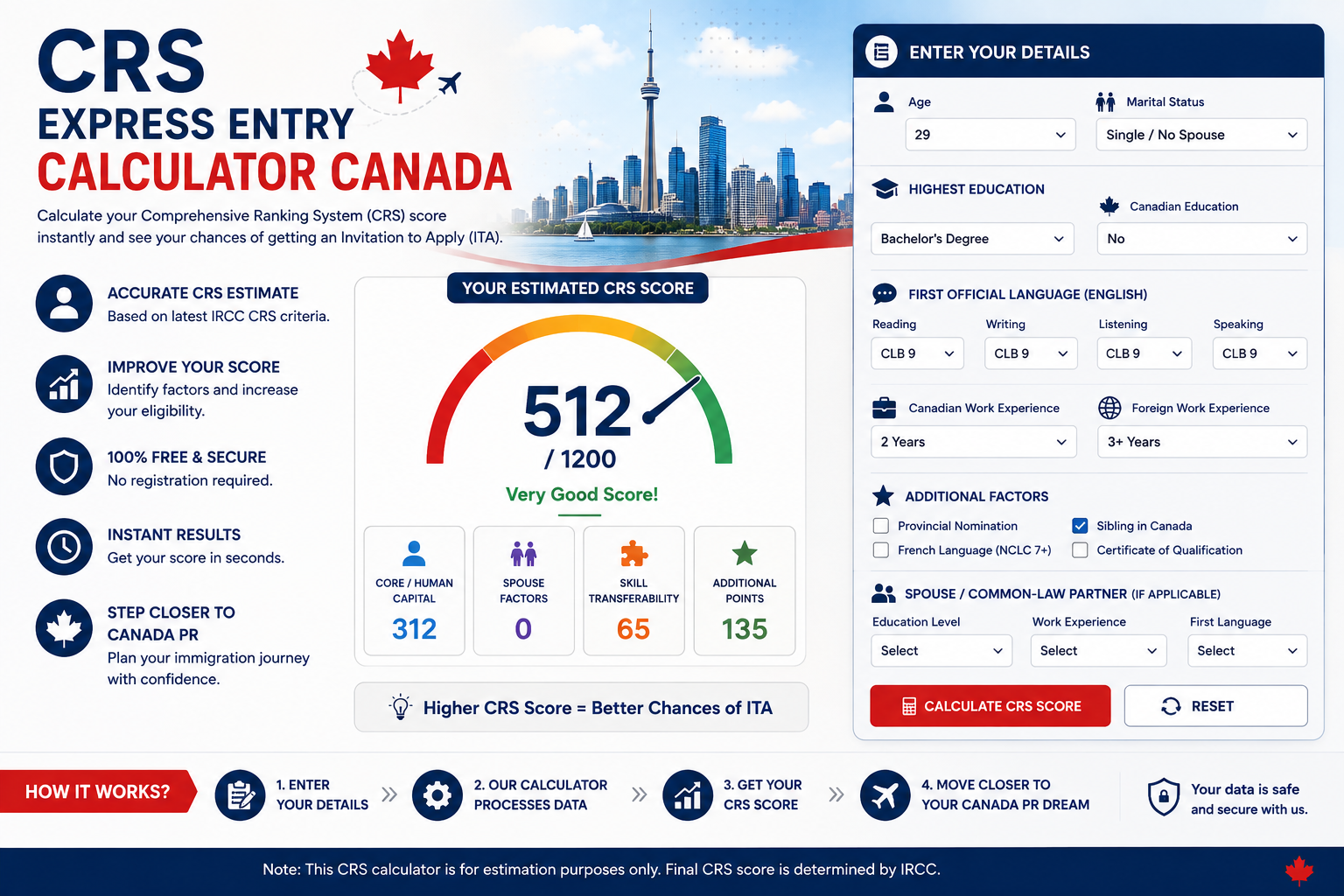
How to Use This PR Points Calculator Canada
- Enter your age.
- Select whether you have an accompanying spouse or common-law partner.
- Select your highest education credential.
- Enter the CLB/NCLC level for each first-language ability.
- Enter your second official language results if applicable.
- Select your Canadian and foreign skilled work experience.
- If applicable, enter your spouse's education, language and Canadian work experience.
- Enter applicable additional CRS factors.
- Click Calculate CRS Score.
The result shows the estimated total as well as separate sections for core factors, spouse factors, skill transferability and additional points. This makes it easier to understand where the calculated CRS score comes from.
CRS Calculator vs PR Points Calculator
The terms CRS Calculator, Express Entry Calculator, and PR Points Calculator Canada are often used interchangeably online. In the context of Express Entry, the relevant ranking system is the Comprehensive Ranking System, or CRS.
The CRS score is used to rank profiles in the Express Entry pool. It should not be confused with the separate eligibility criteria used by individual Express Entry programs.
CRS Score and Express Entry Invitations
Your CRS score is one part of the Express Entry ranking process. Invitation rounds can have different requirements, categories and cut-off scores. A historical cut-off should not be treated as a permanent minimum score because invitation rounds and candidate profiles can change.
For the most current invitation-round information, candidates should check the official IRCC Express Entry information and invitation-round announcements.
Frequently Asked Questions About CRS Express Entry Calculator
What is the maximum CRS score in Express Entry?
The maximum CRS score is 1,200 points. The system includes up to 500 or 460 core/human-capital points depending on spouse status, up to 40 spouse points, 100 skill-transferability points and up to 600 additional points.
Does a job offer give CRS points in 2026?
No. IRCC removed job-offer points from the CRS effective March 25, 2025. A job offer may still be relevant to eligibility for certain programs or provincial streams.
How many CRS points can a provincial nomination add?
A qualifying provincial or territorial nomination can add 600 additional CRS points.
How many CRS points can a sibling in Canada add?
An eligible brother or sister living in Canada can add 15 additional CRS points when the applicable requirements are met.
Can French language ability increase my CRS score?
Yes. French-language proficiency meeting the applicable NCLC 7 threshold in all four abilities can provide 25 additional points in one situation or 50 when the required English benchmark is also met.
What is the role of CLB 9 in the CRS?
CLB 9 can affect both first-language points and certain skill-transferability combinations. The exact effect depends on your education and work-experience profile.
Does having a spouse reduce CRS points?
The CRS grid uses different maximums depending on whether a spouse or common-law partner accompanies the applicant. With an accompanying spouse, core/human-capital points have a maximum of 460 and spouse factors can provide up to 40 additional points.
Is this calculator the official IRCC CRS calculator?
No. This is an independent estimation tool designed to help users understand the CRS scoring structure. Always verify your final score and profile information with the official IRCC resources before making immigration decisions.
Is CRS score the same as Express Entry eligibility?
No. CRS is used to rank profiles in the Express Entry pool. Eligibility for an Express Entry program is a separate matter and depends on the requirements of the program you are applying under.
Can my CRS score change after I create an Express Entry profile?
Yes. Your circumstances can change, such as receiving a new language test result, gaining additional work experience, completing eligible education or changing family circumstances. Profiles should be kept up to date when relevant changes occur.
Conclusion
The CRS Express Entry Calculator Canada provides a practical way to estimate your Express Entry CRS score using the major factors that make up the current scoring system. By entering your age, education, language results, work experience, spouse information and additional factors, you can see how the different CRS sections contribute to your estimated total.
Remember that a calculator is an estimate and that your actual Express Entry profile is assessed using the information and documents you provide to IRCC. CRS rules and immigration program requirements can change, so check the official Government of Canada information for the latest requirements before submitting or updating an Express Entry profile.