
Estimate your chess performance rating using your current rating, average opponent rating, games played, and games won.
Chess Group Calculator Canada
The Chess Group Calculator is an easy online tool for chess players who want to estimate their performance during a group of games, tournament, club event, or online competition. By entering your current rating, average opponent rating, number of games played, and games won, you can quickly see an estimated performance rating and overall win rate.
Chess performance can be difficult to judge from wins and losses alone. The strength of the opponents you face also matters. Winning several games against highly rated players can represent a stronger tournament performance than achieving the same number of wins against lower-rated opponents. This calculator gives players a simple way to look at those factors together.
What Is a Chess Group Calculator?
A Chess Group Calculator is an online chess performance estimation tool. It uses the average rating of the opponents and the player's tournament score to estimate the rating level represented by that performance.
The calculator is particularly useful when you want a quick tournament review without waiting for an official rating update. It can help you understand whether your results were broadly above, near, or below the rating level of the opposition you faced.
How Does the Chess Performance Calculator Work?
The calculator first determines your score percentage from the number of games won and the total number of games played. It then compares that result with the average rating of your opponents.
For this simplified calculator, the estimated performance rating is calculated using the following approach:
For example, if a player wins 6 out of 10 games, the score percentage is 60%. If the average opponent rating is 1700, the calculator produces an estimated performance rating based on that score and opponent level.
This is a simplified educational estimate rather than a complete official rating calculation. Official rating systems can use more detailed rules, rating periods, opponent information, tournament conditions, and other factors.
What Information Do You Need?
You only need four pieces of information to use this calculator:
- Your Current Rating: Enter your existing chess rating.
- Average Opponent Rating: Enter the average rating of the opponents you faced.
- Games Played: Enter the total number of games.
- Games Won: Enter the number of games you won.
Make sure that the number of games won is not greater than the total number of games played. If your event included draws, remember that this simplified calculator does not separately ask for draws.
Understanding Your Chess Performance Rating
A performance rating is different from your permanent or official chess rating. Your official rating generally represents your established rating under the rules of the organization maintaining the rating list, while performance rating is commonly used to describe the rating level represented by a particular set of results.
A performance estimate can therefore be useful after a tournament. It lets you compare the level of your results with the rating level of the opposition you played.
Why Average Opponent Rating Matters
The average rating of your opponents provides important context for tournament results. A player's win percentage does not tell the entire story without considering who the player competed against.
For example, winning six games against opponents with an average rating of 1800 gives different information from winning six games against opponents with an average rating of 1200.
FIDE documentation uses the concept of Average Rating of Opponents (ARO), calculated from opponents' ratings divided by the number of games considered. :contentReference[oaicite:1]{index=1}
Chess Rating and Performance Rating: What's the Difference?
| Term | Meaning |
|---|---|
| Current Rating | Your existing rating before the event. |
| Opponent Rating | The rating level of the players you competed against. |
| Performance Rating | An estimate of the rating level represented by your results. |
| Win Rate | The percentage of games won from the total games played. |
Who Can Use This Chess Calculator?
This chess performance calculator can be useful for players at different stages of their chess journey. You do not need to be a professional player to use it.
- Beginner chess players
- School chess players
- University students
- Chess club members
- Local tournament players
- Online chess players
- Chess coaches
- Parents tracking a young player's tournament progress
Benefits of Using a Chess Performance Calculator
- Quick tournament performance estimate
- Simple and easy-to-use interface
- Instant win-rate calculation
- Useful for post-tournament analysis
- Helps compare results with opponent strength
- Useful for tracking progress over multiple events
- Can support personal chess training goals
Chess in Canada
Chess is played in schools, community clubs, universities, local events, and competitive tournaments across Canada. Players may participate in casual games as well as organized competitions.
A simple chess performance calculator can be useful for Canadian players who want to review their tournament results, compare their performance with the strength of their opponents, and keep a personal record of their progress.
How to Improve Your Chess Performance
A calculator can show you what happened during a group of games, but improvement comes from reviewing those games and identifying recurring mistakes.
- Review your games after each tournament.
- Study tactical patterns regularly.
- Practice calculation instead of relying only on opening memory.
- Learn basic and advanced endgame principles.
- Study your losses carefully.
- Analyse critical positions where the game changed direction.
- Play regularly against appropriately challenging opponents.
- Build a consistent chess training routine.
Common Chess Performance Mistakes
Players sometimes focus only on the final result of a game. A win does not always mean the game was played accurately, and a loss does not always mean the entire game was poor.
- Looking only at the final result
- Ignoring tactical mistakes
- Spending too much time memorizing openings
- Not reviewing losses
- Playing too quickly in critical positions
- Ignoring endgame practice
- Not keeping records of tournament performance
Chess Performance Calculator Example
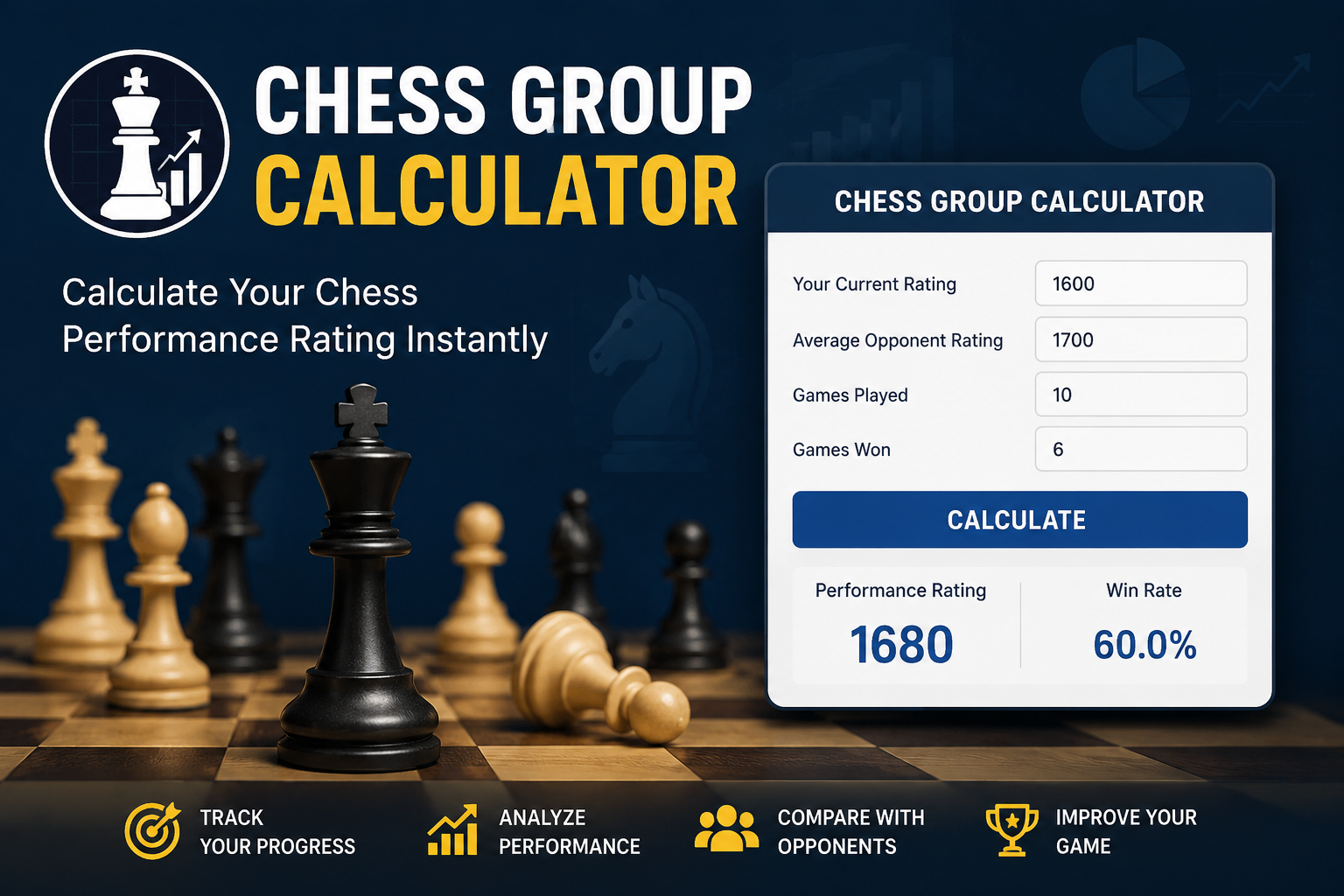
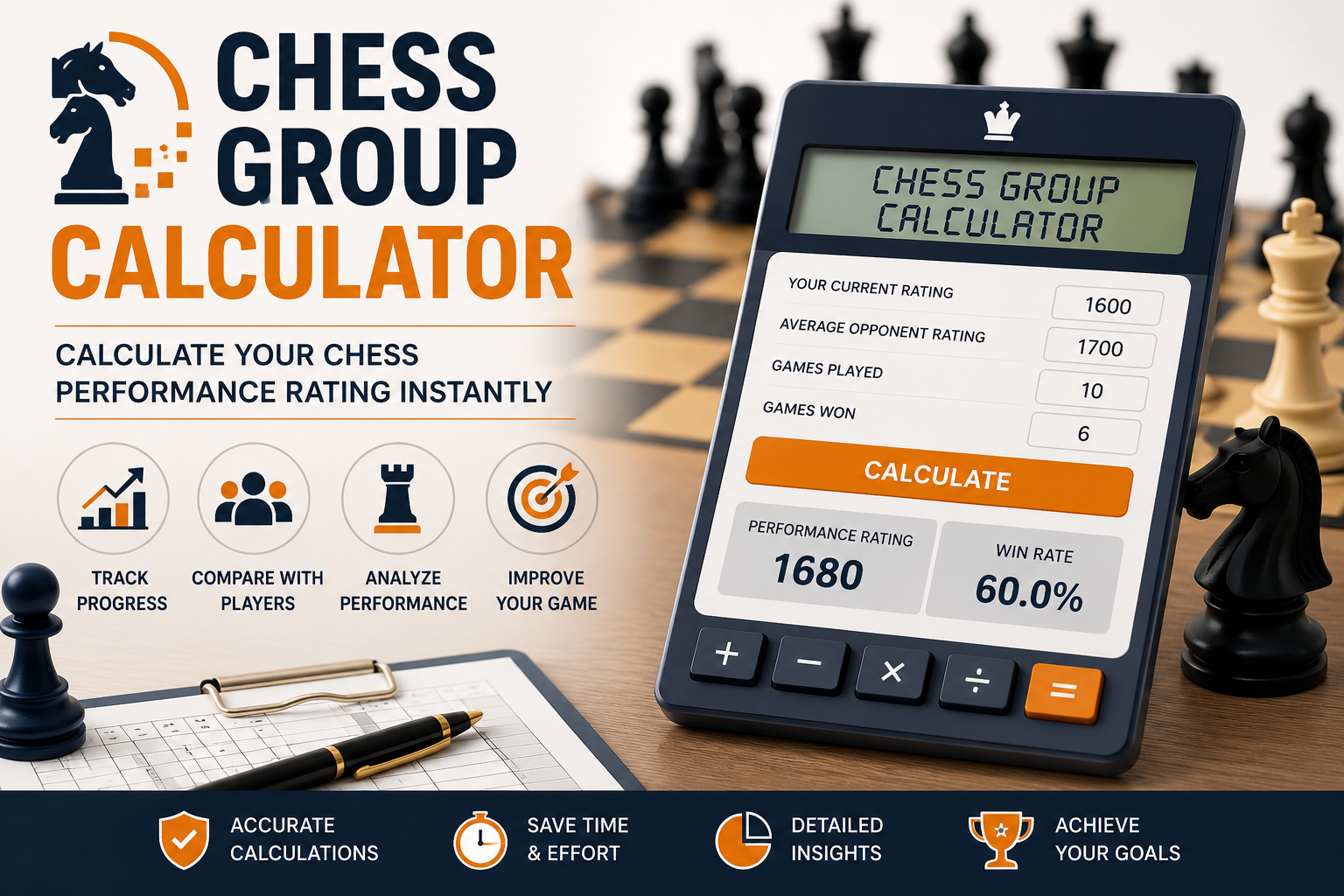
Suppose a player has a current rating of 1600 and faces opponents with an average rating of 1700. If the player competes in 10 games and wins 6, the win rate is 60%.
The calculator uses the average opponent rating and the player's score percentage to produce a simplified performance estimate. The current rating is displayed as part of the input information but is not directly added to the performance formula.
This distinction is important because performance rating and actual rating change are not the same thing.
Is This an Official Chess Rating Calculator?
No. This is an educational and informational chess performance calculator. It should not be used as a replacement for an official rating calculation from a chess federation or tournament rating authority.
Official rating calculations may involve rules and information that are not included in this simplified tool. Therefore, use the result as a quick estimate when reviewing your performance.
Frequently Asked Questions
1. What is a Chess Group Calculator?
A Chess Group Calculator is an online tool that estimates chess performance using game results and the average rating of opponents.
2. What does a chess performance rating mean?
A performance rating is an estimate of the rating level represented by a player's results against a particular group of opponents. It is different from an official rating.
3. Does my current rating affect the performance result?
In this simplified calculator, your current rating is collected for comparison, but the estimated performance rating is based on your score percentage and average opponent rating.
4. Can I use this calculator after a tournament?
Yes. Enter the total number of games, games won, and average rating of your opponents to get a quick performance estimate.
5. Can beginners use the Chess Performance Calculator?
Yes. The calculator is designed to be simple enough for beginners, club players, school players, and experienced tournament players.
6. Does the calculator include chess draws?
This simplified version asks only for games played and games won. It does not separately calculate half-points from drawn games, so tournaments containing many draws may require a more detailed performance calculation.
7. Is the result an official FIDE rating?
No. The result is only an estimate. Official rating systems use their own rules and calculations.
8. Why is average opponent rating important?
Opponent strength provides context for your results. The same number of wins can represent different levels of performance depending on the ratings of the players you faced.
9. Can Canadian chess players use this calculator?
Yes. Players in Canada can use it for personal tournament analysis, club events, school competitions, online games, and other chess activities.
10. Can this calculator predict my next official rating?
No. It estimates performance for the games entered and does not predict or calculate an official future rating.
Final Thoughts
The Chess Group Calculator is a simple way to review chess results and estimate the performance level represented by a group of games. By considering your games won and the average rating of your opponents, you can gain a clearer picture of how your tournament performance compares with the opposition you faced.
For the most useful long-term analysis, combine calculator results with game reviews, tactical practice, opening preparation, and endgame training. Remember that this calculator provides a simplified estimate and should not be treated as an official federation rating calculation.