
Use this Canada Payroll Tax Calculator to estimate your pay-period income tax, CPP contribution, EI premium, total deductions, and take-home pay. Enter your gross salary, province, and pay frequency to get a quick payroll estimate.
Payroll Tax Estimate
| Gross Pay Per Period | $0.00 |
| Estimated Income Tax | $0.00 |
| CPP Contribution | $0.00 |
| EI Premium | $0.00 |
| Total Deductions | $0.00 |
| Estimated Net Pay | $0.00 |
Canada Payroll Tax Calculator 2026
Our Canada Payroll Tax Calculator is designed to help employees, employers, freelancers, and job seekers estimate take-home pay after common payroll deductions. By entering your salary, province or territory, pay frequency, CPP rate, EI rate, and estimated income tax rate, you can quickly see an approximate amount of money remaining after deductions.
Payroll calculations in Canada can be complicated because deductions depend on several factors. Your province or territory, income, pay schedule, tax credits, CPP contributions, EI premiums, and other payroll information can all affect the amount shown on your paycheque.
What Is a Canada Payroll Tax Calculator?
A Canada Payroll Tax Calculator is an online tool that provides an estimate of payroll deductions and net pay. Instead of calculating every deduction manually, users can enter their gross earnings and selected payroll information to understand how much they may receive after estimated deductions.
A typical Canadian payroll calculation may involve income tax, Canada Pension Plan (CPP) contributions, and Employment Insurance (EI) premiums. Employees may also have other deductions such as group benefits, pension contributions, union dues, or other employer-specific amounts.
How Payroll Tax Works in Canada
Canadian employers generally withhold required payroll deductions from employee earnings and remit applicable amounts to the government. The amount withheld is not simply a fixed percentage for every employee. Payroll withholding can depend on annual earnings, payroll frequency, tax credits, province or territory, and other information provided by the employee.
This is why two employees with the same gross salary may not necessarily have exactly the same net pay.
Federal and Provincial Income Tax
Employees in Canada can be subject to federal income tax as well as provincial or territorial income tax, depending on their place of employment and applicable rules. Tax rates are generally progressive, meaning different portions of taxable income can be taxed at different rates.
Canada Pension Plan (CPP)
CPP contributions are payroll deductions that help provide benefits under the Canada Pension Plan. Employee contributions are generally based on pensionable earnings and are subject to annual contribution limits and applicable exemptions.
Employment Insurance (EI)
EI premiums are generally deducted from insurable employment earnings. Employees who meet the applicable requirements may qualify for Employment Insurance benefits in certain circumstances.
How to Use the Canada Payroll Tax Calculator
Using the calculator is simple. Follow these steps:
- Enter your gross salary in Canadian dollars.
- Select whether the salary is annual or monthly.
- Select your province or territory.
- Choose your pay frequency.
- Review the CPP rate shown in the calculator.
- Review the EI rate shown in the calculator.
- Enter an estimated income tax percentage.
- Click Calculate Payroll.
- Review your estimated gross pay, deductions, and net pay.
Gross Pay vs Net Pay
Gross pay is the amount you earn before payroll deductions. Net pay, sometimes called take-home pay, is the amount remaining after applicable deductions have been subtracted.
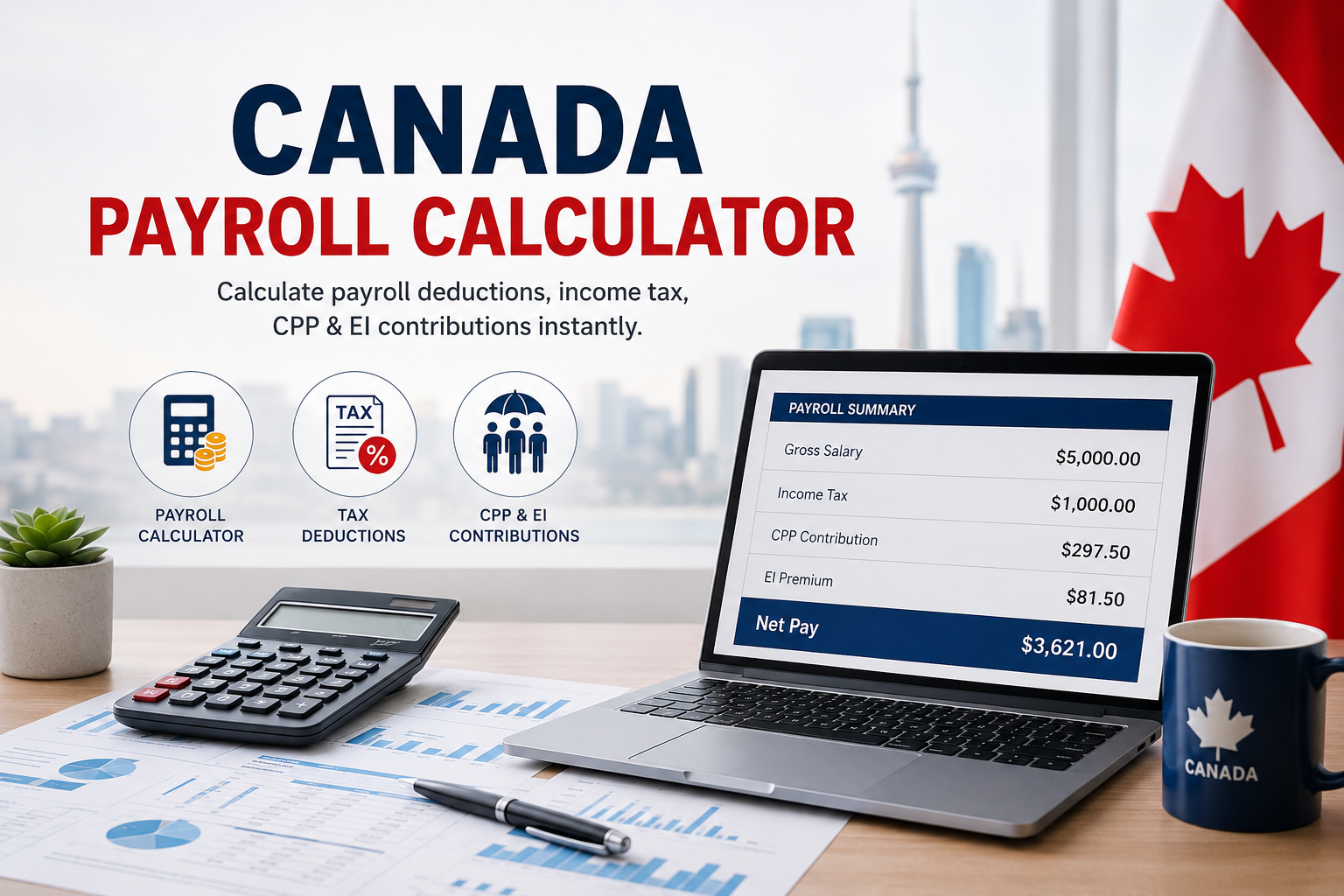
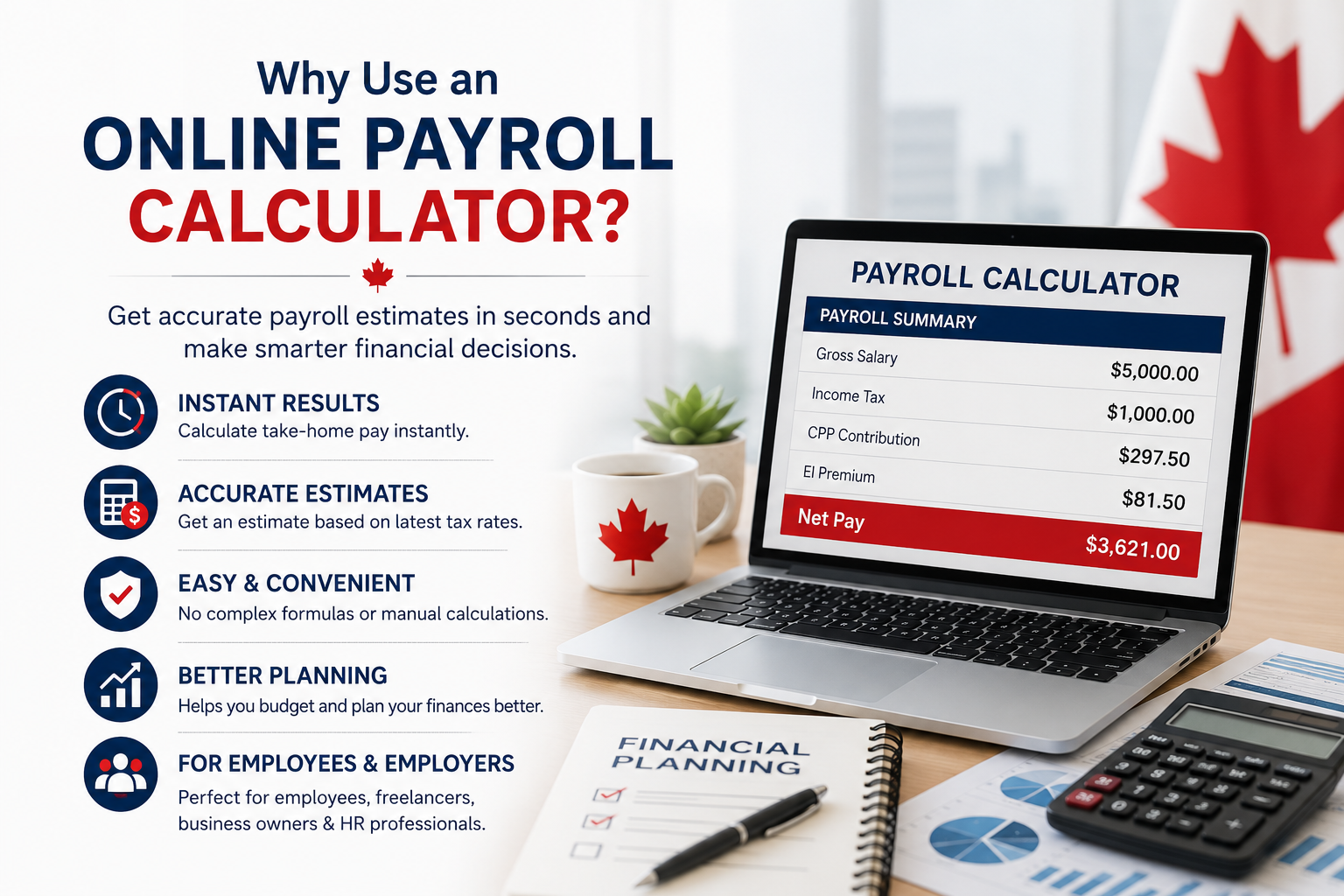
For example, if an employee has gross earnings of $5,000 for a particular pay period, the amount deposited into their bank account may be lower because of income tax, CPP, EI, and other deductions.
What Deductions Can Appear on a Canadian Paycheque?
Depending on the employee and employer, a Canadian pay statement may include several types of deductions, such as:
- Federal income tax
- Provincial or territorial income tax
- CPP contributions
- EI premiums
- Employer benefit premiums
- Pension contributions
- Union dues
- Other authorized payroll deductions
Why Payroll Deductions Can Change
Your payroll deductions can change from one year to another. Government rates, annual contribution limits, tax brackets, maximum pensionable earnings, maximum insurable earnings, and other payroll parameters may be updated.
Your personal circumstances can also affect payroll withholding. Changes in salary, employment, tax credits, benefits, pension contributions, or other payroll information may change the amount deducted from your pay.
Payroll Tax Calculator by Pay Frequency
Monthly Payroll
Monthly payroll means employees receive their regular pay once each month. An annual salary can be divided across the applicable number of monthly pay periods to estimate gross monthly earnings.
Bi-Weekly Payroll
Bi-weekly employees generally receive 26 pay periods in a year. This is different from being paid twice per month, which normally results in 24 pay periods.
Weekly Payroll
Weekly payroll generally involves 52 pay periods per year. Dividing annual salary by the applicable number of pay periods provides a basic estimate of gross weekly earnings before deductions.
Semi-Monthly Payroll
Semi-monthly payroll generally means two payments per month, resulting in 24 pay periods in a year. It should not be confused with bi-weekly payroll.
Benefits of Using a Payroll Tax Calculator
- Quick estimate of take-home pay
- Easy comparison of different salaries
- Useful for personal budgeting
- Helps understand common payroll deductions
- Useful when reviewing a paycheque
- Helpful when comparing employment offers
- Simple way to estimate pay by frequency
Who Can Use a Canada Payroll Calculator?
A payroll calculator can be useful for many people, including:
- Canadian employees
- Job seekers
- Small business owners
- Payroll administrators
- Human resources professionals
- Employers estimating employee payroll
- Freelancers planning their income
- People comparing salary packages
Canada Payroll Tax Calculator vs CRA Payroll Calculator
An online payroll calculator such as this one is useful for quick estimates and financial planning. The official CRA payroll calculation process is more detailed and can account for specific payroll tables, tax credits, annual maximums, employee information, and other applicable factors.
Therefore, the result from this calculator should be treated as an estimate rather than an official payroll statement. Employers processing actual payroll should use the current CRA payroll guidance and applicable payroll deduction tables.
Important Things to Check on Your Paycheque
When reviewing a Canadian paycheque, compare your gross earnings with deductions and net pay. Check whether the amounts for income tax, CPP, EI, benefits, and other deductions appear consistent with your employment arrangements.
If you notice an unexpected deduction or a significant difference between your expected and actual pay, contact your employer's payroll department or another qualified professional for clarification.
Frequently Asked Questions
1. What is a Canada Payroll Tax Calculator?
A Canada Payroll Tax Calculator is an online tool that estimates payroll deductions and take-home pay using information such as salary, province, pay frequency, CPP, EI, and estimated income tax.
2. What deductions are commonly taken from a Canadian salary?
Common payroll deductions can include federal and provincial or territorial income tax, CPP contributions, and EI premiums. Other deductions may apply depending on the employee's circumstances.
3. Is this Canada Payroll Tax Calculator an official CRA calculator?
No. This is an independent estimation tool. Actual payroll deductions should be determined using current CRA requirements and the employee's specific payroll information.
4. Does payroll tax vary by province in Canada?
Yes. Provincial and territorial income tax systems can differ, so the applicable withholding can vary depending on the province or territory and the employee's circumstances.
5. What is CPP in payroll?
CPP stands for Canada Pension Plan. Eligible employees generally make CPP contributions through payroll, subject to applicable rules, exemptions, rates, and annual maximums.
6. What is an EI deduction?
EI stands for Employment Insurance. Employees generally pay EI premiums through payroll on insurable employment earnings, subject to applicable rules and annual limits.
7. Why is my net salary lower than my gross salary?
Net salary is lower because applicable payroll deductions are subtracted from gross earnings. These may include income tax, CPP, EI, benefits, pension contributions, and other authorized deductions.
8. What is the difference between bi-weekly and semi-monthly pay?
Bi-weekly payroll generally means 26 pay periods per year, while semi-monthly payroll generally means 24 pay periods per year.
9. Can I use this calculator to compare job offers?
Yes. You can use the calculator to create estimated take-home pay figures for different gross salaries and pay frequencies. Actual payroll results may vary based on your personal tax and deduction information.
10. Why can my actual payroll deduction differ from this calculator?
Actual payroll deductions may differ because official calculations can consider current CRA payroll tables, tax credits, annual limits, province or territory, pension adjustments, benefits, and other employee-specific information.
Conclusion
The Canada Payroll Tax Calculator provides a convenient way to estimate gross pay, income tax, CPP contributions, EI premiums, total deductions, and take-home pay. It can be useful for budgeting, reviewing salary expectations, comparing employment offers, and understanding how payroll deductions affect your earnings.
Because Canadian payroll calculations can depend on many factors, use the result as an estimate rather than an official payroll calculation. For actual payroll processing and tax withholding, always refer to the latest applicable CRA payroll information and your specific employment details.