GIS Group Calculator Canada
Estimate your potential GIS income group using your age, marital status and annual income.
Use this GIS Group Calculator Canada to get a quick estimate of the Guaranteed Income Supplement (GIS) income group that may apply to your situation. Enter your age, marital status and annual income to see which income threshold category your information falls into.
GIS is an income-tested benefit under Canada's Old Age Security program. This calculator is intended as an educational and planning tool only. It does not determine your official GIS entitlement or monthly payment.
What Is the GIS Group Calculator?
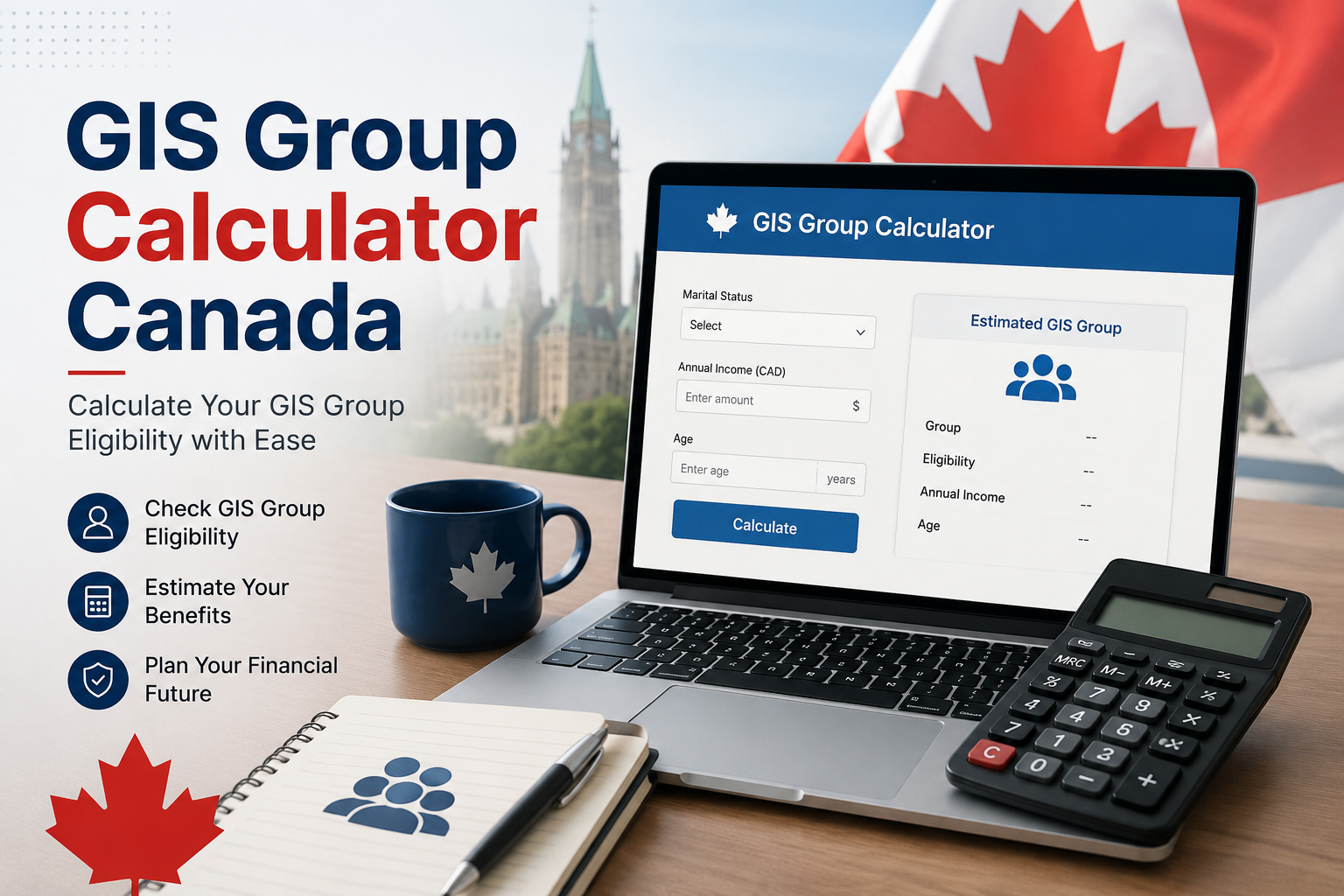
The GIS Group Calculator is an online estimation tool designed to help Canadian seniors understand the income category that may be relevant to their Guaranteed Income Supplement situation.
The Guaranteed Income Supplement, commonly called GIS, is an income-tested benefit available to eligible seniors who receive the Old Age Security pension. The applicable income threshold depends on the person's marital situation and whether their spouse or common-law partner receives certain Old Age Security benefits.
Because GIS rules can be difficult to understand, a simple calculator can provide a useful first step. Instead of looking through several tables, you can enter your basic information and receive an estimated category.
How GIS Works in Canada
The Guaranteed Income Supplement is part of Canada's Old Age Security program. Eligible seniors may receive GIS in addition to their OAS pension when they meet the applicable income and other requirements.
GIS is income tested. This means that your income can affect whether you qualify and how much you may receive. The relevant income threshold also depends on your marital status and your spouse's benefit situation.
Government of Canada benefit amounts and income thresholds are updated periodically. For the July to September 2026 quarter, the published GIS income thresholds include $22,800 for a single, widowed or divorced person, $30,096 for a person whose spouse receives OAS, $42,144 where the spouse receives the Allowance, and $54,624 where the spouse does not receive OAS or the Allowance.
GIS Income Thresholds for July to September 2026
The following figures are the published maximum annual income thresholds for the July to September 2026 period. The figures are useful for understanding the basic categories used by this calculator.
| Situation | Annual Income Threshold | Maximum Monthly GIS |
|---|---|---|
| Single, widowed or divorced | Less than $22,800 | Up to $1,123.17 |
| Spouse/common-law partner receives OAS | Less than $30,096 | Up to $676.09 |
| Spouse/common-law partner receives the Allowance | Less than $42,144 | Up to $676.09 |
| Spouse/common-law partner does not receive OAS or Allowance | Less than $54,624 | Up to $1,123.17 |
These figures apply to the July to September 2026 quarter and should not be treated as permanent thresholds. Government benefit rates and income limits can change as new quarterly amounts are published.
Who May Be Eligible for GIS?
GIS eligibility has several requirements. In general, a person may qualify when they receive an OAS pension, are at least 65 years old, meet the applicable Canadian citizenship or residency requirements, and have income below the maximum threshold for their situation.
Receiving OAS does not automatically mean that a person will receive GIS. GIS is income tested, and the applicable rules depend on the person's circumstances.
Age Requirement
GIS is generally available to people aged 65 or older who receive OAS and meet the other requirements. This calculator therefore checks whether the entered age is at least 65.
OAS Requirement
GIS is linked to the Old Age Security program. A person generally needs to receive the OAS pension to qualify for GIS.
Income Requirement
Income is an important factor in GIS eligibility. The applicable threshold depends on whether the person is single or has a spouse or common-law partner and what benefits the spouse receives.
How to Use the GIS Group Calculator
Step 1: Enter Your Age
Enter your current age in the Age field. GIS eligibility generally starts at age 65.
Step 2: Select Your Marital Situation
Choose the option that best describes your current situation. The calculator provides separate categories for single, widowed or divorced seniors and different spouse benefit situations.
Step 3: Enter Annual Net Income
Enter the annual income amount relevant to the calculator. For couple categories, the applicable threshold is based on combined income according to the Government of Canada rules.
Step 4: Click Calculate GIS Group
Click the Calculate GIS Group button. The calculator compares the entered information with the selected category's current threshold and displays an estimated result.
Step 5: Review the Result
The result explains whether the entered income is below or above the selected GIS income threshold. It also reminds you that the result is an estimate rather than an official benefit determination.
Factors That Can Affect GIS
1. Annual Income
GIS is an income-tested benefit, so changes in annual income can affect eligibility and payment amounts. The Government of Canada generally recalculates GIS based on income information from the previous calendar year.
2. Marital Status
Your marital status can affect the income threshold used for GIS. Single seniors and seniors with spouses or common-law partners can fall under different categories.
3. Spouse's Benefit Status
For married or common-law seniors, whether the spouse receives OAS, the Allowance, or neither can change the applicable GIS category.
4. Changes in Income
A significant change in income can affect future GIS payments. Retirement income, pension income and other income sources may need to be considered when determining the applicable benefit.
5. Quarterly Benefit Updates
OAS program payment amounts and related income thresholds are updated periodically. For this reason, an online GIS calculator should be checked against the latest official information before making an important financial decision.
GIS and Annual Tax Filing
Keeping your income information up to date is important when receiving income-tested government benefits. The Government of Canada states that GIS payments are recalculated each July using net income from the previous calendar year.
For the July 2026 to June 2027 benefit period, the relevant previous calendar year is 2025. This is one reason why keeping tax information current can be important for seniors receiving GIS.
Is GIS Taxable?
GIS payments are not considered taxable income. They are separate from taxable income for Canadian income tax purposes.
Although GIS itself is non-taxable, income used to determine income-tested benefits can still affect eligibility. Therefore, understanding the difference between taxable benefit payments and income used for benefit calculations is important.
GIS vs OAS
Old Age Security and the Guaranteed Income Supplement are different benefits within Canada's public pension system.
OAS is primarily based on age and residence-related eligibility requirements, while GIS is specifically income tested for eligible low-income seniors receiving OAS.
A person who qualifies for OAS may also qualify for GIS if they meet the applicable income and other requirements.
Why Use a GIS Group Calculator?
Government benefit rules can involve several categories and changing thresholds. A calculator provides a convenient way to organize the basic information before reviewing official benefit information.
- Quick GIS category estimate
- Easy income threshold comparison
- Simple marital-status selection
- Useful for retirement planning
- Helpful for understanding GIS categories
- Works on desktop and mobile devices
- Easy to use without complicated formulas
Important Limitations of This GIS Calculator
This calculator is designed to provide a general estimate. It does not calculate an official GIS payment amount and does not account for every individual circumstance that may affect a person's entitlement.
Government of Canada calculations may consider specific income information and benefit circumstances that cannot be determined from only age, marital status and one income figure.
If you are applying for GIS or need to confirm your actual benefit, use the official Government of Canada information and your Service Canada account or contact Service Canada directly.
Frequently Asked Questions
1. What does GIS stand for?
GIS stands for Guaranteed Income Supplement. It is an income-tested benefit under Canada's Old Age Security program for eligible seniors.
2. Who can generally receive GIS?
A person generally needs to be at least 65, receive an OAS pension, meet the applicable residency and legal-status requirements, and have income below the applicable GIS threshold.
3. Is GIS taxable income?
No. GIS payments are generally not considered taxable income.
4. Does marital status affect GIS?
Yes. GIS income thresholds differ depending on whether a person is single, widowed or divorced or has a spouse or common-law partner. The spouse's benefit status can also affect the applicable category.
5. What is the 2026 GIS income threshold for a single senior?
For July to September 2026, the published annual income threshold for a single, widowed or divorced person receiving OAS is $22,800.
6. What is the GIS threshold if my spouse receives OAS?
For July to September 2026, the published threshold is $30,096 in combined income when the spouse or common-law partner receives OAS.
7. What if my spouse does not receive OAS?
For July to September 2026, the published threshold for a spouse or common-law partner who does not receive OAS or the Allowance is $54,624 in combined income.
8. Can GIS payments change from year to year?
Yes. GIS payments can change because of changes in income, marital status and government benefit rates or thresholds.
9. How often are GIS amounts updated?
OAS program benefit amounts are reviewed and adjusted quarterly. Government of Canada payment tables are published for January to March, April to June, July to September, and October to December.
10. Does this calculator give my exact GIS payment?
No. This calculator provides an estimate of the applicable income group. It should not be used as an official determination of your GIS entitlement or exact monthly payment.
11. Can I receive OAS and GIS at the same time?
Yes. GIS is designed as an additional benefit for eligible low-income seniors who receive the OAS pension.
12. Why can my GIS change after I file my taxes?
GIS is income tested and is generally recalculated using income information from the previous calendar year. Changes in reported income can therefore affect future GIS payments.
Final Thoughts
The GIS Group Calculator Canada provides a simple way to compare your age, marital situation and annual income with the applicable GIS income category. It can be useful when learning how the Guaranteed Income Supplement works and when preparing for retirement planning.
However, GIS eligibility is based on official Government of Canada rules and individual circumstances. Benefit thresholds can also change over time. Always verify your situation using the latest Government of Canada information before making an important financial or retirement decision.