
Scientific Notation Converter
Convert standard numbers into scientific notation or change scientific notation back into standard decimal form.
Conversion Result
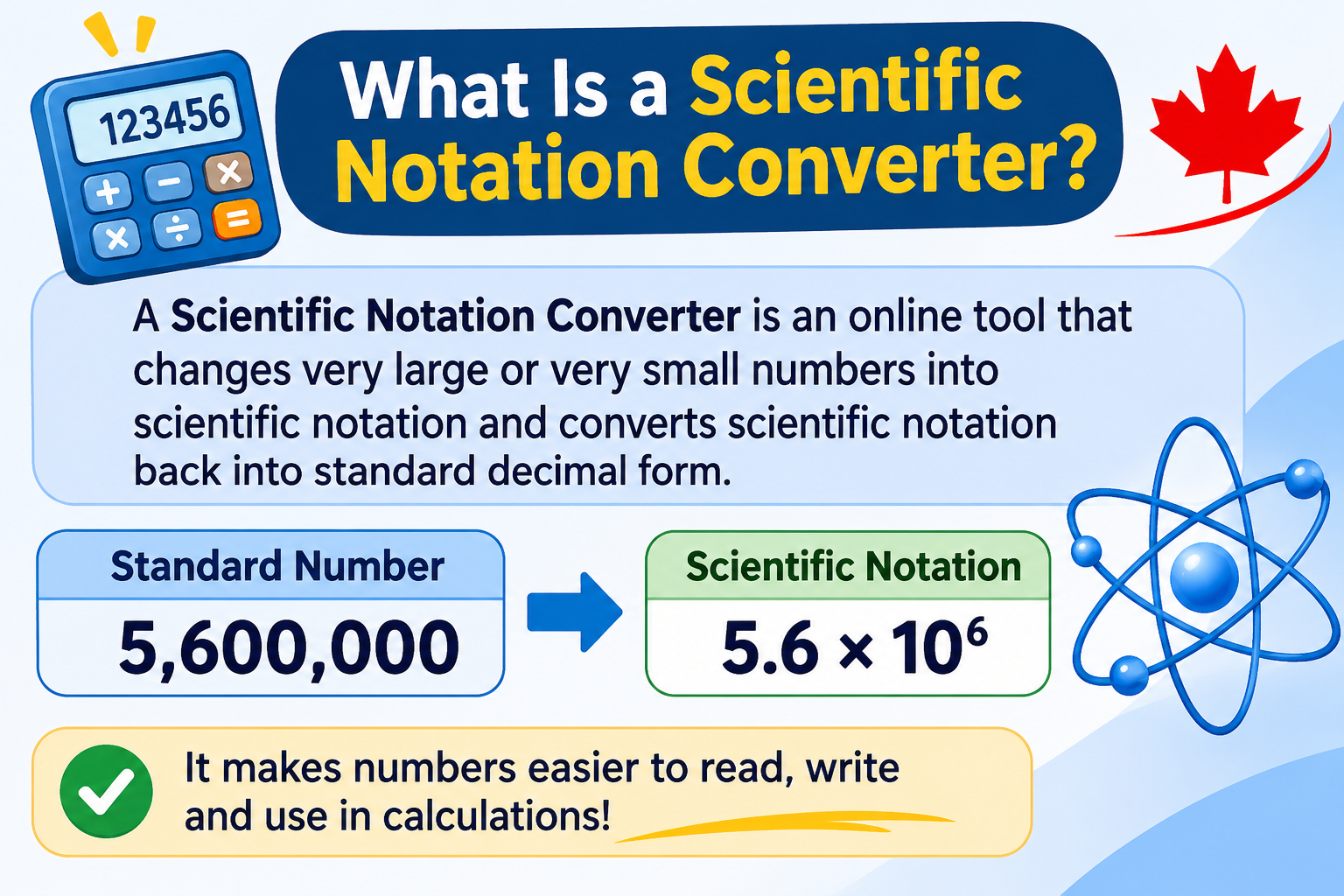
What Is a Scientific Notation Converter?
A Scientific Notation Converter is an online mathematical tool that changes very large or very small numbers into scientific notation and converts scientific notation back into ordinary decimal form. It makes numbers easier to read, write, compare and use in mathematical calculations.
Scientific notation is commonly used in mathematics, physics, chemistry, astronomy, engineering and other scientific subjects. Instead of writing a long series of zeros, a number can be represented using a coefficient and a power of 10.
For example, the number 5,600,000 can be written as 5.6 × 10⁶. Both expressions represent exactly the same value, but scientific notation is shorter and easier to work with.
How Does Scientific Notation Work?
Scientific notation expresses a number in a standard format using two main parts: a coefficient and an exponent. The coefficient contains the significant digits, while the exponent indicates the power of 10 used to represent the number.
a × 10n
a: The coefficient or significant number.
n: The integer exponent of 10.
In properly normalized scientific notation, the absolute value of the coefficient must be at least 1 and less than 10 for a non-zero number. The exponent can be positive, negative or zero.
1. Understanding the Coefficient
The coefficient is the number placed before the power of 10. In 7.25 × 10⁴, the coefficient is 7.25. It contains the significant digits of the original number.
2. Understanding the Exponent
The exponent tells you the power of 10. A positive exponent is commonly used for large numbers, while a negative exponent is used for numbers smaller than 1.
8,200,000 = 8.2 × 10⁶
0.00082 = 8.2 × 10⁻⁴
How to Use This Scientific Notation Converter
Our free Scientific Notation Converter is designed to make number conversion straightforward. You do not need to perform decimal calculations manually. Follow these steps to get your result.
Step 1: Choose the Conversion Type
First, select whether you want to convert a standard decimal number into scientific notation or convert scientific notation into a standard number.
Step 2: Enter Your Number
If you select standard number conversion, enter your number in the input field. For reverse conversion, enter the coefficient and exponent separately.
Step 3: Click Calculate
Press the Calculate button. The converter will process your input and display the equivalent numerical value.
Step 4: Review the Result
Check the converted number and the explanation displayed below the result. You can use the Copy Result button to copy the answer for your notes or calculations.
Step 5: Reset and Try Another Number
Select Reset to clear the previous calculation and enter a new value.
Scientific Notation Conversion Examples
The following examples show how different types of numbers can be expressed in scientific notation.
Example 1: Converting a Large Number
Move the decimal point 7 places to the left.
Scientific notation: 4.5 × 10⁷
Example 2: Converting a Small Decimal
Move the decimal point 4 places to the right.
Scientific notation: 3.6 × 10⁻⁴
Example 3: Converting Scientific Notation into a Decimal
Move the decimal point 3 places to the right.
Standard number: 6,250
Example 4: Negative Exponent
Move the decimal point 3 places to the left.
Standard number: 0.0074
Positive vs Negative Exponents in Scientific Notation
The sign of the exponent helps determine how the number is represented when converting between scientific and standard notation.
- Positive exponent: Expanding the number moves the decimal point to the right. It is commonly used for large numbers.
- Negative exponent: Expanding the number moves the decimal point to the left. It is commonly used for very small decimal values.
- Zero exponent: Any non-zero number multiplied by 10⁰ remains unchanged because 10⁰ equals 1.
3.5 × 10⁻⁴ = 0.00035
3.5 × 10⁰ = 3.5
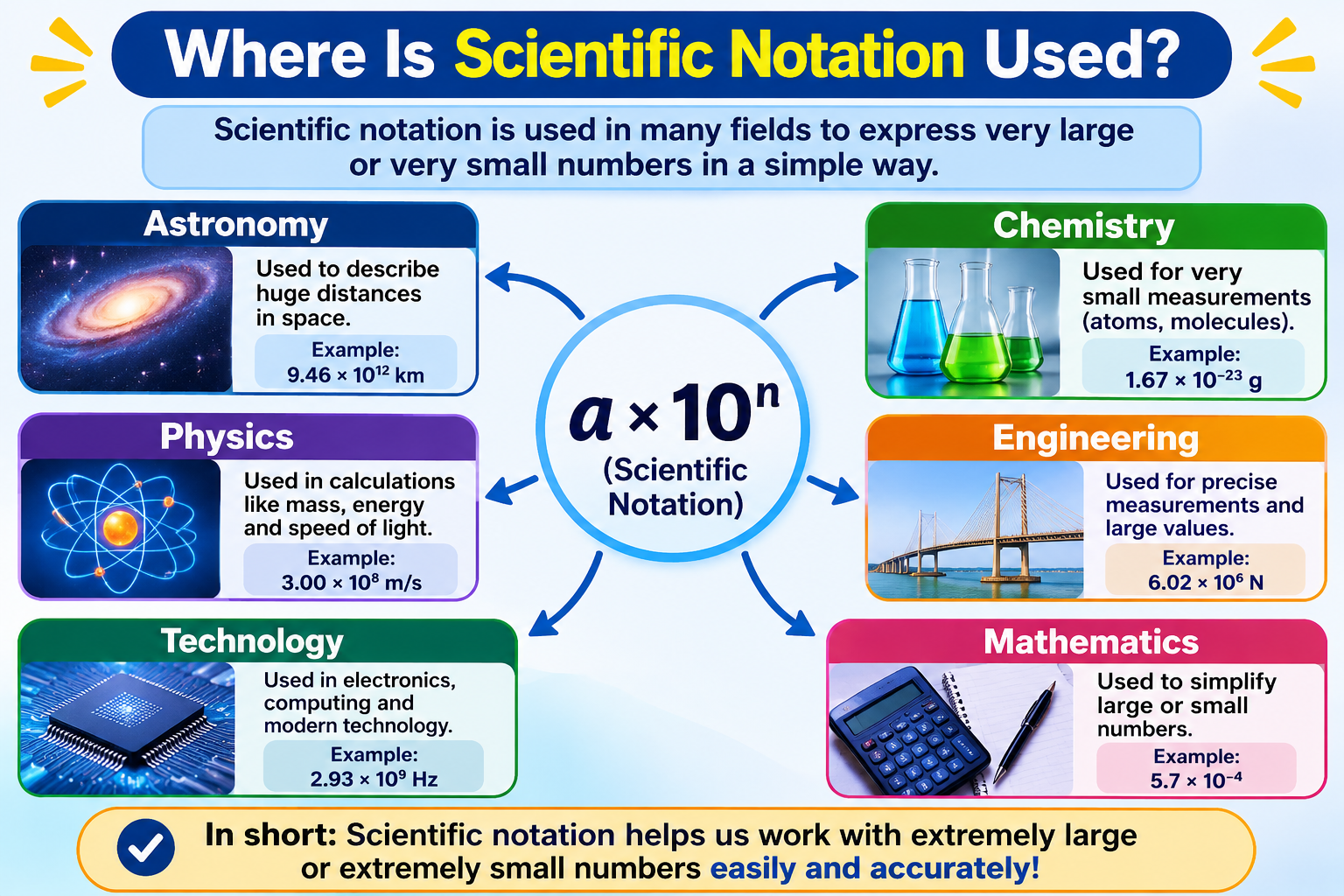
Where Is Scientific Notation Used?
Scientific notation is more than a classroom concept. It is used in many practical fields where numbers may be extremely large or extremely small.
1. Astronomy
Astronomers use scientific notation to describe enormous distances between planets, stars and galaxies. It helps avoid writing long numbers with many zeros.
2. Chemistry
Chemistry uses scientific notation to express very small measurements, including atomic-scale quantities and values involving extremely small masses.
3. Physics
Scientists use it when working with measurements such as the speed of light, energy, mass and other physical quantities.
4. Engineering and Technology
Engineers use scientific notation to handle measurements, electrical values, tolerances and calculations involving a wide range of numerical sizes.
5. Mathematics and Education
Students use scientific notation to simplify calculations, understand powers of ten and solve problems involving large and small values.
Scientific Notation vs Standard Notation
Standard notation writes numbers in their usual decimal form, whereas scientific notation uses a coefficient multiplied by a power of 10.
| Standard Number | Scientific Notation |
|---|---|
| 1,000 | 1 × 10³ |
| 25,000 | 2.5 × 10⁴ |
| 0.005 | 5 × 10⁻³ |
| 0.00009 | 9 × 10⁻⁵ |
Benefits of Using an Online Scientific Notation Calculator
- Saves time: Converts numbers without manually counting decimal places.
- Easy to use: A simple input system makes conversions accessible to students and professionals.
- Supports both directions: Convert standard numbers to scientific notation and back again.
- Reduces manual mistakes: Helps avoid common decimal placement errors.
- Useful for learning: Step-by-step explanations help users understand how conversions work.
- Accessible online: Use the calculator on desktop computers, tablets and mobile devices.
Common Mistakes to Avoid
Although scientific notation follows a straightforward rule, a few mistakes can change the value of a number.
- Using the wrong exponent sign when converting small decimals.
- Moving the decimal point the wrong number of places.
- Entering a coefficient that is not properly normalized.
- Forgetting that a negative exponent represents a reciprocal power of ten.
- Confusing the coefficient with the exponent.
Always check whether your coefficient is between 1 and 10 in absolute value for a non-zero number, and confirm the exponent before using the result.
Frequently Asked Questions (FAQs)
1. What is a Scientific Notation Converter?
A Scientific Notation Converter is an online tool that changes standard decimal numbers into scientific notation and converts scientific notation back into ordinary decimal form.
2. What is the formula for scientific notation?
Scientific notation uses a coefficient multiplied by 10 raised to an exponent. The coefficient has an absolute value of at least 1 and less than 10 for a non-zero number.
3. What does a positive exponent mean?
A positive exponent indicates a positive power of 10. When expanding the number into decimal form, the decimal point moves to the right.
4. What does a negative exponent mean?
A negative exponent represents a reciprocal power of 10. It is commonly used to express very small numbers, such as 0.0005.
5. Can I convert scientific notation into a regular number?
Yes. Select the scientific notation to standard number option, enter the coefficient and exponent, and click Calculate to get the decimal result.
6. Can scientific notation represent decimal numbers?
Yes. Scientific notation can represent whole numbers, decimal numbers and extremely small values. Negative exponents are particularly useful for small decimal numbers.
7. Is scientific notation used in real life?
Yes. It is widely used in astronomy, chemistry, physics, engineering, technology and scientific research to represent very large and very small measurements.
8. Is this Scientific Notation Converter free to use?
Yes. You can use the Scientific Notation Converter on Canada Calculators without paying a fee. Enter your values and calculate the conversion whenever you need it.
Conclusion
Scientific notation makes it easier to work with extremely large and small numbers without writing long strings of zeros. By understanding coefficients, exponents and decimal movement, you can represent numerical values more clearly and solve mathematical problems with greater confidence.
The Scientific Notation Converter at Canada Calculators provides a convenient way to convert numbers in both directions. Whether you are a student studying mathematics, working on a science assignment or handling numerical calculations, this tool helps you get clear results without manually moving decimal places.
Use the calculator to explore different numbers, check positive and negative exponents, and understand how standard numbers relate to scientific notation. It is a practical starting point for learning and everyday mathematical conversions.