
Simple Interest Calculator
Calculate simple interest and the total amount using your principal, annual interest rate and time period.
Your Simple Interest Results
Calculation Breakdown
Formula: SI = (P × R × T) / 100
What Is a Simple Interest Calculator?
A Simple Interest Calculator is an online financial tool that helps you estimate the interest earned or paid on an original principal amount over a specific period. It uses three main values: the principal amount, the annual interest rate and the length of time.
Whether you are comparing a borrowing arrangement, reviewing a savings example or learning basic financial mathematics, this calculator makes it easier to understand how interest is calculated. You can enter an amount in Canadian dollars (CAD), select an annual rate and choose a duration in months or years.
The calculator displays the estimated interest separately from the original principal, along with the combined total. This can help you compare different rates and time periods without performing the calculations manually.
How Does Simple Interest Work?
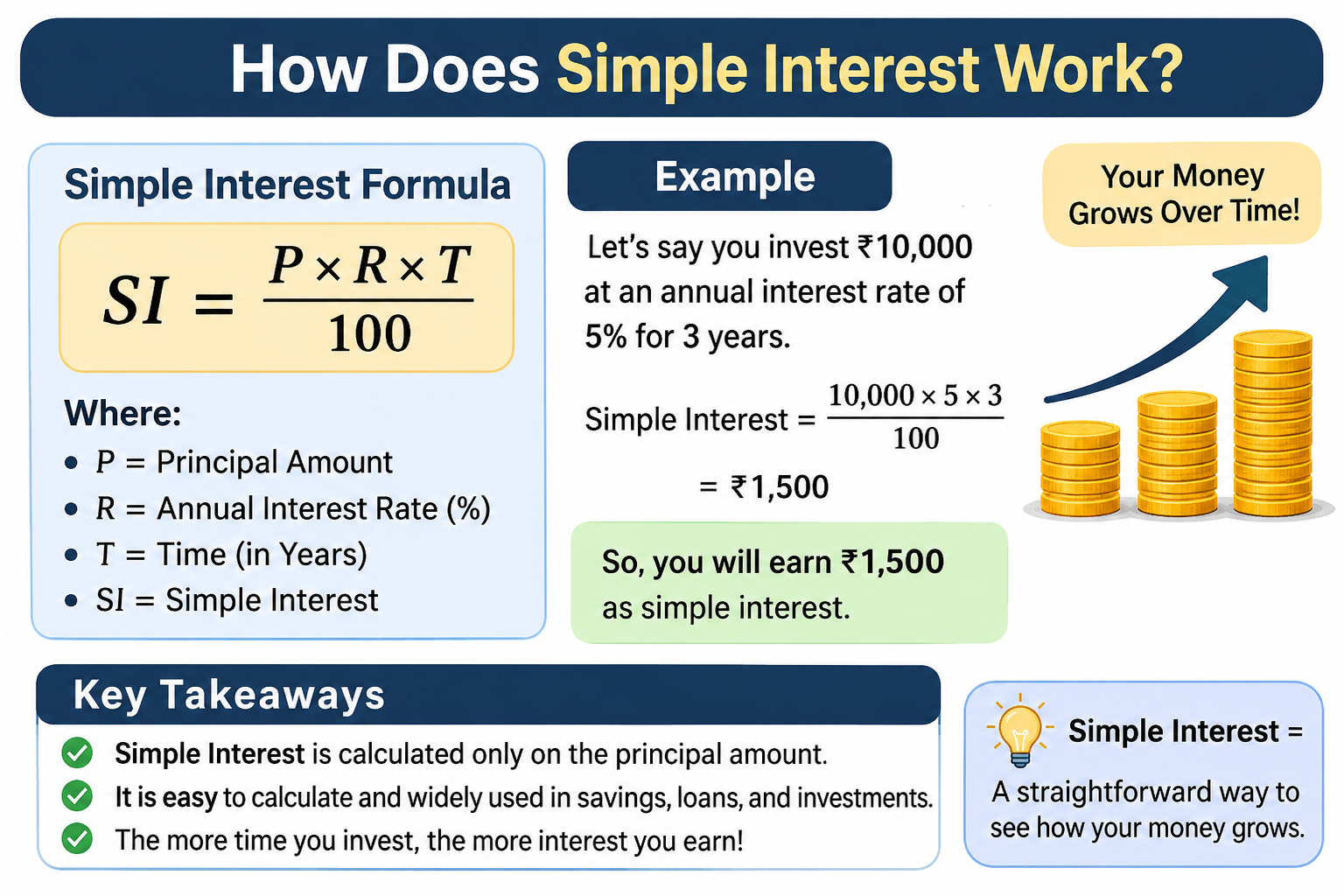
Simple interest is calculated only on the original principal amount. The interest earned or charged does not become part of the principal for future simple-interest calculations.
For example, suppose you deposit or lend $10,000 at an annual simple interest rate of 5% for three years. The interest for each full year is $500, as long as the principal and rate stay unchanged.
After three years, the total interest is $1,500. Adding this to the original $10,000 gives a total amount of $11,500.
This is why simple interest is relatively easy to understand: the interest amount for each year remains constant when the principal and rate do not change.
Simple Interest Formula
The standard formula used to calculate simple interest is:
Where:
- P: Principal amount, or the original money borrowed or invested.
- R: Annual interest rate expressed as a percentage.
- T: Time period expressed in years.
Total Amount = Principal + Simple Interest
If your duration is in months, convert it into years before applying the formula:
For example, 6 months equals 0.5 years, while 18 months equals 1.5 years.
How to Use Our Simple Interest Calculator
Follow these steps to estimate the simple interest on an amount:
- Enter the principal amount: Type the original amount in Canadian dollars, such as $5,000 or $10,000.
- Enter the annual interest rate: Add the yearly rate as a percentage. For example, enter 5 for 5%.
- Enter the time period: Specify how long the money will be borrowed or invested.
- Select the time unit: Choose Years or Months.
- Click Calculate Interest: The calculator will work out the simple interest and total amount.
- Review the results: Check the principal, interest and final total in the results section.
To perform another calculation, select Reset and enter your new values.
Simple Interest Calculation Example
Consider an example in which $15,000 is invested at an annual simple interest rate of 4% for five years.
Given:
Principal (P) = $15,000
Rate (R) = 4%
Time (T) = 5 years
Formula: SI = (P × R × T) / 100
SI = (15,000 × 4 × 5) / 100
Simple Interest = $3,000
Total Amount = $15,000 + $3,000
Total Amount = $18,000
In this example, the interest over five years is $3,000. The principal plus interest equals $18,000, before any applicable fees, taxes or other adjustments.
Simple Interest Calculation Table
The table below shows how simple interest changes over time when the principal is $10,000 and the annual interest rate is 5%.
| Time Period | Principal | Interest Earned | Total Amount |
|---|---|---|---|
| 1 Year | $10,000 | $500 | $10,500 |
| 2 Years | $10,000 | $1,000 | $11,000 |
| 3 Years | $10,000 | $1,500 | $11,500 |
| 4 Years | $10,000 | $2,000 | $12,000 |
| 5 Years | $10,000 | $2,500 | $12,500 |
The interest increases by $500 each year because it is calculated on the same original principal at the same annual rate.
What Are the Main Types of Simple Interest?
Simple interest can be calculated using different day-count conventions when a financial agreement uses days rather than whole months or years.
1. Ordinary Simple Interest
Ordinary simple interest commonly uses a 360-day year for day-based calculations. This convention is sometimes used in commercial or financial calculations. The specific convention depends on the agreement.
2. Exact Simple Interest
Exact simple interest uses the actual number of days in the relevant year, which is normally 365 days or 366 days in a leap year. It can be useful when interest is calculated for an exact number of calendar days.
This calculator uses an annual rate and a duration entered in years or months. It does not automatically apply a 360-day or actual-day convention.
Simple Interest vs Compound Interest
Simple interest and compound interest are different ways of calculating interest. The key difference is whether previously accumulated interest is included when calculating interest for a later period.
| Feature | Simple Interest | Compound Interest |
|---|---|---|
| Calculation basis | Original principal | Principal plus accumulated interest |
| Interest growth | Usually constant each period | Can increase over time |
| Interest on interest | No | Yes |
| Calculation | SI = P × R × T / 100 | Depends on compounding frequency |
| Complexity | Generally straightforward | Requires compounding details |
For example, $10,000 at 5% for five years produces $2,500 in simple interest. If interest is compounded annually at the same rate, the interest is approximately $2,762.82. The actual method used depends on the terms of the financial product.
Where Is Simple Interest Used?
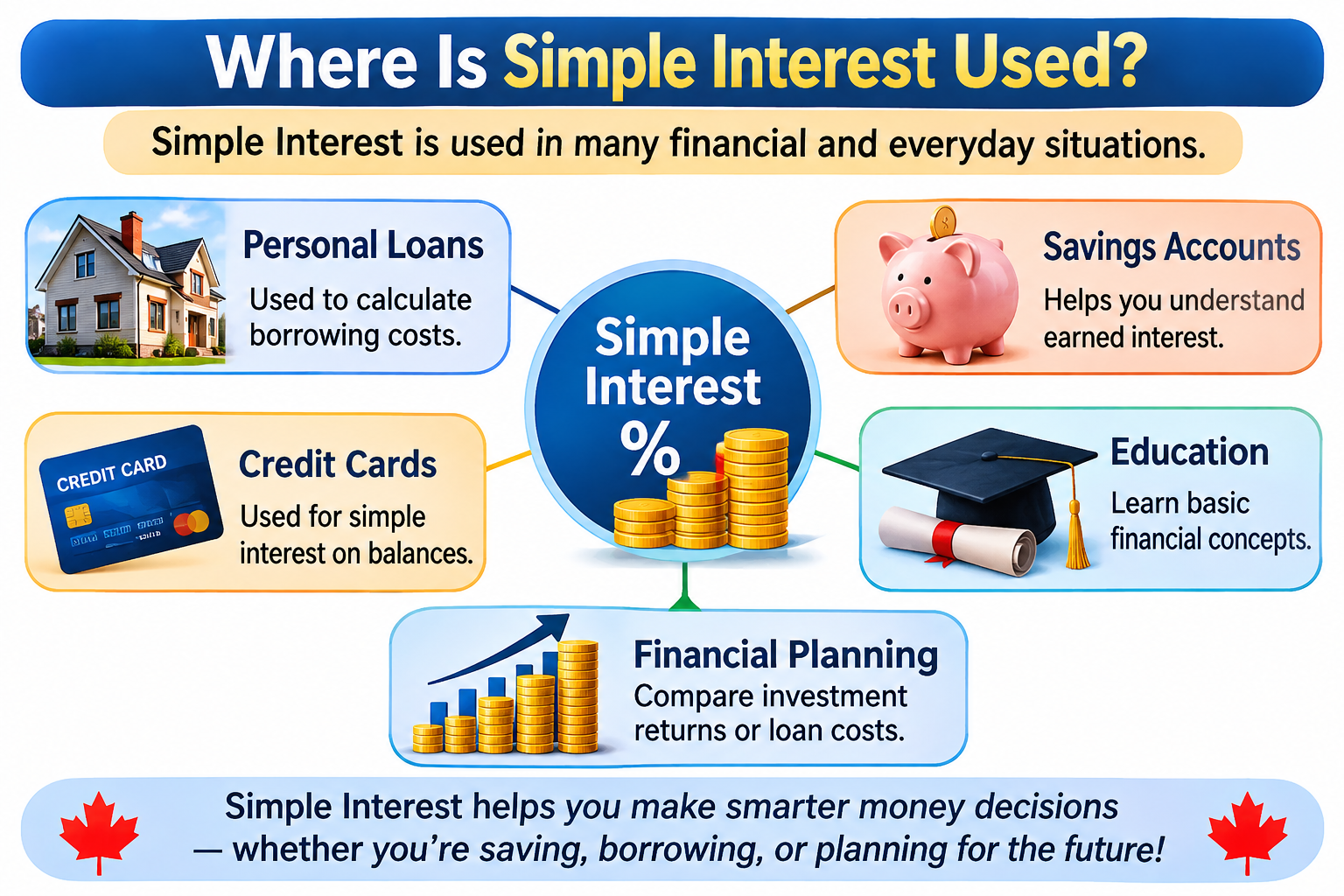
Simple interest is used in financial calculations, borrowing examples and educational settings. It can help people understand how a fixed rate applies to an original amount over time.
Personal Loans
Some loan agreements use a simple-interest method to calculate borrowing costs. Knowing the principal, rate and duration can help you estimate the interest, although payment schedules and lender terms may affect the actual amount owed.
Short-Term Borrowing
Simple interest can be useful for estimating interest over a short period when the borrowing agreement specifically uses this method. Always review the lender's stated rate and calculation terms.
Educational Calculations
Students often learn simple interest as part of mathematics and financial literacy. The formula offers a practical example of how percentages, money and time work together.
Financial Planning
Simple-interest estimates can help when comparing hypothetical returns or borrowing costs. However, actual savings and investment products may use different methods and may include fees, conditions or other adjustments.
Factors That Affect Simple Interest
Three main factors determine the simple interest calculated by the formula:
- Principal Amount: A larger principal produces more interest when the rate and duration stay the same.
- Interest Rate: A higher annual rate increases the interest amount.
- Time Period: A longer duration produces more interest when the principal and rate remain unchanged.
For example, doubling the principal from $5,000 to $10,000 doubles the simple interest if the rate and time remain unchanged. The same is true if the duration is doubled while the other values stay constant.
Benefits of Using an Online Simple Interest Calculator
An online calculator can make basic interest calculations quicker and easier to review. Some useful benefits include:
- Quick calculations: Estimate interest in seconds without doing the arithmetic manually.
- Simple inputs: Enter the principal, annual rate and duration.
- Clear results: See the principal, interest and total amount separately.
- Flexible duration: Enter time in months or years.
- Easy comparisons: Change the rate or duration to see how the estimate changes.
- Free access: Use the calculator online whenever you need a basic estimate.
Important Things to Consider Before Calculating Interest
Before relying on a simple-interest estimate for a financial decision, keep these points in mind:
- Confirm whether the financial agreement uses simple interest or compound interest.
- Check whether the quoted rate is annual, monthly or another type of rate.
- Review any additional fees, charges or penalties.
- Understand how repayments affect the outstanding principal.
- Check whether the lender uses a daily interest calculation or a specific day-count convention.
- Remember that actual savings or investment returns may differ from a basic estimate.
This calculator provides a mathematical estimate using a fixed principal and annual interest rate. It does not include taxes, fees, changing balances, repayments or special lender calculation rules.
Frequently Asked Questions (FAQs)
1. What is a Simple Interest Calculator?
A Simple Interest Calculator is an online tool that estimates the interest earned or paid on an original principal amount over a selected period. It uses the principal, annual interest rate and time to calculate the interest and total amount.
2. What is the formula for simple interest?
The formula is SI = (P × R × T) / 100. P represents the principal, R is the annual interest rate expressed as a percentage, and T is the time in years.
3. How do I calculate simple interest for one year?
Multiply the principal by the annual interest rate and divide by 100. For example, $5,000 at 5% for one year produces $250 in simple interest.
4. Can I calculate simple interest in months?
Yes. Select Months as the time unit. The calculator converts the entered months into years by dividing the number of months by 12 before applying the formula.
5. What is the difference between simple and compound interest?
Simple interest is calculated only on the original principal. Compound interest is calculated on the principal plus previously accumulated interest, so it can grow faster over time.
6. Does simple interest increase every year?
The total accumulated simple interest increases over time. However, when the principal and annual rate remain unchanged, the interest added for each full year stays the same.
7. Is this Simple Interest Calculator free to use?
Yes. You can use the Simple Interest Calculator on Canada Calculators without paying a fee. Enter your values to estimate the interest and total amount.
8. Does this calculator include Canadian taxes and bank fees?
No. The calculator estimates simple interest only. It does not include Canadian income taxes, banking fees, loan charges or other financial costs. Check your financial agreement for the applicable details.
9. Can the calculator be used for loans and savings?
Yes. You can use it to estimate simple interest on a hypothetical loan or savings amount, provided the calculation uses a fixed principal and annual simple-interest rate. Actual financial products may use different terms.
Conclusion
A Simple Interest Calculator makes it easier to understand how interest is calculated on an original amount of money. By entering the principal, annual interest rate and time period, you can quickly estimate the interest and the total amount.
Whether you are learning financial mathematics, comparing a simple-interest example or reviewing a potential borrowing cost, understanding the formula can help you make more informed comparisons. Keep in mind that real financial products may include fees, repayments, taxes or different interest calculation methods.
Use the free Simple Interest Calculator on Canada Calculators to explore different amounts, rates and time periods. For an actual financial decision, always confirm the calculation method and terms with your bank or lender.