
Paint Calculator
Estimate how much paint you need for your next home improvement project. Enter your room dimensions, account for doors and windows, choose the number of coats, and calculate your estimated paint requirements in gallons and litres.
Calculate How Much Paint You Need
Enter measurements in feet and coverage in square feet per US gallon. Use the coverage printed on your paint can for a more useful estimate.
Your Paint Estimate
This is an estimate, not a guaranteed quantity. Actual coverage depends on the paint product, surface texture, preparation, application method and colour change. Check the label before purchasing.
What Is a Paint Calculator?
A paint calculator is a practical tool that estimates the amount of paint required for a room, wall or other painting project. Instead of guessing how many cans to buy, you can enter your room measurements and the expected paint coverage to get a quantity estimate before visiting a hardware or paint store.
Whether you are refreshing a bedroom, repainting a living room, preparing a rental property or updating a basement, knowing the approximate paint requirement can help you plan your budget and reduce leftover paint.
This paint calculator is designed for common room-painting projects. It estimates wall area from the room's length, width and height, subtracts standard allowances for doors and windows, and optionally includes the ceiling. It then accounts for the number of coats and your extra paint allowance.
How to Use the Paint Calculator
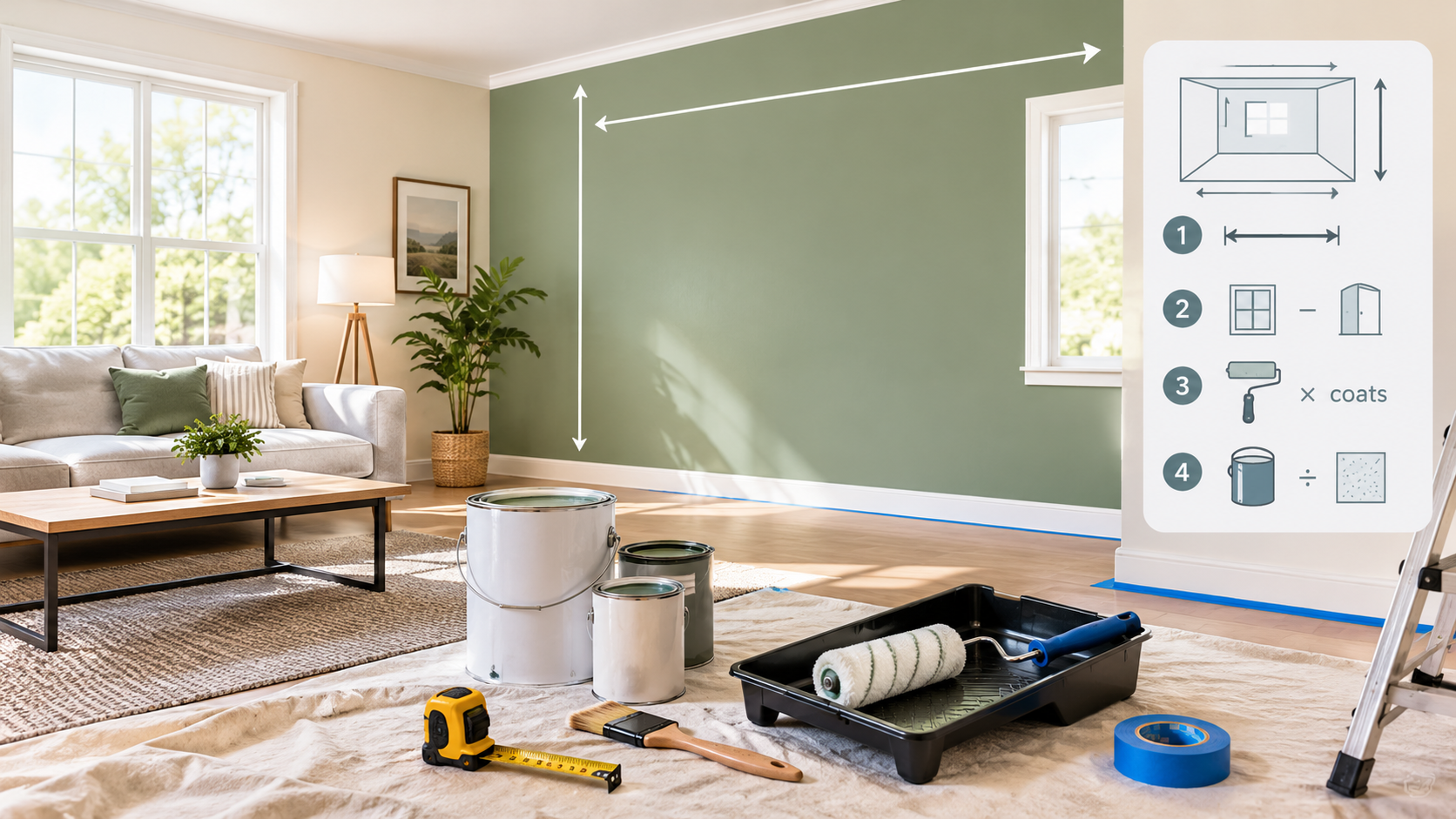
Follow these steps to estimate the paint required for your room.
Step 1: Measure the Room
Measure the room's length and width in feet. Measure the wall height from the floor to the ceiling. Enter these measurements into the calculator. For an irregular room, divide the space into smaller rectangular sections and calculate each section separately.
Step 2: Enter Doors and Windows
Enter the number of doors and windows that will not be painted. The calculator uses a standard deduction of 20 square feet per door and 15 square feet per window. These are estimates; actual openings may be smaller or larger.
Step 3: Choose the Number of Coats
Select the number of paint coats you plan to apply. Two coats are a common planning assumption for many interior projects, but the correct number depends on the paint instructions, surface condition and colour change. Follow the product label.
Step 4: Enter Paint Coverage
Check the coverage information on the paint container or product data sheet. Enter the coverage in square feet per US gallon. A planning figure such as 350 square feet per gallon can be used when you do not yet have a product selected, but actual coverage varies by product and surface.
Step 5: Add an Extra Paint Allowance
The calculator starts with a 10% extra allowance for small losses and touch-ups. You can change this value to suit your project. Rough or porous walls, spills, difficult application and major colour changes may require a different estimate.
Step 6: Calculate Your Paint Requirement
Click Calculate Paint. The result displays the estimated paintable area, total area across all coats, required gallons, equivalent litres and a rounded-up purchase estimate. If you want to start again, click Reset.
How Does a Paint Calculator Work?
The calculator uses the room's dimensions to estimate the surface area that needs painting. It then adjusts the area for openings, multiplies it by the number of coats and applies the extra allowance before dividing by the coverage rate.
Wall area = 2 × (Room Length + Room Width) × Wall Height
Paintable area = Wall area − Door deductions − Window deductions
Total area = (Paintable wall area + Optional ceiling area) × Number of coats
Paint volume in gallons = Total painting area × (1 + Extra allowance ÷ 100) ÷ Coverage per gallon
One US gallon is approximately 3.785 litres. The calculator converts gallons into litres to help users compare the estimate with paint containers sold in Canada. The final purchase quantity should be matched to the sizes available for your chosen product.
Paint Calculator Example: A 12 × 12 Foot Room
Suppose you are painting a room that is 12 feet long, 12 feet wide and 8 feet high. The room has one door and two windows. You plan to apply two coats and use paint rated at 350 square feet per US gallon, with a 10% extra allowance.
- Wall perimeter: 2 × (12 + 12) = 48 feet.
- Total wall area: 48 × 8 = 384 square feet.
- Door deduction: 1 × 20 = 20 square feet.
- Window deduction: 2 × 15 = 30 square feet.
- Estimated paintable wall area: 384 − 20 − 30 = 334 square feet.
- Area for two coats: 334 × 2 = 668 square feet.
- Area including 10% extra: 668 × 1.10 = 734.8 square feet.
- Estimated paint required: 734.8 ÷ 350 = approximately 2.10 US gallons.
In this example, the rounded-up estimate is 3 US gallons, equivalent to approximately 11.36 litres. Your actual requirement could be different if your paint has a different coverage rate or your walls need extra preparation.
How Much Paint Do You Need per Square Foot?
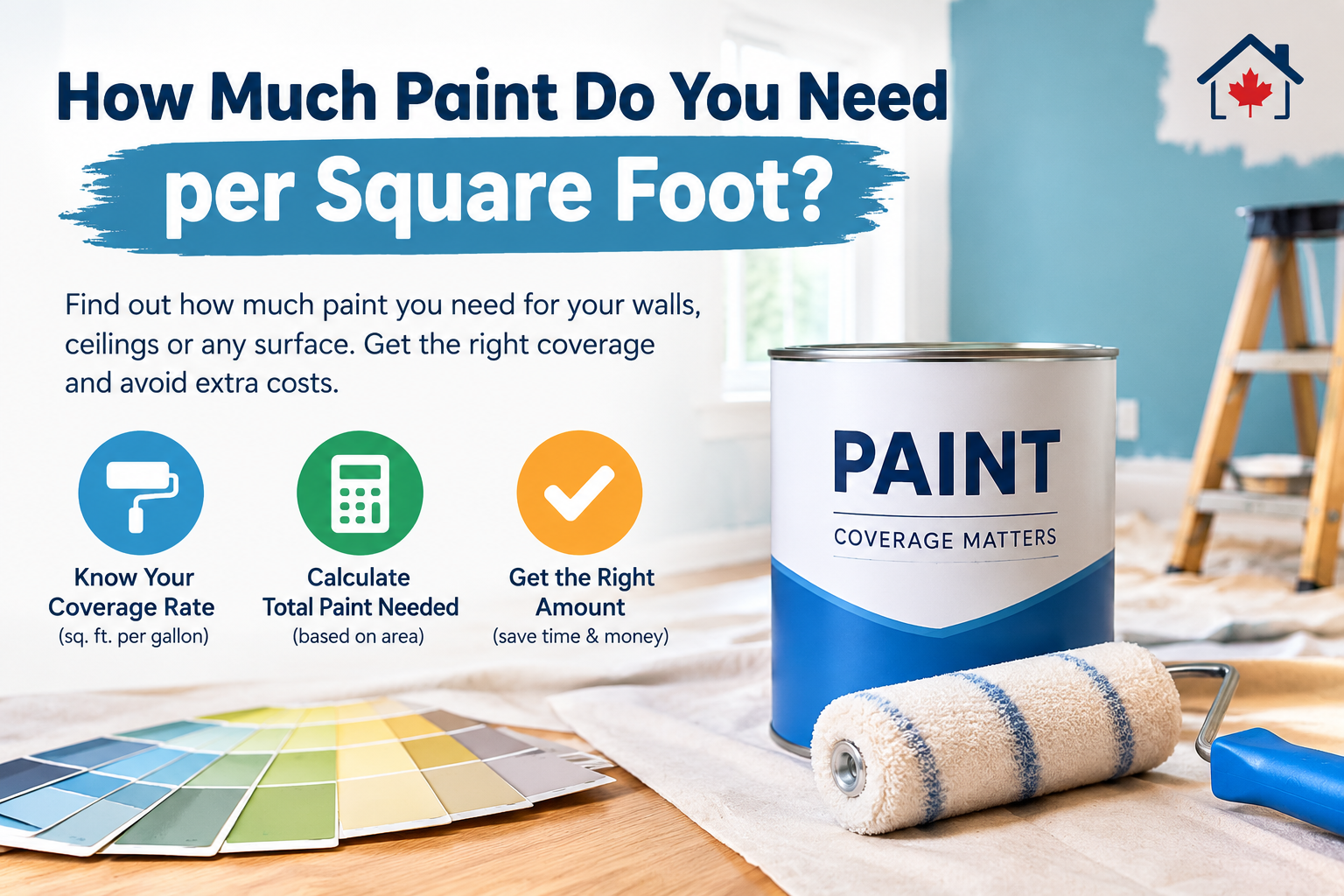
Paint coverage is the amount of surface a specified quantity of paint can cover under stated conditions. Many interior paints list coverage in square feet per gallon, while Canadian product labels may also show metric coverage in square metres per litre or per container.
For illustration, the following table shows the approximate volume needed for one coat over a given area when the product covers 350 square feet per US gallon. It does not include extra allowance.
| Paintable area | Approx. paint volume |
|---|---|
| 100 sq. ft. | 1.08 litres |
| 250 sq. ft. | 2.70 litres |
| 500 sq. ft. | 5.41 litres |
| 1,000 sq. ft. | 10.81 litres |
These figures are mathematical estimates based on the stated coverage rate. Two coats approximately double the required volume before adding any extra allowance. Always use the actual coverage rate and application instructions for your paint.
Factors That Affect Paint Coverage
1. Wall Texture and Porosity
Smooth, properly prepared walls may use paint more efficiently than rough, porous or damaged surfaces. Unpainted plaster, bare drywall and masonry may absorb more material, so the surface may need suitable preparation or primer.
2. Paint Type and Product Coverage
Interior wall paint, exterior paint, primer, ceiling paint and specialist coatings can have different coverage rates. Do not assume every product covers the same area. Check the technical information for the exact product you intend to use.
3. Number of Coats
Each additional coat increases the amount of paint needed. Some surfaces may need more coats to achieve an even finish, particularly when the existing colour is very dark or the new colour is much lighter.
4. Application Method
Brushes, rollers and sprayers can produce different application patterns and levels of material loss. Corners, edges, detailed trim and difficult-to-reach areas may also require additional paint.
5. Primer and Surface Preparation
Cleaning, filling holes, sanding and priming can improve the final finish. Primer is a separate product, so calculate it separately when needed rather than assuming that the wall paint estimate includes it.
How to Estimate Paint Costs in Canada
Once you know the approximate quantity of paint, you can estimate your project budget. Multiply the quantity you expect to buy by the price per container. Include primer, brushes, rollers, painter's tape, drop cloths and other supplies if required.
For example, if you need three containers and each costs $55 CAD, your estimated paint cost is $165 CAD before taxes and other supplies. This is only an example; prices depend on the product, container size, retailer and location.
When comparing paint prices in Canada, check whether the container is measured in litres or US gallons. One US gallon is approximately 3.785 litres, so the two quantities are not interchangeable. The rounded-up gallon estimate from this calculator is a planning guide, not a guarantee that the same number of containers will be available in your preferred size.
Tips for Getting a More Accurate Paint Estimate
- Measure each wall carefully and double-check the room dimensions.
- Measure unusually large doors and windows instead of relying on standard deductions.
- Use the coverage rate listed for your specific paint product.
- Calculate walls and ceilings separately if they use different paints.
- Account for primer separately when the surface or product instructions call for it.
- Consider the surface condition, colour change and number of coats.
- Keep a small amount of leftover paint for future touch-ups, if practical.
Frequently Asked Questions
1. How do I calculate how much paint I need?
Calculate the wall area using the room's length, width and height. Subtract the area of doors and windows, multiply the remaining area by the number of coats, add your extra allowance and divide by the paint's coverage per gallon.
2. How much area does one gallon of paint cover?
Coverage depends on the product and the surface. For planning, you might use 350 square feet per US gallon, but some products list different rates. Check the label or technical data sheet before calculating your final quantity.
3. How much paint do I need for a 12 × 12 room?
A 12 × 12 foot room with 8-foot walls has 384 square feet of wall area before subtracting doors and windows. The amount of paint depends on the openings, number of coats, coverage rate and whether you are also painting the ceiling.
4. Should I include the ceiling in my paint calculation?
Include the ceiling if you plan to paint it. This calculator adds the ceiling area using room length multiplied by room width. If the ceiling uses a different product, calculate its paint requirement separately for a more accurate shopping list.
5. Why should I subtract doors and windows?
Doors and windows generally do not require the same wall paint as the surrounding surface. Subtracting their area helps avoid overestimating the wall paint requirement. The default deductions are approximate, so measure large or unusual openings when possible.
6. How many coats of paint should I apply?
Two coats are a common planning assumption for many painting projects, but the appropriate number depends on the paint, existing colour, surface condition and desired finish. Follow the manufacturer's instructions for the product you choose.
7. How do I convert gallons to litres?
Multiply US gallons by approximately 3.785 to convert to litres. For example, 2 US gallons equal approximately 7.57 litres. Check the unit on your paint container because other gallon definitions exist.
8. Does this Paint Calculator work for exterior painting?
It can provide a basic area estimate for a rectangular building, but exterior projects may involve siding, trim, multiple elevations, gables and different surface materials. Measure those sections separately and use the coverage rate for the exterior product.
9. Does the calculator include primer?
No. The result estimates the selected paint only. If your project requires primer, calculate its coverage and quantity separately using the primer's own product information.
10. Is the Paint Calculator result exact?
No. It is an estimate based on your measurements and selected assumptions. Surface texture, paint absorption, application technique, spills and product differences can affect actual consumption. Confirm your purchase quantity with the product label or a painting professional.
Conclusion
Planning your paint quantity before starting a decorating project can save time, reduce unnecessary spending and help you avoid repeated trips to the store. The Canada Calculators Paint Calculator provides an easy way to estimate paint for walls and optional ceilings, account for doors and windows, and adjust the result for multiple coats and extra allowance.
For the most useful result, take accurate measurements and enter the coverage rate printed on your chosen paint product. Treat the result as a planning estimate, then confirm the required quantity and container sizes before purchasing your paint.
Disclaimer: This tool provides an approximate paint quantity for general planning purposes. Actual requirements vary with the product, surface and application conditions. Always follow the manufacturer's instructions.