
Compound Interest Calculator
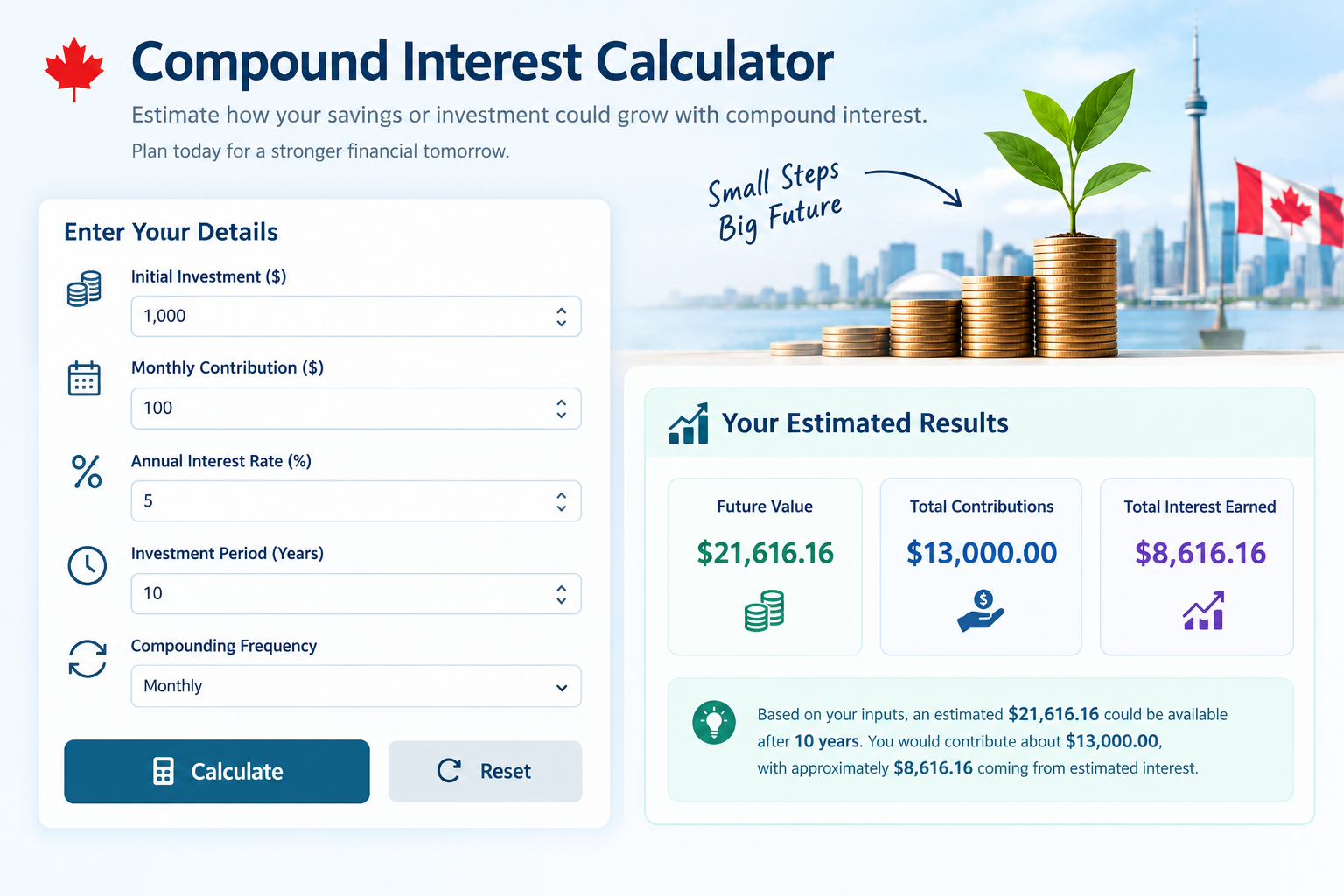
Estimate your savings growth with compound interest and regular monthly contributions.
Your Estimated Results
Compound Interest Calculator Canada
Our Compound Interest Calculator Canada helps you estimate how your savings could grow over time. Enter your initial investment, monthly contribution, annual interest rate, investment period and compounding frequency to calculate an estimated future balance in Canadian dollars.
Compound interest is especially useful to understand when planning long-term savings. When interest is added to your balance, that interest can also earn interest in later periods. Regular contributions can further increase the amount you accumulate over time.
What Is Compound Interest?
Compound interest is interest calculated on your original deposit and on interest accumulated from previous periods. This is often called earning interest on interest. Unlike simple interest, which is generally calculated only on the original principal, compound interest can help a balance grow as accumulated interest remains invested.
For example, if you deposit $1,000 and earn interest, your balance increases. In a later period, interest may be calculated on that larger balance. The exact growth depends on the rate, compounding schedule, fees and terms of the account.
How to Use This Compound Interest Calculator
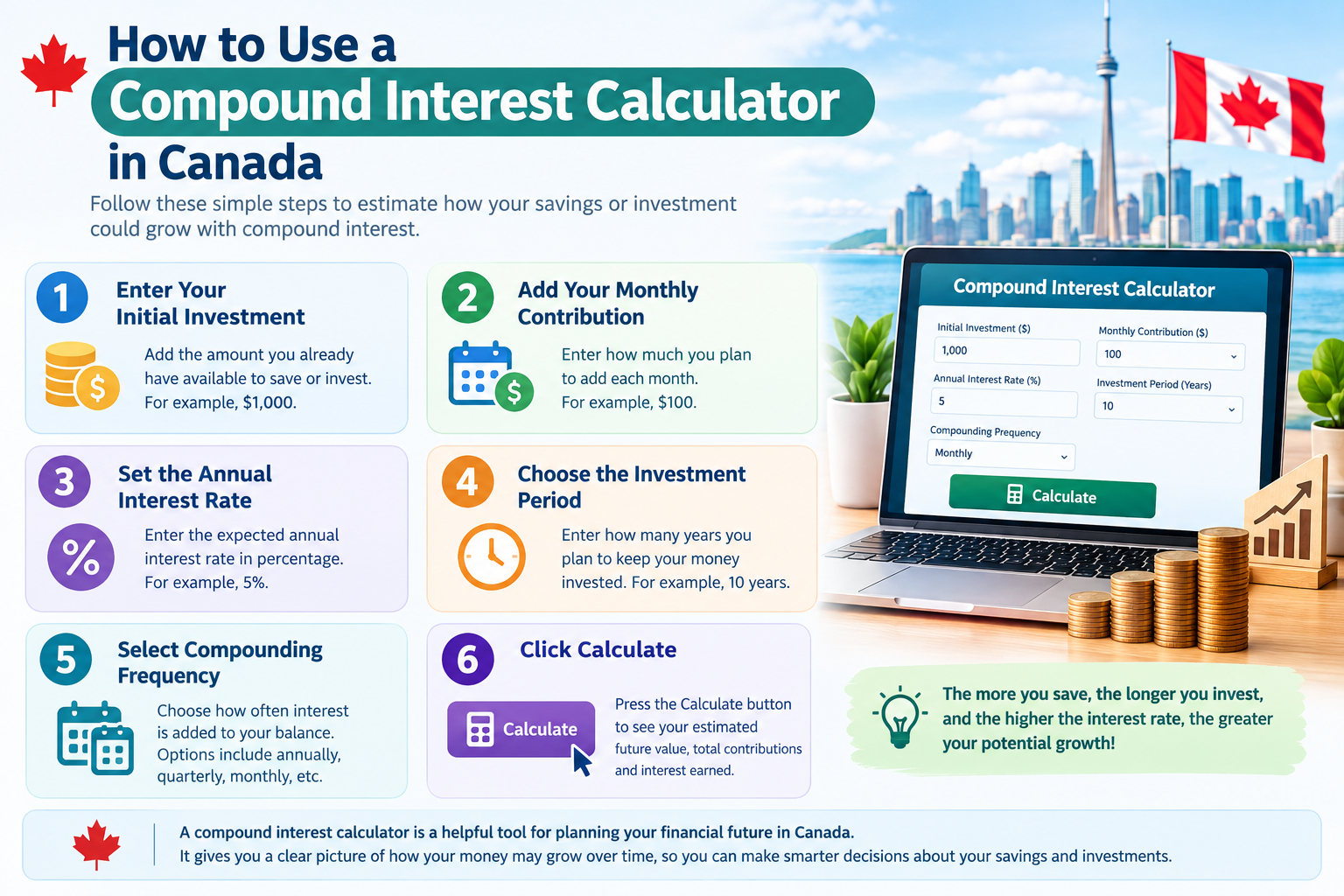
Follow these simple steps to estimate your savings or investment growth.
- Initial Investment: Enter your starting deposit or current investment amount.
- Monthly Contribution: Enter how much you plan to add each month. Enter zero if you will not make regular deposits.
- Annual Interest Rate: Enter an assumed annual rate as a percentage.
- Investment Period: Choose how many years you plan to save or invest.
- Compounding Frequency: Select annual, semi-annual, quarterly, monthly or daily compounding.
- Calculate: Click Calculate to view your estimated future value, total contributions and interest earned.
Compound Interest Formula
For a one-time investment with no additional deposits, the standard compound interest formula is:
In this formula:
- A: Future value of the investment.
- P: Initial principal or starting deposit.
- r: Annual interest rate expressed as a decimal.
- n: Number of compounding periods per year.
- t: Investment duration in years.
When monthly contributions are included, each deposit has a different amount of time to earn interest. The calculator estimates growth period by period, with monthly contributions added at the end of each month.
How Does Compounding Frequency Affect Growth?
Compounding frequency describes how often interest is added to an account balance. Depending on the financial product, interest may be compounded annually, semi-annually, quarterly, monthly or daily.
For the same nominal annual rate, more frequent compounding generally produces a higher effective annual rate when the rate is positive. However, the actual result depends on the account's terms. Check whether the advertised rate is nominal or effective and how the provider calculates interest.
Compound Interest Example
Suppose you start with $1,000, add $100 at the end of every month, earn an assumed annual interest rate of 5%, and save for 10 years with monthly compounding. Your total deposits would be $13,000 before interest.
Under these assumptions, the estimated final balance is approximately $16,700, with roughly $3,700 in interest. The exact result depends on the calculation conventions used. Try the calculator above to explore different rates, contributions and time periods.
Why Time Matters With Compound Interest
Time gives savings more opportunities to accumulate interest. When earned interest remains invested, it can contribute to further growth in subsequent periods. Starting earlier and making consistent deposits can make a difference, although actual returns are never guaranteed.
A longer investment period does not remove financial risk. Interest rates may change, investments may lose value, and fees or taxes can affect the amount you ultimately keep.
Compound Interest With Monthly Contributions
Monthly contributions let you add money gradually rather than relying only on a lump-sum deposit. This approach can be helpful when planning a regular savings habit around monthly income.
Deposits made earlier generally have more time to earn interest than deposits made later. The calculator assumes contributions are made at the end of each month, so actual account results may differ if deposits are made on another schedule.
Using a Compound Interest Calculator in Canada
Canadians can use a compound interest calculator to explore savings goals, emergency funds, education savings and retirement planning scenarios. You can compare the possible effects of different monthly contributions, interest rates and investment periods without performing the calculations manually.
Remember that a mathematical estimate is not a prediction of what a particular bank account or investment will earn. Registered accounts and other financial products may have different tax rules, fees, restrictions and risks. Review the specific product terms before making financial decisions.
Compound Interest vs Simple Interest
The key difference is how interest is treated after it is earned.
- Simple interest: Generally calculated on the original principal only.
- Compound interest: Calculated on the principal and accumulated interest, according to the compounding terms.
The difference can become more noticeable over longer periods, especially when interest remains invested and regular contributions are added.
Factors That Affect Compound Interest Growth
- Initial deposit or investment amount.
- Size and timing of monthly contributions.
- Annual interest rate or investment return.
- Length of the savings period.
- Compounding frequency.
- Account fees and investment costs.
- Applicable taxes and account rules.
- Changes in interest rates or investment performance.
Frequently Asked Questions
1. What is a Compound Interest Calculator?
It is a tool that estimates how money could grow when interest is added to a balance and can earn further interest. This calculator also includes optional monthly contributions and different compounding frequencies.
2. How do I calculate compound interest in Canada?
Enter your initial investment, expected annual interest rate, investment period and compounding frequency. Add your planned monthly contribution if applicable, then click Calculate to see the estimated future value and interest earned in Canadian dollars.
3. Does monthly compounding earn more than annual compounding?
At the same positive nominal annual rate, monthly compounding generally produces a higher effective annual rate than annual compounding. The difference depends on the rate and the terms of the financial product.
4. Can I calculate compound interest with monthly deposits?
Yes. Enter your regular deposit in the Monthly Contribution field. The calculator adds each contribution at the end of the month and estimates how the balance grows over the selected period.
5. What is the difference between total contributions and interest earned?
Total contributions include your initial investment and all monthly deposits. Interest earned is the estimated growth above those contributions, before any unmodelled fees, taxes or withdrawals.
6. Is the future value guaranteed?
No. The future value is an estimate based on your inputs and the calculator's assumptions. Actual results may differ because of changing rates, market performance, account terms, fees and taxes.
7. Why is the investment period important?
A longer period gives the balance more time to accumulate interest. When interest remains invested, it may also earn additional interest in later periods.
8. Can I use this calculator for retirement planning?
You can use it to explore basic savings-growth scenarios. A complete retirement plan may also need to account for inflation, taxes, investment risk, fees, future withdrawals and changes in income.
Conclusion
Compound interest can help explain how savings may grow when interest accumulates over time. Your initial investment, monthly contributions, assumed rate, compounding frequency and investment period all affect the estimated result.
Use the Compound Interest Calculator above to compare different savings scenarios and understand the possible impact of regular deposits and time. For actual financial decisions, review the terms, costs and tax treatment of the financial product you are considering.