
Payroll Tax Calculator Canada
Estimate Canadian payroll deductions including federal and provincial income tax, CPP, CPP2, EI, employee net pay, and employer payroll contributions.
What Is a Payroll Tax Calculator Canada?
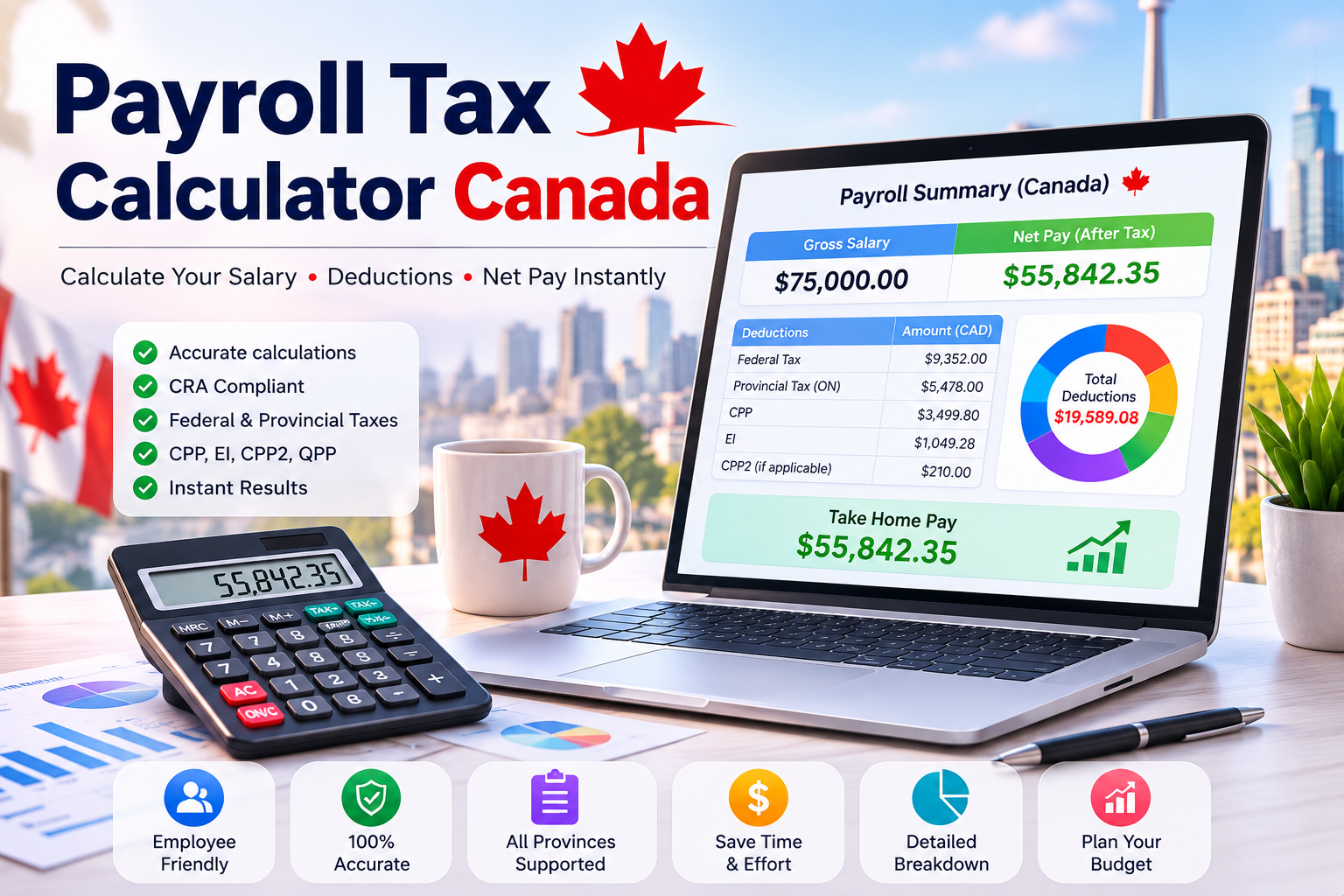
A Payroll Tax Calculator Canada is an online tool that helps employees, employers, payroll administrators, and business owners estimate payroll deductions from an employee's gross earnings. Canadian payroll calculations commonly involve federal income tax, provincial or territorial income tax, Canada Pension Plan (CPP) contributions, and Employment Insurance (EI) premiums.
The amount deducted from a paycheque depends on several factors, including the employee's province or territory, pay frequency, annualized earnings, CPP and EI eligibility, year-to-date earnings, and tax-credit information. Because payroll rules can change during the year, this calculator is intended as a convenient estimate and planning tool rather than an official CRA payroll calculation.
The Canada Revenue Agency publishes payroll deduction tables and formulas and provides its Payroll Deductions Online Calculator (PDOC) for official payroll deduction calculations. CRA's current 2026 payroll materials include updated CPP, EI, federal, provincial, and territorial information.
How Does the Canadian Payroll Tax Calculator Work?
The calculator starts with gross pay for the selected pay period and annualizes the amount using the selected payroll frequency. It then estimates the major payroll deductions that normally affect an employee's take-home pay.
For the employer, payroll cost can be higher than the employee's gross wages because the employer may also have to contribute its share of CPP and EI.
Actual payroll processing can include additional items such as benefits, pension plans, union dues, garnishments, taxable benefits, vacation pay, commissions, special payments, and other deductions.
What Payroll Taxes Are Deducted in Canada?
1. Federal Income Tax
Federal income tax is based on federal taxable income and the applicable federal income-tax brackets. Canada uses a progressive tax system, meaning different portions of taxable income are taxed at different rates.
For 2026, the federal rates published by the CRA range from 14% on the first tax bracket to 33% on taxable income above the highest threshold. The 2026 federal thresholds are $58,523, $117,045, $181,440 and $258,482.
2. Provincial or Territorial Income Tax
In addition to federal income tax, employees generally pay provincial or territorial income tax. The applicable rates depend on the province or territory.
For example, Ontario's 2026 provincial rates start at 5.05%, while Alberta's start at 8%. British Columbia, Manitoba, Saskatchewan, Nova Scotia, New Brunswick and the territories have their own brackets and rates.
3. Canada Pension Plan (CPP)
CPP is a mandatory payroll contribution for most eligible employees outside Quebec. Both the employee and employer generally contribute.
For 2026, CRA lists a CPP Year's Maximum Pensionable Earnings of $74,600 and a basic exemption of $3,500. The combined base and first additional employee contribution rate is 5.95%, with a maximum annual employee contribution of $4,230.45 before considering CPP2.
4. Second Additional CPP (CPP2)
CPP2 applies to pensionable earnings above the first CPP earnings ceiling and up to the second additional maximum. For 2026, CRA lists a Year's Additional Maximum Pensionable Earnings of $85,000 and a CPP2 contribution rate of 4% on the applicable earnings between the relevant limits. The maximum CPP2 contribution is $416.
5. Employment Insurance (EI)
EI premiums are normally deducted from an employee's insurable earnings. Employers also remit an employer portion.
For 2026, the maximum annual insurable earnings outside Quebec are $68,900. The employee EI rate is 1.63%, while the employer rate is 2.282%. The maximum annual employee premium is $1,123.07 and the maximum employer premium is $1,572.30.
2026 Canadian Payroll Tax Rates
The following major figures are incorporated into the calculator for planning purposes.
| Payroll Item | 2026 Amount / Rate | Applies To |
|---|---|---|
| CPP contribution | 5.95% | Employee and employer, subject to CPP limits |
| CPP maximum pensionable earnings | $74,600 | CPP |
| CPP basic exemption | $3,500 | Annual CPP calculation |
| CPP2 rate | 4.00% | Applicable earnings above the first CPP ceiling |
| CPP2 maximum additional earnings | $10,400 | 2026 |
| EI employee rate | 1.63% | Canada except Quebec |
| EI employer rate | 2.282% | Canada except Quebec |
| EI maximum insurable earnings | $68,900 | 2026 |
These values come from CRA's 2026 payroll deduction information. Payroll administrators should always verify the applicable CRA tables and formulas for the payroll date being processed.
2026 Federal Income Tax Brackets
Canada's federal income tax is progressive. This means that moving into a higher bracket does not mean the entire salary is taxed at the higher rate.
| Federal Taxable Income | 2026 Federal Rate |
|---|---|
| $0 to $58,523 | 14% |
| $58,523.01 to $117,045 | 20.5% |
| $117,045.01 to $181,440 | 26% |
| $181,440.01 to $258,482 | 29% |
| Over $258,482 | 33% |
These are the 2026 federal tax brackets published by the Canada Revenue Agency. Provincial or territorial income tax is calculated separately according to the employee's applicable province or territory.
Why Does Province Matter for Payroll Tax?
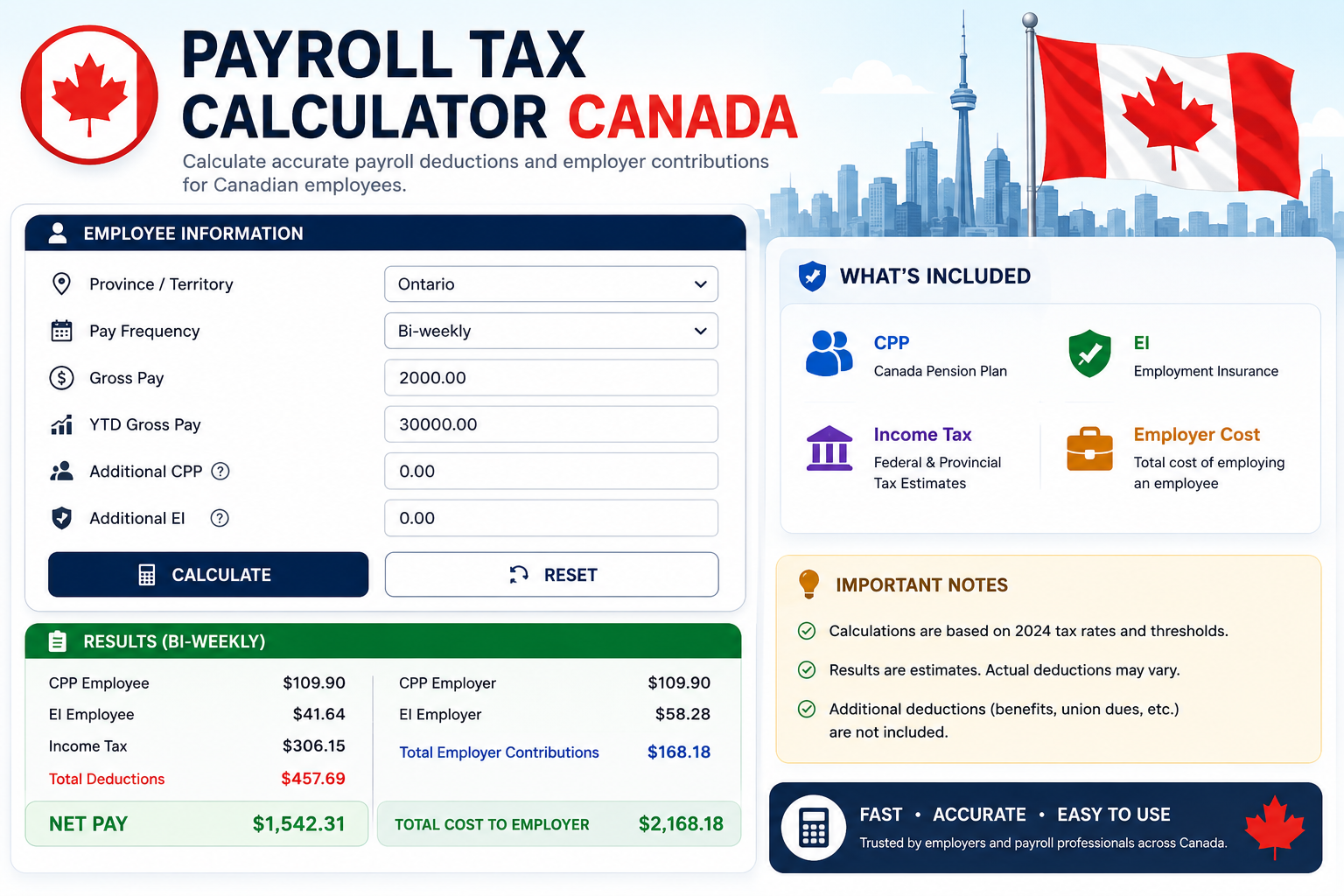
Province is an important input because Canadian employees are subject to different provincial and territorial tax rates. Two employees with the same gross salary can therefore have different estimated income-tax deductions depending on the applicable province.
For example, the first 2026 provincial bracket is 5.05% in Ontario, 8% in Alberta, 5.06% in British Columbia, 10.8% in Manitoba, and 10.5% in Saskatchewan. The higher brackets also differ significantly between provinces.
How Pay Frequency Changes Your Paycheque
Your annual salary does not change simply because you are paid weekly instead of monthly, but the amount shown on each individual paycheque does change.
Common Canadian payroll frequencies include:
- Weekly — 52 pay periods
- Bi-weekly — 26 pay periods
- Semi-monthly — 24 pay periods
- Monthly — 12 pay periods
- Every four weeks — 13 pay periods
For example, an employee earning $65,000 annually and paid bi-weekly has a gross paycheque of approximately:
The actual payroll deductions for each pay period can vary depending on year-to-date earnings, tax credits, payroll adjustments, and other employee-specific factors.
What Is Net Pay?
Net pay is the amount an employee receives after payroll deductions have been subtracted from gross earnings.
Typical statutory deductions include income tax, CPP and EI where applicable. However, an employee's actual paycheque can include additional deductions such as group insurance, pension contributions, charitable deductions, union dues or garnishments.
Employee Payroll Taxes vs Employer Payroll Costs
Employees and employers do not have identical payroll deductions. An employee's paycheque is reduced by employee-side deductions, while the employer has additional payroll costs.
For example, an employer generally contributes its own share of CPP and EI in addition to the employee's gross wages. CRA states that employers must remit both the employee and employer shares of applicable CPP and EI contributions.
How to Use This Payroll Tax Calculator
Step 1: Select Your Province
Choose the employee's applicable province or territory from the dropdown menu. Provincial tax rates vary across Canada.
Step 2: Select Pay Frequency
Choose weekly, bi-weekly, semi-monthly, monthly, every four weeks, daily, or annual pay frequency.
Step 3: Enter Gross Pay
Enter the employee's gross earnings for one pay period. This should be the amount before income tax, CPP, EI and other deductions.
Step 4: Enter Year-to-Date Earnings
If the employee has already received income during the year, enter applicable year-to-date earnings. This is important because CPP and EI have annual maximums.
Step 5: Add Optional Tax Credits
If you know that the employee has additional eligible tax credits, enter them in the additional tax-credit field. If there are no additional credits, leave the field at zero.
Step 6: Click Calculate Payroll Tax
The calculator will display estimated income tax, CPP, CPP2, EI, total employee deductions, estimated net pay, employer contributions and estimated total payroll cost.
What Is Year-to-Date Payroll?
Year-to-date, commonly abbreviated as YTD, represents the amount already accumulated during the current calendar year.
YTD information is especially important for CPP and EI because both contributions have annual maximums. Once an employee reaches the applicable maximum, further deductions may stop for the remainder of the year, subject to the relevant rules. CRA confirms that CPP and EI deductions stop when the applicable annual maximum has been reached.
Payroll Tax Calculator Canada for Employers
Employers can use a payroll tax calculator as a quick budgeting and payroll-planning tool. Besides the employee's gross wage, employers need to consider employer CPP and EI contributions and any other employment-related costs.
A simple payroll-cost estimate can be represented as:
Actual employer costs may also include workers' compensation premiums, benefits, vacation pay, pension plans and other employment expenses that are outside the basic payroll-tax calculation.
CPP vs EI: What Is the Difference?
CPP
The Canada Pension Plan is designed to provide retirement, disability and survivor benefits to eligible contributors. Payroll contributions are generally shared between employees and employers.
EI
Employment Insurance provides benefits to eligible workers in qualifying situations, such as job loss and certain types of leave. EI premiums are normally deducted from insurable earnings, and employers contribute as well.
Payroll Tax Calculator Canada for Quebec
Quebec has a different payroll-tax framework from the other Canadian provinces. Quebec payroll calculations can involve the Québec Pension Plan (QPP), Québec Parental Insurance Plan (QPIP), Quebec provincial income tax and other Quebec-specific rules.
For this reason, this calculator flags Quebec separately and should not be used as the final payroll calculation for a Quebec employee. Revenu Québec and the CRA's applicable payroll resources should be consulted for Quebec payroll processing.
CRA's 2026 payroll formulas list different EI and QPIP rates for Quebec compared with the rest of Canada.
Why Payroll Deductions Can Differ From Your Estimate
A payroll calculator provides an estimate because real payroll processing can involve many employee-specific circumstances.
- Tax-credit amounts
- TD1 information
- Multiple employers
- Bonus or commission payments
- Taxable benefits
- CPP and EI year-to-date amounts
- Pension adjustments
- Additional deductions
- Provincial tax credits
- Special payroll situations
The CRA notes that its Payroll Deductions Online Calculator is designed to calculate payroll deductions using the applicable province and pay period, and it is the recommended official resource for payroll deduction calculations.
Payroll Tax Calculator Canada FAQs
What is a Payroll Tax Calculator Canada?
A Payroll Tax Calculator Canada is an online tool that estimates payroll deductions such as federal and provincial income tax, CPP and EI and calculates an estimated employee take-home pay.
How is Canadian payroll tax calculated?
Canadian payroll deductions can include federal income tax, provincial or territorial income tax, CPP contributions and EI premiums. The amount depends on earnings, province, pay frequency, tax credits and year-to-date payroll information.
What is the CPP rate in Canada for 2026?
For 2026, the combined base and first additional CPP employee contribution rate is 5.95%, subject to the applicable earnings limits and annual maximums. CPP2 may also apply to earnings above the first CPP earnings ceiling.
What is the EI rate in Canada for 2026?
For 2026, the employee EI premium rate outside Quebec is 1.63%, with maximum annual insurable earnings of $68,900. The employer rate is 2.282%. Quebec has different EI and QPIP arrangements.
Does province affect payroll tax in Canada?
Yes. Provincial and territorial income-tax rates differ across Canada. Therefore, employees with the same salary can have different income-tax deductions depending on the applicable province or territory.
What is the difference between gross pay and net pay?
Gross pay is the amount earned before payroll deductions. Net pay is the amount remaining after applicable deductions such as income tax, CPP, EI and other employee-specific deductions.
Why does my payroll tax change when my salary increases?
Canada uses progressive income-tax brackets. As taxable income increases, additional portions of income can be taxed at higher marginal rates. CPP and EI can also change until their annual contribution limits are reached.
Does the employer also pay payroll taxes?
Yes. Employers generally contribute their own share of CPP and EI in addition to paying the employee's gross wages. Other employer costs may also apply.
Can I use this calculator for Quebec payroll?
Quebec has separate provincial payroll rules involving QPP, QPIP and Quebec income tax. The calculator identifies Quebec separately, but Quebec employers should use the applicable CRA and Revenu Québec payroll resources for final calculations.
Is this calculator an official CRA payroll calculator?
No. It is an independent estimation tool. For official payroll deductions, employers should use the CRA Payroll Deductions Online Calculator, current payroll deduction tables and formulas applicable to the payroll date.
Conclusion
The Payroll Tax Calculator Canada provides a convenient way to estimate the major deductions that affect a Canadian employee's paycheque. By entering gross pay, province, pay frequency, year-to-date earnings and optional tax-credit information, you can get an estimate of income tax, CPP, CPP2, EI, net pay and employer payroll contributions.
Understanding these deductions makes it easier for employees to estimate their take-home pay and for employers to plan payroll costs. However, Canadian payroll calculations can become more complex when bonuses, taxable benefits, multiple employers, special tax credits, Quebec payroll rules or other circumstances are involved.
For that reason, use this calculator as a helpful planning and estimation tool and verify final payroll deductions against the latest CRA payroll tables, formulas or the official Payroll Deductions Online Calculator before processing actual payroll.