
Estimate your Canada Express Entry Comprehensive Ranking System (CRS) score using your age, education, language ability, work experience, spouse factors and additional CRS points.
1. Personal Information
2. Education Credentials
3. First Official Language
Enter your CLB/NCLC level separately for Reading, Writing, Listening and Speaking.
4. Second Official Language
5. Skilled Work Experience
7. Additional CRS Points
What Is a PR Points Calculator Canada?
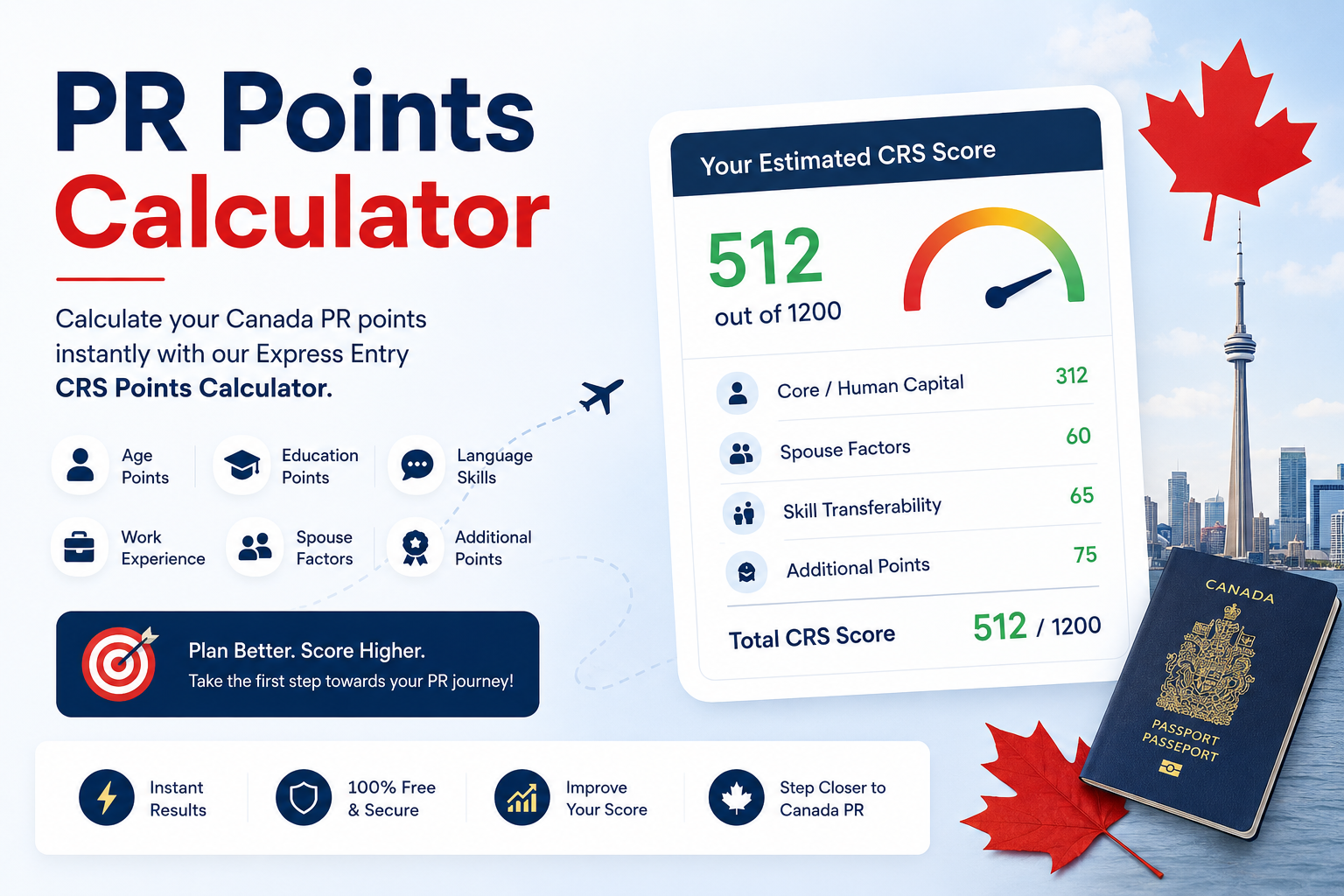
A PR Points Calculator Canada is an online tool that helps Express Entry candidates estimate their Comprehensive Ranking System (CRS) score. The CRS is used by Immigration, Refugees and Citizenship Canada (IRCC) to assess and rank candidates in the Express Entry pool.
Your CRS score is calculated using several factors, including age, education, official language ability, Canadian work experience, spouse or common-law partner factors, skill transferability and additional points.
The maximum CRS score is 1,200 points. The exact score depends on the information in your Express Entry profile and the CRS criteria that apply to your situation.
How Does the Canada PR Points Calculator Work?
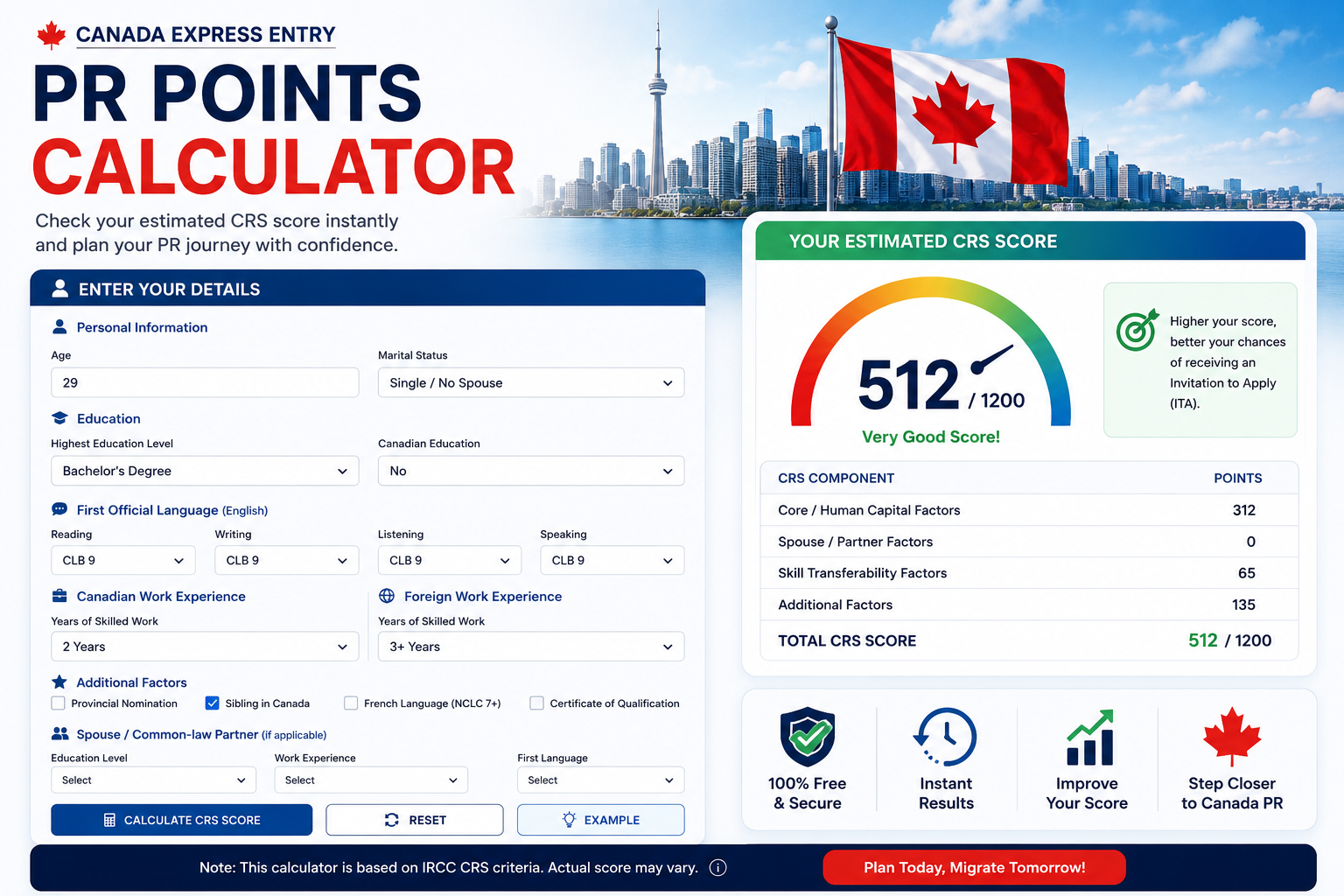
This calculator collects the main information used in the CRS system and calculates an estimated score. It separates the calculation into core factors, spouse factors, skill transferability and additional CRS points.
Candidates without an accompanying spouse or common-law partner can receive up to 500 points in the core/human capital category. Candidates with an accompanying spouse can receive up to 460 points in that category, with up to 40 additional spouse factor points.
Canada CRS Points Breakdown
| CRS Category | Maximum Points |
|---|---|
| Core / Human Capital Factors | 500 without spouse / 460 with spouse |
| Spouse / Common-Law Partner Factors | Up to 40 |
| Skill Transferability Factors | Up to 100 |
| Additional CRS Points | Up to 600 |
| Total Maximum CRS Score | 1,200 |
Age Points in the Canada PR Points Calculator
Age is one of the core CRS factors. The highest age score is available from ages 20 to 29. After age 29, the number of points gradually decreases, and candidates aged 45 or older receive zero CRS points for age.
| Age | Without Spouse | With Spouse |
|---|---|---|
| 17 or younger | 0 | 0 |
| 18 | 99 | 90 |
| 19 | 105 | 95 |
| 20–29 | 110 | 100 |
| 30 | 105 | 95 |
| 31 | 99 | 90 |
| 32 | 94 | 85 |
| 33 | 88 | 80 |
| 34 | 83 | 75 |
| 35 | 77 | 70 |
| 36 | 72 | 65 |
| 37 | 66 | 60 |
| 38 | 61 | 55 |
| 39 | 55 | 50 |
| 40 | 50 | 45 |
| 41 | 39 | 35 |
| 42 | 28 | 25 |
| 43 | 17 | 15 |
| 44 | 6 | 5 |
| 45+ | 0 | 0 |
Education Points for Canada Express Entry
Education is another major component of the CRS. Your highest eligible educational credential is used to determine the core education points.
The CRS education category includes secondary school, one-year post-secondary programs, two-year programs, bachelor's degrees, two or more eligible credentials, master's or professional degrees, and doctoral degrees.
If your education was completed outside Canada, an Educational Credential Assessment (ECA) may be required for the relevant Express Entry situation.
Language Points and CLB Levels
Official language ability can have a major effect on your CRS score. The first official language is assessed across four abilities:
- Reading
- Writing
- Listening
- Speaking
For English-language tests, results are converted into Canadian Language Benchmark (CLB) levels. French-language ability is measured using the NCLC system.
Higher first-language levels provide more CRS points. CLB 9 or higher across all four abilities can also affect several skill transferability combinations.
Why CLB 9 Matters for CRS
CLB 9 is an important level in CRS planning because language proficiency is used not only for first-language points but also in some skill-transferability calculations.
For example, education combined with strong official-language ability can generate transferability points when the applicable requirements are met. Foreign work experience can also combine with language proficiency.
Canadian Work Experience Points
Eligible Canadian skilled work experience can contribute to the CRS core factors. The number of points increases with qualifying years of Canadian work experience.
| Canadian Work Experience | Without Spouse | With Spouse |
|---|---|---|
| None / less than 1 year | 0 | 0 |
| 1 year | 40 | 35 |
| 2 years | 53 | 46 |
| 3 years | 64 | 56 |
| 4 years | 72 | 63 |
| 5 years or more | 80 | 70 |
Foreign Work Experience and CRS Points
Foreign skilled work experience does not simply add a fixed number of points to the core human-capital section. Instead, it can contribute through skill-transferability combinations.
Foreign work experience can combine with strong first-language ability or Canadian work experience. The number of transferability points depends on the number of years of foreign work experience and the other qualifying factors in the CRS.
Spouse or Common-Law Partner CRS Points
If an accompanying spouse or common-law partner is included in the Express Entry profile, spouse factors can contribute up to 40 CRS points.
- Spouse's education — up to 10 points
- Spouse's official language proficiency — up to 20 points
- Spouse's Canadian work experience — up to 10 points
The presence of an accompanying spouse can also change the maximum points available in some of the principal applicant's core categories.
Skill Transferability Points
Skill-transferability points recognize combinations of education, language ability, Canadian work experience, foreign work experience and trade qualifications.
The complete skill-transferability category is capped at 100 points.
- Education + first official language
- Education + Canadian work experience
- Foreign work experience + first official language
- Foreign work experience + Canadian work experience
- Certificate of qualification + official language ability
Provincial Nomination and CRS Points
A qualifying provincial or territorial nomination can add 600 additional CRS points.
Provincial nomination programs have their own eligibility requirements. Receiving a nomination and receiving an Express Entry invitation are separate steps, so candidates should check the requirements of the relevant province or territory.
French Language Additional CRS Points
Strong French-language ability can provide additional CRS points when the applicable NCLC requirements are met across all four language abilities.
Under the current CRS structure, qualifying NCLC 7 or higher results in all four French abilities can provide either 25 or 50 additional points, depending on the candidate's English-language level.
Canadian Education Additional Points
Certain post-secondary credentials completed in Canada can provide additional CRS points. Depending on the qualifying credential, candidates may receive 15 or 30 additional points.
These points are separate from the core education points used for the candidate's highest educational credential.
Sibling in Canada CRS Points
A qualifying brother or sister living in Canada may provide 15 additional CRS points when the applicable requirements are met.
The sibling must meet the applicable requirements, including Canadian citizenship or permanent resident status and the relevant age and relationship conditions.
Are Job Offers Still Worth CRS Points?
The CRS rules changed on March 25, 2025. IRCC no longer awards CRS ranking points for job offers. The previous 50-point and 200-point job-offer bonuses were removed from the CRS.
A job offer can still be relevant to eligibility under certain Express Entry programs or provincial nominee streams, so the removal of CRS ranking points does not mean job offers are irrelevant to Canadian immigration.
CRS Score vs. FSW 67-Point Grid
The CRS score and the Federal Skilled Worker 67-point grid are different systems and should not be confused.
The FSW selection grid is used as part of Federal Skilled Worker eligibility. The CRS is used to rank candidates who are in the Express Entry pool.
How to Use the PR Points Calculator Canada
- Enter your current age.
- Select your marital and accompanying-spouse status.
- Choose your highest eligible education credential.
- Enter your first official language CLB/NCLC levels.
- Add your second official language levels if applicable.
- Select your Canadian and foreign skilled work experience.
- Enter spouse factors if your spouse is accompanying you.
- Select applicable additional CRS points.
- Click Calculate PR Points.
Why Use an Online Canada PR Points Calculator?
Calculating CRS points manually can be time-consuming because several categories interact with one another. An online calculator provides a convenient way to organize your information and create an initial estimate.
It can also help you identify which parts of your profile may contribute to your overall score, such as language proficiency, education, Canadian work experience or additional CRS factors.
Frequently Asked Questions
What is the maximum CRS score for Canada Express Entry?
The maximum CRS score is 1,200 points. The score is made up of core/human-capital factors, spouse factors where applicable, skill-transferability factors and additional points.
What is the difference between PR points and CRS points?
In the Express Entry context, people often use "PR points" to refer to the CRS score used for ranking candidates. The CRS is the official Comprehensive Ranking System used by IRCC for Express Entry candidates.
Does age affect my Canada PR score?
Yes. Age is a core CRS factor. Candidates aged 20 to 29 receive the highest age points. Age points decrease after age 29 and become zero at age 45 or older.
How many CRS points can I get for a provincial nomination?
A qualifying provincial or territorial nomination can add 600 additional CRS points.
Do job offers still give CRS points?
No. IRCC removed CRS points for job offers effective March 25, 2025. A job offer may still be relevant for certain program eligibility requirements.
How many points can I get for Canadian education?
Qualifying Canadian post-secondary credentials can provide additional CRS points. Depending on the qualifying credential, the additional amount can be 15 or 30 points.
Does Canadian work experience increase CRS points?
Yes. Eligible Canadian skilled work experience can contribute to the core CRS score. The available points increase according to the qualifying number of years of Canadian work experience.
Does French give additional CRS points?
Yes. Qualifying French-language ability at NCLC 7 or higher in all four abilities can provide additional CRS points, subject to the applicable English-language conditions.
Is this PR Points Calculator an official IRCC calculator?
No. This is an independent calculator designed for estimation and planning. Your official Express Entry profile and the IRCC system determine your actual CRS score.
Can a high CRS score guarantee an Invitation to Apply?
No. There is no single permanent CRS score that guarantees an Invitation to Apply. Invitation requirements can vary according to the type of Express Entry round and the applicable criteria.
Conclusion
The PR Points Calculator Canada can help you estimate your Express Entry CRS score using important factors such as age, education, language ability, work experience, spouse factors and additional points.
Use the calculator as a planning tool before creating or updating your Express Entry profile. Because immigration rules and invitation rounds can change, always compare your estimate with the latest information published by Immigration, Refugees and Citizenship Canada (IRCC).