
Quadratic Group Calculator
Solve quadratic equations and find real or complex roots instantly.
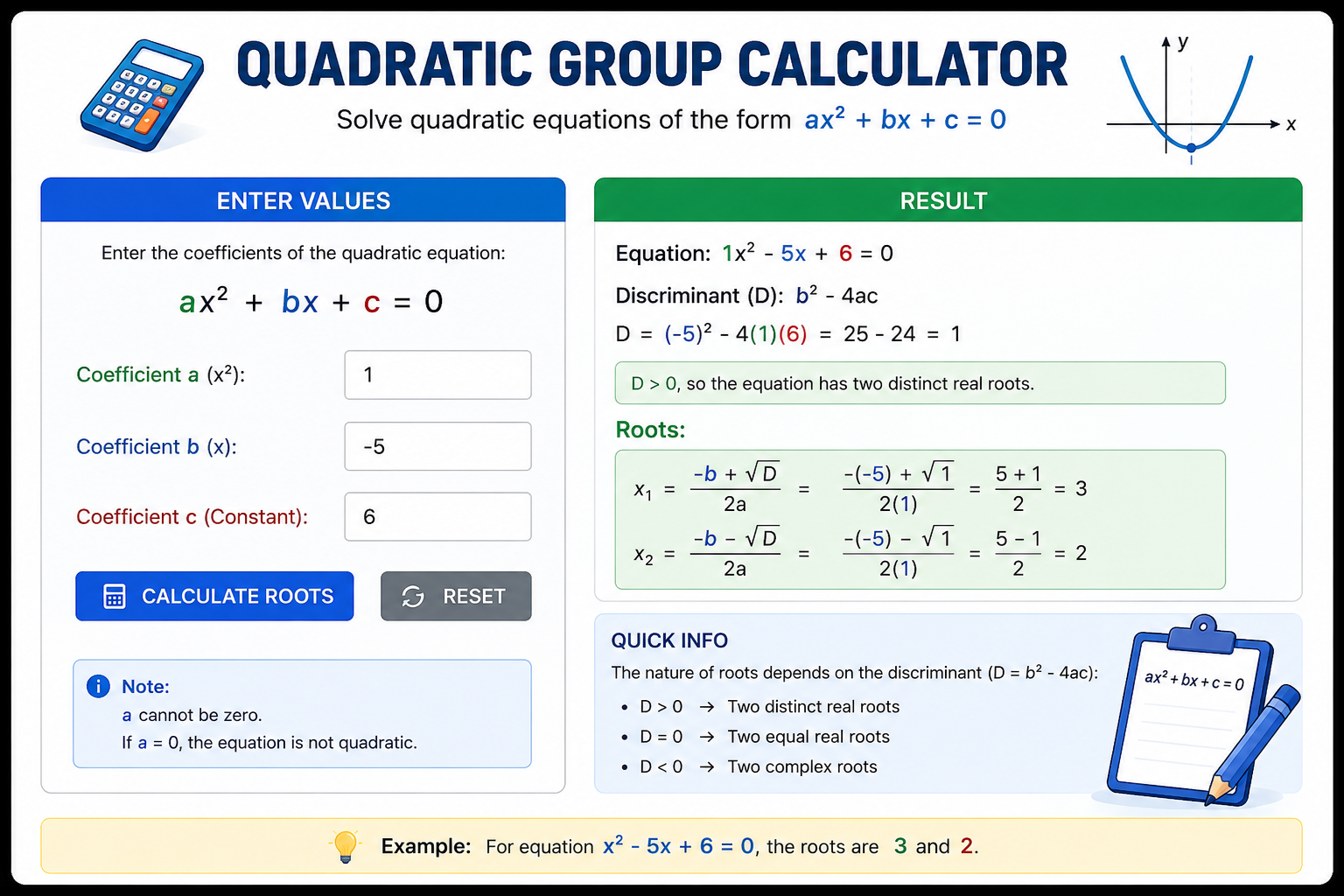
Use this free Quadratic Group Calculator to solve quadratic equations instantly. Enter the values of a, b, and c from the standard quadratic equation and calculate the roots automatically. The calculator can identify two real roots, one repeated real root, or two complex roots depending on the value of the discriminant.
What Is a Quadratic Group Calculator?
A Quadratic Group Calculator is an online mathematical tool that helps solve quadratic equations quickly. A quadratic equation is a second-degree polynomial equation in which the highest power of the variable is two.
The standard form of a quadratic equation is:
In this equation, a, b, and c are numerical coefficients, while x represents the unknown variable. For an equation to be quadratic, the value of a must not be zero.
Instead of applying the quadratic formula manually, users can enter the three coefficients into the calculator and immediately see the calculated roots and discriminant.
Understanding the Standard Quadratic Equation
Every standard quadratic equation contains three important coefficients. Understanding what each coefficient represents makes it easier to enter the correct values into a quadratic equation calculator.
- a: The coefficient of x².
- b: The coefficient of x.
- c: The constant term.
For example, consider the equation:
Here, a = 1, b = -5, and c = 6. Entering these values into the calculator produces the two roots of the equation.
How Does the Quadratic Formula Work?
The calculator uses the standard quadratic formula to determine the value of x. The formula is:
The plus-minus symbol means that the calculation can produce two possible values. These values are the two roots of the quadratic equation when the discriminant is positive.
The expression inside the square root is called the discriminant.
What Is the Discriminant?
The discriminant is one of the most important parts of solving a quadratic equation. It determines the nature and number of the roots.
Positive Discriminant
If the discriminant is greater than zero, the quadratic equation has two different real roots. Both roots can be represented using ordinary real numbers.
Zero Discriminant
If the discriminant is exactly zero, the equation has one repeated real root. The two solutions from the quadratic formula are equal.
Negative Discriminant
If the discriminant is less than zero, the equation has two complex conjugate roots. The calculator displays these roots using the imaginary unit i.
How to Use the Quadratic Group Calculator
Using this calculator is straightforward. You only need the three coefficients from the quadratic equation.
Step 1: Identify the Equation
Write your equation in standard form: ax² + bx + c = 0.
Step 2: Enter the Value of a
Enter the coefficient attached to x² in the Value of a field.
Step 3: Enter the Value of b
Enter the coefficient attached to x in the Value of b field. Remember to include the negative sign when b is negative.
Step 4: Enter the Value of c
Enter the constant term in the Value of c field.
Step 5: Calculate the Roots
Click the Calculate Roots button. The calculator will determine the discriminant and display the appropriate roots.
Example of a Quadratic Equation
Consider the equation:
The coefficients are:
- a = 1
- b = -5
- c = 6
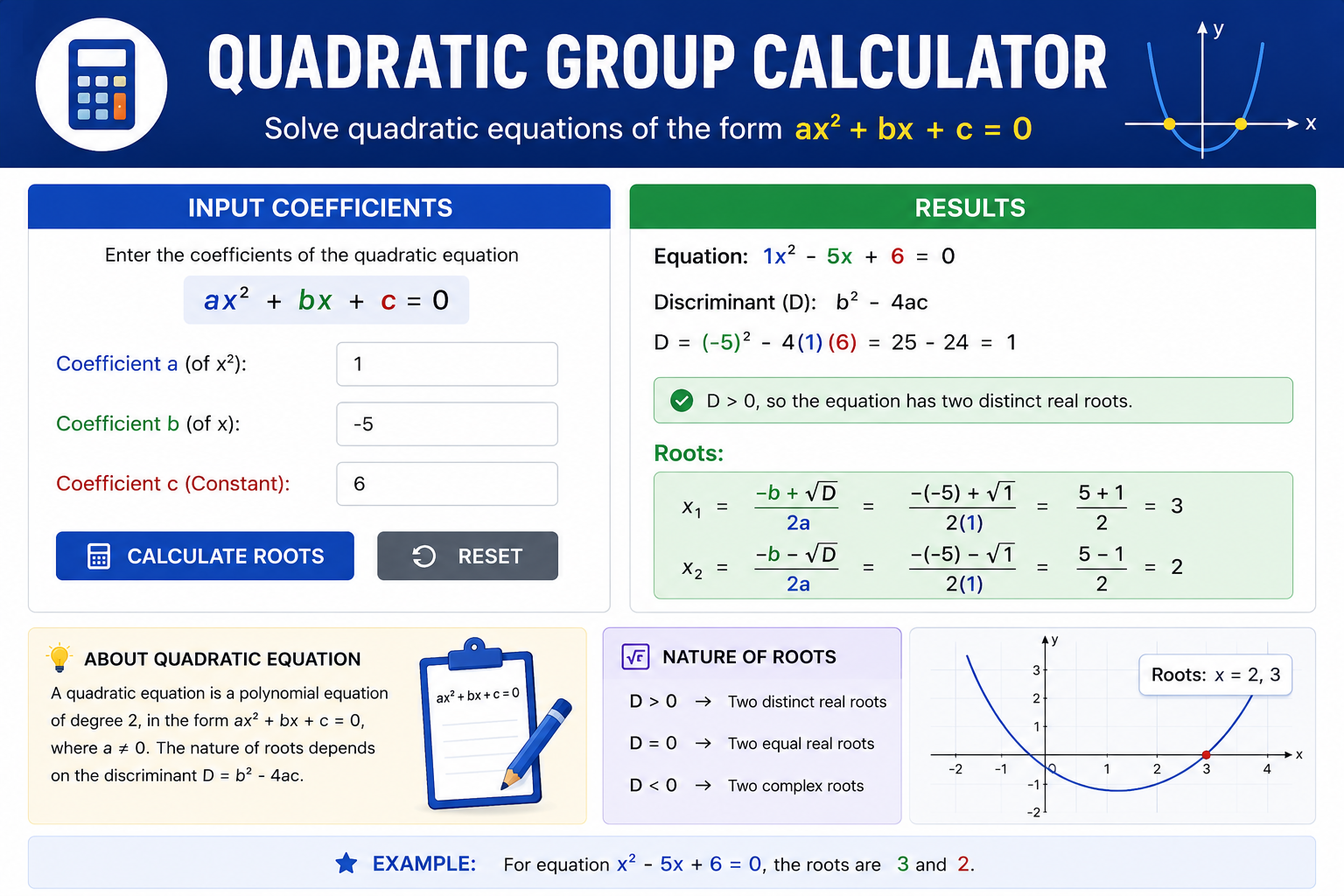
Applying the quadratic formula gives two real solutions: x = 2 and x = 3.
| Quadratic Equation | Type of Roots | Solution |
|---|---|---|
| x² - 5x + 6 = 0 | Two Real Roots | 2 and 3 |
| x² - 4x + 4 = 0 | One Repeated Root | 2 |
| x² + 4x + 8 = 0 | Complex Roots | -2 ± 2i |
Quadratic Equation Calculator for Real Roots
A quadratic equation may have two real solutions when its discriminant is positive. Real roots are useful in many algebra problems because they represent values that satisfy the original equation using ordinary real numbers.
For example, the equation x² - 5x + 6 = 0 has a positive discriminant. The calculator therefore returns two different real roots.
Quadratic Calculator for Complex Roots
Not every quadratic equation has real solutions. When the discriminant is negative, the square root in the quadratic formula involves a negative number. In this situation, the solutions are complex numbers.
A complex number contains a real component and an imaginary component. The imaginary unit is represented by i, where i² = -1.
This calculator automatically identifies a negative discriminant and displays the corresponding complex conjugate roots.
Why Use a Quadratic Group Calculator?
Solving a quadratic equation manually is useful for learning algebra, but repetitive calculations can take time. An online quadratic calculator provides a quick way to verify calculations and understand the resulting roots.
- Provides quick quadratic equation solutions.
- Calculates the discriminant automatically.
- Identifies real and complex roots.
- Reduces arithmetic mistakes.
- Works with positive and negative coefficients.
- Supports decimal values.
- Useful for students and educators.
- Helps verify manually calculated answers.
Applications of Quadratic Equations
Quadratic equations are not limited to classroom algebra. They are used in a variety of mathematical and applied problems.
1. Mathematics
Quadratic equations are an important part of algebra. They are used to study polynomial functions, equations, graphs, roots, and mathematical relationships.
2. Physics
Quadratic relationships can appear in motion problems, including situations involving acceleration and projectile trajectories.
3. Engineering
Engineers may encounter quadratic equations while working with physical models, optimization problems, structural calculations, and system relationships.
4. Economics and Finance
Quadratic functions can be used to model relationships and optimization problems in economics, business analysis, and financial mathematics.
5. Computer Science
Quadratic equations and polynomial calculations can appear in algorithms, simulations, graphics, numerical methods, and computational mathematics.
Quadratic Formula vs Factoring
Factoring is another common method for solving some quadratic equations. When an equation can be easily factored, factoring may be a convenient approach.
However, not every quadratic equation factors neatly using integers. The quadratic formula provides a general method that can be applied to any quadratic equation where a ≠ 0.
This makes the quadratic formula particularly useful when coefficients are complicated or when the equation produces irrational or complex roots.
Can the Calculator Handle Decimal Values?
Yes. The calculator accepts decimal coefficients for a, b, and c. This allows you to solve equations containing fractional or decimal coefficients without first converting them manually.
For example, you can enter values such as 1.5, -2.75, or 4.25. The calculator processes these values using JavaScript mathematical calculations.
Why Cannot the Value of a Be Zero?
The coefficient a determines the x² term in a quadratic equation. If a equals zero, the x² term disappears.
The equation then becomes a linear equation rather than a quadratic equation. For this reason, the calculator does not accept zero as the value of a.
Quadratic Equation Graph and Roots
A quadratic equation can be represented graphically as a parabola. The roots of the equation correspond to the points where the parabola crosses or touches the x-axis.
When there are two real roots, the parabola intersects the x-axis at two different points. When there is one repeated root, the parabola touches the x-axis at one point. When there are no real roots, the parabola does not cross the x-axis.
Important Quadratic Formula Terms
Coefficient a: The number multiplying x².
Coefficient b: The number multiplying x.
Constant c: The number without x.
Discriminant: b² − 4ac.
Roots: Values of x that satisfy the quadratic equation.
Complex root: A root containing an imaginary component.
Frequently Asked Questions
1. What is a quadratic equation?
A quadratic equation is a second-degree polynomial equation generally written as ax² + bx + c = 0, where a is not equal to zero.
2. What does the Quadratic Group Calculator calculate?
It calculates the roots of a quadratic equation using the coefficients a, b, and c. It also determines the discriminant and identifies whether the roots are real or complex.
3. What is the quadratic formula?
The quadratic formula is x = (-b ± √(b² − 4ac)) / 2a. It is used to calculate the roots of a quadratic equation.
4. What is the discriminant?
The discriminant is b² − 4ac. It determines the type of roots produced by a quadratic equation.
5. What happens when the discriminant is positive?
A positive discriminant means the equation has two different real roots.
6. What happens when the discriminant is zero?
A zero discriminant means the equation has one repeated real root.
7. What happens when the discriminant is negative?
A negative discriminant means the equation has two complex conjugate roots rather than two real roots.
8. Can I enter negative numbers?
Yes. Negative values can be entered for a, b, or c. Make sure the negative sign is included correctly when entering the coefficient.
9. Can I use decimal coefficients?
Yes. The calculator supports decimal values for all three coefficients.
10. Why can't a be zero?
When a is zero, the x² term disappears and the equation becomes linear instead of quadratic.
11. Can this calculator solve complex roots?
Yes. When the discriminant is negative, the calculator displays the two complex conjugate roots.
12. Is this quadratic calculator useful for students?
Yes. Students can use it to check algebra homework, understand the quadratic formula, practice identifying roots, and verify manual calculations.
Conclusion
The Quadratic Group Calculator provides a simple way to solve quadratic equations using the standard quadratic formula. By entering the coefficients a, b, and c, you can quickly determine the discriminant and find the corresponding roots.
Whether you are studying algebra, checking homework, preparing for an exam, or working with mathematical equations, an online quadratic equation calculator can save time and make calculations easier to verify.
Remember that the discriminant determines whether an equation has two real roots, one repeated real root, or two complex roots. Understanding this relationship is an important part of working with quadratic equations.